Free first chapter
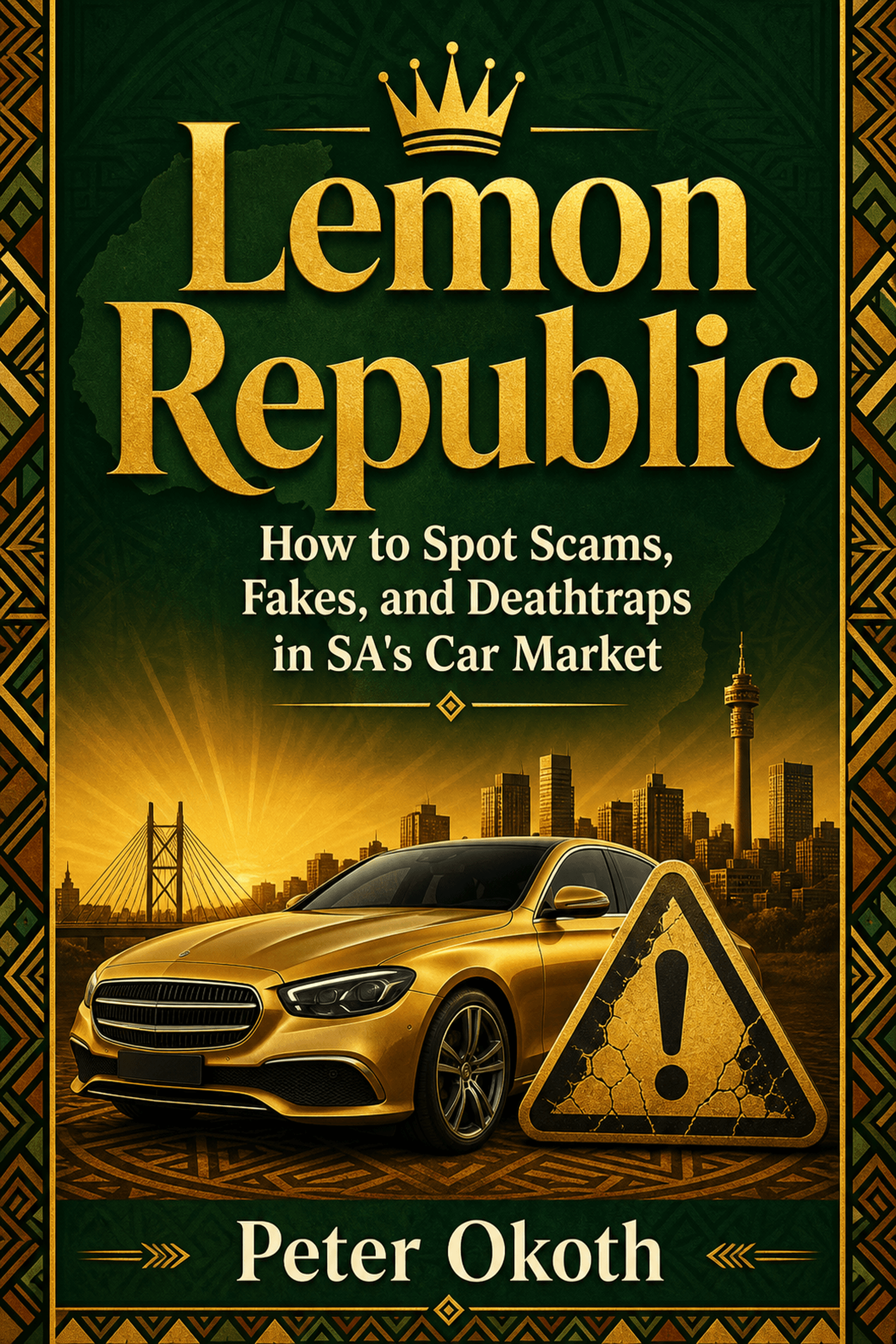
Lemon Republic
How to Spot Scams, Fakes, and Deathtraps in SA's Car Market
Read the first chapter in your browser. It's free, with no account and no email needed.
Free to read. No account required.
About this book
A roadworthy certificate does not mean a used car is good. It means the car is legal to drive. In the gap between those two things, lemons hide: the engine about to fail, the welded subframe, the car that spent time underwater in a flood.
This book teaches you to do the inspection the roadworthy does not. You do not need to be a mechanic. You learn the anatomy of a lemon, then how to read panel gaps, paint and other body clues, and how to spot engine and mechanical red flags. You see how electrical gremlins and warning lights give themselves away, and you follow a test drive protocol that shows you what a car is really like.
You also learn to check the undercarriage for structural damage, verify microdots and VINs, and recognise when to walk away. The book ends with a master checklist you can carry in your hand and use on every car you view, using your eyes, your hands and your phone.
Look inside
Preface
A roadworthy certificate does not mean the car is good. It means the car is legal to drive. There is a massive difference — and that gap is where lemons hide.
In South Africa, a used car only needs to pass a roadworthy inspection to be legally sold with a registration transfer. The roadworthy checks lights, brakes, steering, tyres, and a handful of safety items. It does not check whether the engine is about to die. It does not check whether the subframe has been welded after an accident. It does not check whether the car spent a week underwater in the KwaZulu-Natal floods.
This book is for the inspection that the roadworthy does not do. It teaches you — a person who may know nothing about cars — how to physically inspect a used vehicle and detect hidden damage, mechanical faults, and safety hazards in under an hour, with nothing more than your eyes, your hands, your phone, and this checklist.
You do not need to be a mechanic. You need to be observant. This book teaches you what to observe.
Who This Book Is For
- Used car buyers with no mechanical knowledge who want to screen vehicles themselves
- Buyers viewing multiple cars and needing a quick way to separate the good from the garbage
- Anyone who has ever bought a car that looked fine and turned out to be a money pit
- Parents teaching a young adult what to check before buying their first car
What You Will Walk Away With
A Lemon Detection Master Checklist — a single printable page you take to every vehicle viewing. Fifty inspection points across exterior, engine bay, interior, test drive, undercarriage, and documents. Pass or fail. If it fails more than three critical points, walk away.
Welcome to Lemon Republic
Nomsa is a single mother in Bloemfontein. She saved R85,000 over two years — skipping meals, working overtime, putting nothing into savings except what went towards the car fund. She needed reliable transport to get her daughter to school and herself to work.
She found a 2015 Hyundai i20 at a small independent dealer. R82,000. Roadworthy certificate in hand. Test drive went fine. The dealer said the car had "no major issues." She paid.
Three months in, the problems started.
The engine overheated on the N1 between Bloemfontein and Welkom. Cost of the head gasket replacement: R18,000. Two weeks later, the brakes started grinding — pads worn to metal, discs scored. Cost: R6,500. Then the clutch started slipping. Cost: R12,000.
Total repair bill in the first six months: R38,000 — nearly half the purchase price.
When she took the car to an independent mechanic for a full inspection (something she should have done before buying), he found more. The front subframe had been welded — evidence of a significant frontal impact. The welding was covered by underseal. The roadworthy inspector had not checked it. The dealer had not disclosed it. The car had been in an accident and repaired just well enough to sell.
Nomsa's R82,000 car had cost her R120,000 and was worth perhaps R40,000 on the open market.
Eish. A roadworthy certificate does not mean the car is good. It means the car is legal to drive. There is a massive difference.
What You Will Learn
- Understand what a roadworthy certificate actually checks (and what it does not)
- Identify the four categories of lemons: cosmetic, mechanical, structural, and safety
- Know the 10 inspection points that catch 80% of hidden problems
- Understand why you should inspect BEFORE buying, not after
- Use this chapter as the foundation for the detailed inspection chapters that follow
What a Roadworthy Actually Checks
A roadworthy certificate (also called a Certificate of Roadworthiness or CRW) is required for change of vehicle ownership in South Africa. It confirms the vehicle meets minimum safety standards for road use.
What it checks:
- Lights (headlights, brake lights, indicators)
- Brakes (pedal operation, handbrake)
- Steering (play, alignment)
- Tyres (tread depth, condition)
- Windscreen (cracks, wipers)
- Exhaust emissions
- Suspension (basic check)
- Seat belts
What it does NOT check:
- Engine condition (compression, oil consumption, head gasket)
- Gearbox and clutch condition
- Accident history or structural damage
- Odometer accuracy
- Electrical systems beyond lights
- Air conditioning
- Power steering fluid condition
- Rust under the body
- Subframe and structural welds
The roadworthy is a 15-minute safety check, not a comprehensive vehicle inspection. Nomsa's car passed its roadworthy because the lights worked, the brakes stopped the car (barely), and the tyres had tread. The welded subframe, the failing head gasket, and the worn clutch were invisible to the roadworthy test.
The Four Categories of Lemons
1. Cosmetic Lemons
The car looks bad but is mechanically sound. Scratches, dents, faded paint, worn interior. These are the cheapest to fix and the least dangerous to buy. Often a cosmetic lemon is actually a good deal — you pay less for a car that runs well but needs some bodywork.
2. Mechanical Lemons
The car looks fine but has hidden mechanical problems — engine, gearbox, clutch, suspension. These are the most common lemons and the most expensive to fix. A gearbox replacement on a modern car can cost R20,000-R60,000.
3. Structural Lemons
The car has been in an accident and the structural components (chassis, subframe, pillars) have been damaged and repaired. Cosmetically invisible if the repair is done well. But structurally compromised — the car will not protect you in another accident the way it was designed to. This was Nomsa's car.
4. Safety Deathtraps
The worst category. Cars with compromised brakes, bald tyres hidden by tyre shine, airbags that have been deployed and not replaced (the airbag light is disabled), or structural damage that makes the car collapse in a crash. These cars are not just expensive mistakes — they are dangerous.
The 10-Point Quick Screen
Before you do a detailed inspection (Chapters 3-8), this 10-point screen takes 10 minutes and catches the most obvious lemons:
- 1 — Walk around the car. Are all panel gaps even? — ☐ — ☐
- 2 — Run your hand along the body panels. Any bumps or ripples? — ☐ — ☐
- 3 — Open the bonnet. Is the engine bay clean (too clean = recently steam-cleaned to hide leaks)? — ☐ — ☐
- 4 — Start the engine cold. Does it start immediately? Any smoke? — ☐ — ☐
- 5 — Check the oil on the dipstick. Is it black/gritty? Milky (water contamination)? — ☐ — ☐
- 6 — Check all four tyres. Mismatched brands? Uneven wear? — ☐ — ☐
- 7 — Sit inside. Does the seat wear match the claimed mileage? — ☐ — ☐
- 8 — Turn on the ignition (do not start). Are there any warning lights that stay on? — ☐ — ☐
- 9 — Push down hard on each corner of the car. Does it bounce more than once? (Worn shocks) — ☐ — ☐
- 10 — Look under the car. Any fresh oil drips or wet patches? — ☐ — ☐
Three or more fails? Do not buy without a professional inspection. Walk away if the seller refuses to allow one.
Your Checklist
- ☐ — I understand what a roadworthy does and does not check — Minimum safety, not comprehensive condition
- ☐ — I know the four lemon categories — Cosmetic, mechanical, structural, safety
- ☐ — I have memorised the 10-point quick screen — Or saved it on my phone
- ☐ — I will inspect BEFORE paying — Not after
Your Move
- Save the 10-point quick screen to your phone. Use it at every vehicle viewing.
- Never rely on a roadworthy certificate as proof that a car is in good condition. It is not.
- Budget R500-R1,500 for a professional pre-purchase inspection from an independent mechanic or service like MotorHappy or AA. This is non-negotiable for any car over R50,000.
Quotes to share
A roadworthy certificate does not mean a used car is good.
Free to read. No account required.