Free first chapter
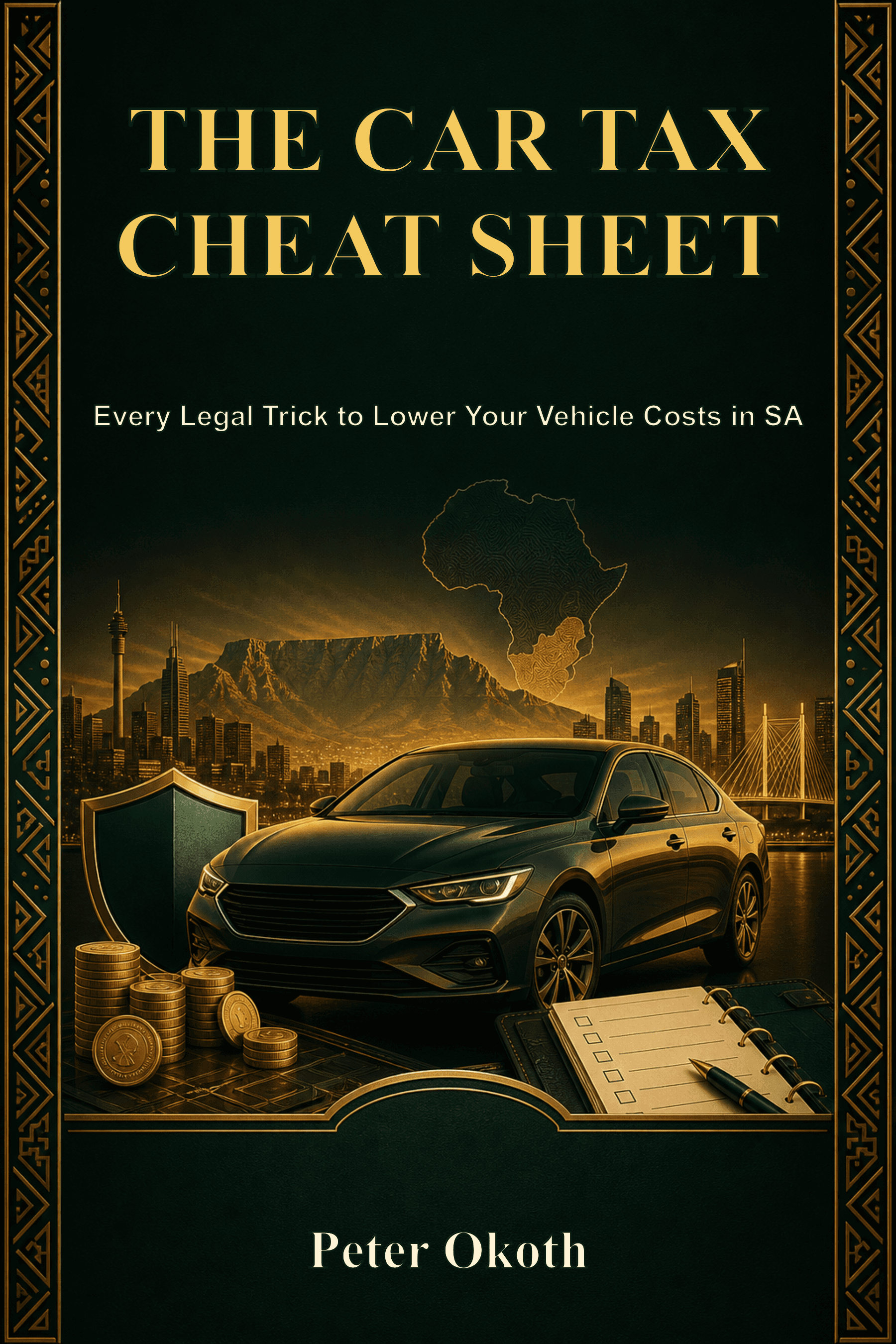
The Car Tax Cheat Sheet
Every Legal Trick to Lower Your Vehicle Costs in SA
Read the first chapter in your browser. It's free, with no account and no email needed.
Free to read. No account required.
About this book
Your car is one of the most expensive things you will own, and unlike a house it loses value every year. What many South Africans do not realise is that the tax system offers several ways to lower what that car actually costs you. A travel allowance, a company car, or business use can all change your tax picture, for better or worse.
The Car Tax Cheat Sheet starts by showing what you really pay on a car, then breaks down ad valorem excise duty, VAT on vehicles, and the CO2 emissions tax. You will learn how a vehicle can be a business expense, how the travel allowance and logbook method work, and how to compare a company car with an allowance. Further chapters cover import duty for the rare importer, and insurance and running cost deductions.
It closes with a vehicle tax optimisation plan, so you can apply it to the car you already have or the one you are about to buy.
Look inside
Preface
Your car is the second most expensive thing you will ever own. And unlike your house, your car loses value every single year. But here is what nobody tells you: the tax system offers several ways to reduce what that car actually costs you — and most South Africans never use them.
If you receive a travel allowance from your employer, you could be claiming back R20,000 to R40,000 per year in tax savings — if you keep a logbook. If you use your car for business, the wear-and-tear allowance and the prescribed rate method can turn a depreciating asset into a tax deduction. If you are deciding between a company car and an allowance, the wrong choice could cost you R3,000 per month in unnecessary tax.
This book sits at the intersection of two things South Africans care about deeply: their cars and their tax bill. It is the crossover between our Tax Series and our Driver's Edge Series — pulling together every legal trick, every deduction, and every structuring option that reduces what your vehicle costs you.
We are not going to tell you which car to buy. We are going to tell you how to make whatever car you buy or own cost you less — legally, provably, and starting this tax year.
Who This Book Is For
- Salaried employees with a travel allowance who have never kept a logbook
- Business owners using a vehicle for work and unsure what they can deduct
- Anyone deciding between a company car and a travel allowance
- New car buyers who want to understand the R50,000+ in taxes baked into their purchase price
- Uber and Bolt drivers who need to structure vehicle costs for tax efficiency
What You Will Walk Away With
A Vehicle Tax Optimization Plan — a personalized worksheet showing exactly which vehicle-related tax benefits apply to your situation, what documentation you need, and the estimated Rand savings for each. Real money back, not theory.
What You Actually Pay on a Car
Mpho is a marketing manager in Cape Town. She has just bought a new Hyundai Creta for R449,000. She feels good about the deal — the salesperson said it was "well-priced."
But Mpho has no idea how much of that R449,000 went straight to the government before she even turned the key.
Let us break it down:
- VAT (15%) — Included in the R449,000 price — R58,565
- Ad valorem excise duty — Based on recommended retail price — R16,700 (approximately)
- CO2 emissions tax — Based on emissions per km — R9,800 (approximately)
- Total tax in the purchase price — R85,065
R85,065 in taxes. That is 19% of the purchase price — nearly one in every five Rand Mpho paid went to SARS and the fiscus before she drove a single kilometre.
And that is just the purchase. Over the life of the car, Mpho will pay fuel levies every time she fills up (roughly R6 per litre in combined fuel and RAF levy), licensing fees annually, and — if she uses the car for business — she may be eligible for deductions that reduce her income tax.
Eish — nobody explained this at the dealership.
What You Will Learn
- Identify every tax baked into a vehicle's purchase price in South Africa
- Calculate the tax component of any new vehicle purchase
- Understand how VAT, ad valorem duty, and CO2 tax interact
- Know which taxes apply to new vs used vehicles
- Set the foundation for the tax optimization strategies in the rest of this book
The Three Purchase Taxes
1. VAT — 15%
Every new vehicle sold in South Africa includes 15% VAT in the price. When a dealer quotes you R449,000, that price already includes R58,565 in VAT (calculated as 15/115 of the price).
For used vehicles from a VAT-registered dealer, VAT also applies — but the dealer can claim a notional input VAT credit on their purchase, so the VAT impact is on the dealer's margin, not the full price.
For used vehicles from a private seller, no VAT applies. This is one reason private sale prices are lower — there is no VAT layer.
2. Ad Valorem Excise Duty
This is South Africa's luxury tax on vehicles. It is calculated as a percentage of the vehicle's recommended retail price and increases as the price goes up. The formula is complex, but the effect is simple: more expensive cars pay proportionally more duty.
For vehicles below approximately R250,000, the duty is minimal. For vehicles above R500,000, it starts to bite. For luxury vehicles above R1 million, the duty can add R50,000-R200,000 to the price.
The duty is included in the purchase price — you do not pay it separately. But understanding it matters when you are choosing between models at different price points.
Last verified: March 2026. The ad valorem duty schedule is published by SARS annually.
3. CO2 Emissions Tax
A levy on new vehicles based on their carbon dioxide emissions per kilometre. Vehicles that emit less CO2 pay less. Electric vehicles are exempt.
The current rate is approximately R132 per gram of CO2/km above a threshold of 95 g/km for passenger vehicles. A typical petrol sedan emitting 150 g/km pays roughly R7,260 in CO2 tax. A large SUV emitting 230 g/km pays roughly R17,820.
Last verified: March 2026.
This tax is another reason to consider fuel-efficient or electric vehicles — not just for the fuel savings, but for the lower purchase tax.
New vs Used — The Tax Difference
- VAT — 15% included — VAT on dealer margin — None
- Ad valorem duty — Yes, included — No (charged on first sale only) — No
- CO2 emissions tax — Yes, included — No (charged on first sale only) — No
- Licensing transfer — Yes — Yes — Yes
The tax advantage of buying used is significant. A used vehicle from a private seller carries zero VAT, zero ad valorem duty, and zero CO2 tax. The only costs are the purchase price, licensing transfer, and roadworthy.
This is one reason used vehicles represent better value for most buyers — the tax-adjusted cost is substantially lower than the sticker price difference suggests.
The Ongoing Tax Costs
Beyond the purchase, vehicle ownership carries annual tax costs:
- Annual vehicle licence — R500-R3,000 (varies by province and vehicle value) — Annual
- Fuel levy — R3.93/litre (petrol) — Every fill-up
- Road Accident Fund levy — R2.18/litre — Every fill-up
- E-toll (Gauteng only) — Varies — Per trip
Last verified: March 2026.
The fuel levies alone mean that roughly R6 of every litre of petrol you buy goes to the government — that is approximately 24% of the pump price.
Your Checklist
- ☐ — I know the three purchase taxes — VAT, ad valorem duty, CO2 emissions tax
- ☐ — I can estimate the tax on any new vehicle — Using the calculations above
- ☐ — I understand the tax advantage of used vehicles — No ad valorem or CO2 tax on second sale
- ☐ — I know the ongoing fuel levies — R6+ per litre in government taxes
Your Move
- For your current or target vehicle: Calculate the tax component of the purchase price using the framework above.
- If choosing between new and used: Factor in the tax saving — it can be R50,000-R100,000 for the same model a few years old.
- Read on: The real savings in this book come from Chapters 5-7, where we show you how to use the tax code to reduce the ongoing cost of your vehicle through deductions and allowances.
Key Terms
Ad valorem excise duty
Quotes to share
What many South Africans do not realise is that the tax system offers several ways to lower what that car actually costs you.
Free to read. No account required.