Free first chapter
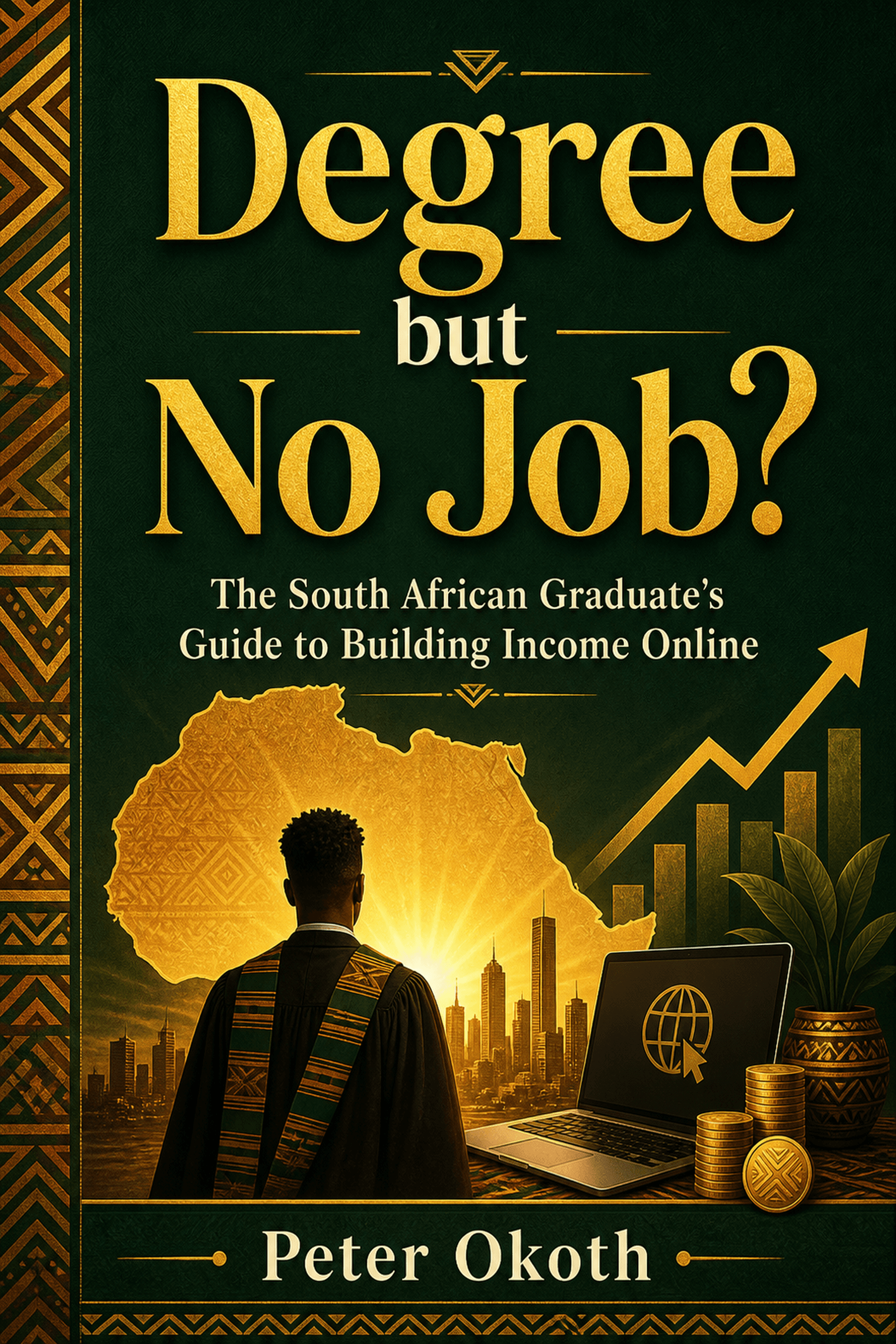
Degree but No Job?
The South African Graduate's Guide to Building Income Online
Read the first chapter in your browser. It's free, with no account and no email needed.
Free to read. No account required.
About this book
You studied, you graduated, and then you hit the silence. Applications go unanswered, and the queue everyone told you to join is not moving. This book is not about motivation. It is a practical guide to building income online with the phone in your pocket and a wifi connection.
Degree but No Job? starts by looking honestly at why the queue is broken, then maps the online income landscape in South Africa. You will explore phone-only business models, freelancing, virtual assistant and transcription work, content creation, e-commerce and digital products, and affiliate marketing and online tutoring.
Just as important, you will learn how to get paid through bank transfers, Payoneer, Wise, and other routes, and how to filter out the scams that target people looking for work. The book also covers tax and compliance for online earners and ends with a 90-day launchpad to get you moving. It is written for South Africans, so the options and examples fit your reality.
Look inside
Preface
You did everything right. You went to school. You sat the matric exams. You survived the university years – maybe even with NSFAS funding that now follows you like a shadow. You wore the gown. You threw the cap. Then you walked out of the graduation hall and straight into nothing.
No callback from the applications. No "we will get back to you." Just silence, and the slow realization that the queue you joined – the one everyone told you to join – does not move.
This book is not about motivation. It is not about "believing in yourself" or "manifesting abundance." It is a manual. A specific, step-by-step guide to building online income – real money, deposited into your bank account or sent to your phone, earned with the device in your pocket and a wifi connection.
Who This Book Is For
- Recent graduates who have spent months (or years) sending CVs into the void
- Underemployed South Africans working jobs that do not match their qualifications or pay their bills
- Anyone with a phone and wifi who wants to earn money online but does not know where to start – or who to trust
- University and TVET students who want to start earning before they graduate
- Parents looking for something useful to hand their unemployed son or daughter
- NSFAS recipients who graduated with debt and no job to pay it back
What You Will Walk Away With
By the last page, you will know the real online income options available in South Africa – ranked by startup cost and earning potential. You will know how to start with zero capital using only your phone. You will know how to get paid from anywhere in the world through bank transfers, Payoneer, and Wise. You will know how to spot scams before they take your money. And you will have a 90-day plan to launch your first digital hustle – your first real online income stream.
Every platform named in this book is accessible from South Africa. Every amount is in Rands. Every strategy has been tested by real South Africans earning real money.
No gatekeeping. No fluff. Asisebenzi – let us work.
The Queue Is Broken
Thabo graduated from a mid-tier South African university in 2023 with a Bachelor of Commerce degree. Decent grades. No disciplinary issues. He attended the career fair, updated his CV the way the career office taught him, and started applying.
In the first six months, he sent 180 applications. He got four callbacks and two interviews. One interview was for an admin role in Sandton paying R8,000 per month – in Johannesburg, where renting a backroom in Soweto starts at R2,500 and transport to Sandton costs R1,200 per month in taxi fare alone. He did not get it.
By month twelve, the count was 350 applications. Eight interviews. Zero job offers.
Thabo now works part-time at a Shoprite in Soweto. He earns R4,500 per month – not a salary, more of a stipend for showing up. His mother calls every Sunday evening from the Eastern Cape and asks the same question: "Thabo, usebenzile?" – have you found work?
Meanwhile, his NSFAS debt sits at R120,000. The interest does not care that he is unemployed.
Thabo's classmate Naledi graduated the same year, same degree, same university. During their third year, she stumbled into freelance writing on a platform called Upwork. She started with short blog posts for USD 10 each. By the time they threw their graduation caps, she had earned R15,000 from writing. Today, 18 months after graduation, Naledi earns between R15,000 and R25,000 per month – from her laptop, from her flat in Braamfontein, with no boss, no commute, and no Shoprite uniform.
She is also making NSFAS repayments. On her own terms.
Thabo thinks Naledi got lucky.
Here is what Thabo does not know – and what this chapter will teach you.
What You Will Learn
- Explain why South Africa's formal job market cannot absorb its graduates – with real numbers
- Identify the structural reasons unemployment is not your personal failure
- Understand how NSFAS debt amplifies the urgency of finding income
- Define online income, digital hustle, and side income – the three terms this book builds on
- Separate fact from fiction about earning money online in South Africa
- Assess what you already have – the assets most graduates overlook
Why This Matters
Every year, South African universities, universities of technology, and TVET colleges release over 200,000 graduates into the job market. The formal economy creates roughly 50,000 to 80,000 new positions in a good year – and many of those go to experienced candidates, not fresh graduates.
Do the math. Even if every new job went to a new graduate – which it does not – at least 120,000 graduates per year walk into nothing. Year after year. The queue grows longer. It does not move.
Statistics South Africa puts the youth unemployment rate at 57% for ages 15-24, and 46% for the broader 15-34 age group. Among those aged 25-34 with degrees, unemployment still hovers around 33%. More than half of young South Africans who want to work cannot find formal employment. Last verified: Q4 2025 Stats SA Quarterly Labour Force Survey.
This is not a personal failure. It is arithmetic.
And yet, every family gathering, every Sunday phone call, every WhatsApp group chat carries the same unspoken accusation: If you had worked harder, studied more, known the right people, you would have a job by now.
That narrative is wrong. And it is expensive – because it keeps people like Thabo waiting in a queue that cannot physically move fast enough, while the internet offers alternatives they have been taught to distrust.
The Queue That Does Not Move
The Reality
Walk into any library or internet cafe in any South African city and you will find graduates printing CVs. Some of them have been printing CVs for years. The format changes. The font changes. The "personal statement" gets reworded. The applications go out. The silence comes back.
This is not laziness. This is a system designed for a different economy. The degree-to-job pipeline was built when South Africa had fewer graduates and more formal sector growth. That pipeline is now broken. Not bent – broken.
How It Actually Works
Here is what the employment system looks like from the inside:
The numbers do not add up. South Africa's formal sector employs roughly 11 million people out of a working-age population of over 23 million. The informal sector – spaza shops, street traders, panel beaters, domestic workers, and piece jobs – absorbs some of the rest. But a university degree was supposed to be the ticket out of the informal economy, not a detour back into it.
The competition is brutal. For every advertised position in Johannesburg or Cape Town, there are often 500 to 2,000 applicants. Not because South Africans are bad at their jobs – because there are dramatically more qualified people than positions. A friend who works in HR at a mid-sized company in Sandton told me they posted a R15,000/month marketing role last year. They received 1,800 applications in 48 hours. They shortlisted 15. They hired one.
Connections still matter more than CVs. The phrase "it is not what you know, it is who you know" is not cynicism. It is the documented reality. Without networks – without someone inside the company who can push your CV to the top – your application sits in a pile that nobody reads.
Quotes to share
Applications go unanswered, and the queue everyone told you to join is not moving.
Free to read. No account required.