Free first chapter
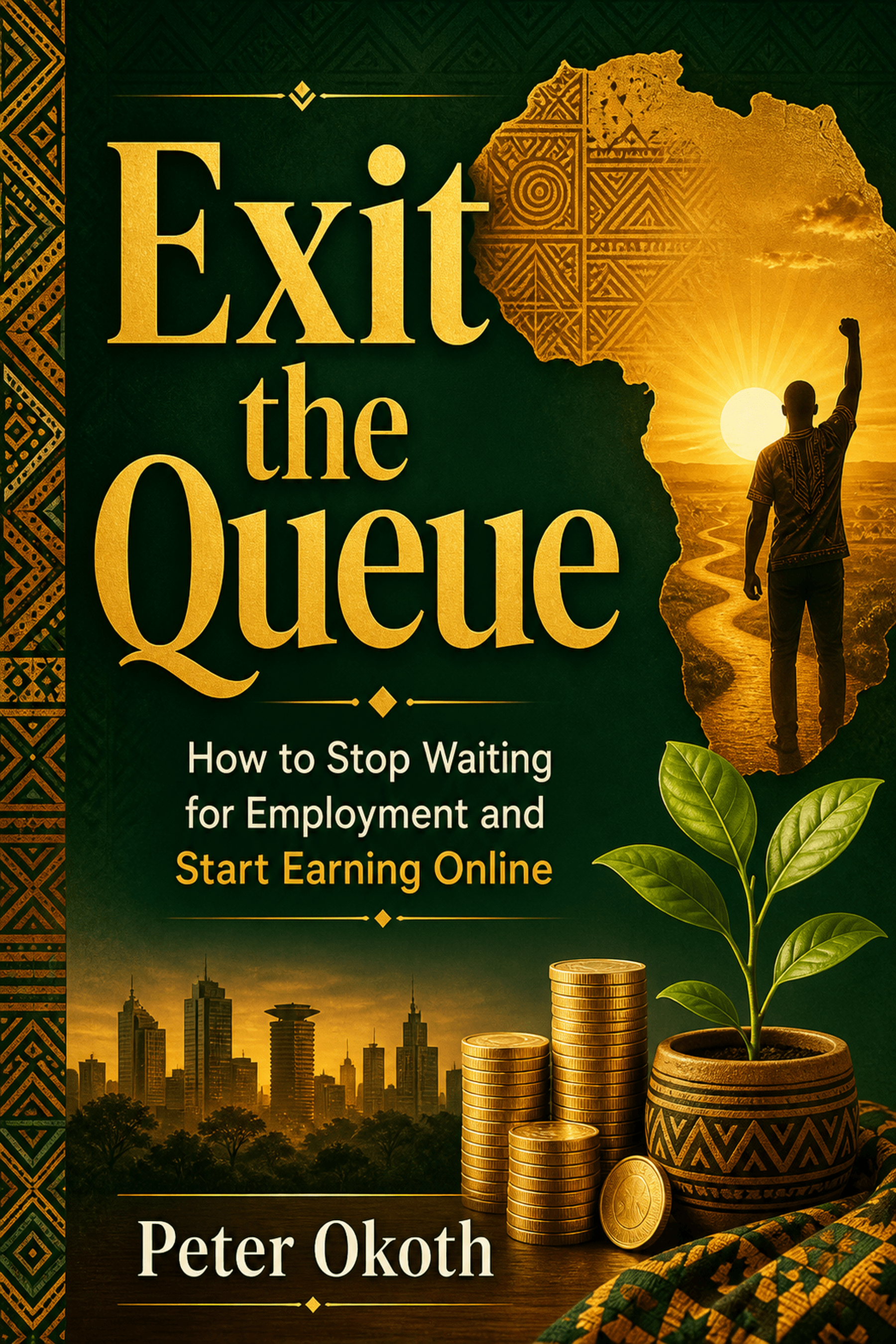
Exit the Queue
How to Stop Waiting for Employment and Start Earning Online
Read the first chapter in your browser. It's free, with no account and no email needed.
Free to read. No account required.
About this book
You know the queue is broken. You have refreshed the job boards, rewritten the same CV, and answered the question about work with I am still looking. Leaving the queue can feel like giving up, as if money earned outside a formal job does not count, or the internet is a place where only other people succeed.
Exit the Queue is about the decision before the how-to. It looks at why waiting feels safer than building, what the employment story gets wrong, and what the internet actually pays people for. You will confront the permission trap, learn to see your phone as a business tool, and aim for your first five hundred rand. The book speaks to the people around you, from family to friends, and prepares you for the days when things do not work, so one setback does not send you back to the queue.
It is for graduates, employed South Africans wanting more, and parents trying to understand why a child chooses online income.
Look inside
Preface
You know the queue is broken. You have read the statistics, maybe even lived them. Sixty percent youth unemployment. Hundreds of applications. Silence.
And yet here you are – still waiting. Still refreshing Careers24. Still rewriting the same CV. Still answering "usebenzile?" with "I am still looking."
Why?
Because leaving the queue feels like giving up. Because your family invested in your degree. Because earning money outside a formal job feels like it does not count. Because the internet feels like a place where other people succeed and you get scammed.
This book is for the space between knowing the queue is broken and actually stepping out of it. It is not a how-to guide for platforms – Book 1 in this series covers that. It is not a 90-day plan – Book 5 does that. This book is about the decision. The internal shift. The moment you stop waiting for someone to hire you and start building something of your own.
Who This Book Is For
- Graduates who know the queue is broken but cannot bring themselves to leave it
- Employed South Africans trapped in underpaying jobs who feel guilty about wanting something different
- Parents who want to understand why their graduate child is pursuing online income instead of "a real job"
- Anyone who tried online income once, failed, and went back to the queue
- NSFAS debtors who need income but feel paralyzed by the weight of debt and expectation
What You Will Walk Away With
By the last page, you will have named every barrier keeping you in the queue – and dismantled each one. You will have a framework for handling family pressure, surviving failure, and making decisions without permission. You will have earned your first R500 online – or at least know exactly how to. And you will have made a decision: stay in the queue, or build.
This is not a motivation book. It does not end with "you can do it!" It ends with "here is what to do next." The ubuntu way: umuntu ngumuntu ngabantu – a person is a person through people. Building income is not leaving your community behind. It is building the capacity to serve them better.
No fluff. No inspiration posters. Just the truth, and a path forward.
The Queue Is a Choice
Nomzamo graduated from Nelson Mandela University in Gqeberha with a Bachelor of Public Administration degree. She wanted to work in local government – to fix things, to serve her community, to make the Eastern Cape work better. Noble goals. Good grades.
She started applying for government positions the week after graduation. In the first year, she wrote 14 aptitude tests, attended 6 panel interviews, and submitted applications to every municipality and provincial department that had an opening. She drove to Bhisho twice for interviews. She borrowed taxi fare from her mother both times.
By month eighteen, the count was: 14 aptitude tests. 6 interviews. Zero offers.
Nomzamo now works at a call centre in Gqeberha. She earns R5,500 per month. After rent, transport, and sending R800 to her mother in Ngqushwa, she has R1,200 left for food, data, and everything else. Her NSFAS statement arrives every quarter. The balance: R87,000.
Her cousin Busisiwe never finished university. She dropped out after second year when funding became complicated. But Busisiwe has a talent for writing captions, creating content, and understanding what makes people stop scrolling. She started managing social media for a hair salon in Gqeberha – first for free, then for R2,000/month. She found two more small businesses on LinkedIn. Today she earns R12,000 per month managing social media for three clients. From her phone. From the same township Nomzamo grew up in.
Nomzamo has a degree. Busisiwe does not. Nomzamo is in the queue. Busisiwe stepped out of it.
Here is the question this chapter asks: what if the queue itself is the problem?
What You Will Learn
- Recognize the queue for what it is – a system that cannot serve the number of people standing in it
- Distinguish between personal failure and structural failure
- Name the emotional cost of waiting: shame, anxiety, and the slow erosion of confidence
- Understand that stepping out of the queue is not giving up – it is choosing a different path
- Identify what is keeping you in the queue right now
Why This Matters
There is a moment in every unemployed South African's life when the queue stops feeling like a process and starts feeling like a punishment. You did the degree. You wrote the exams. You sat the interviews. And nothing happened.
But you stay. You stay because everyone is staying. You stay because your mother took NSFAS debt so you could graduate. You stay because leaving the queue feels like admitting the degree was worthless. You stay because you do not know where else to stand.
This chapter names that feeling. And then it shows you the door.
The Queue Nobody Talks About
The Reality
South Africa produces over 200,000 university and TVET graduates every year. The formal economy, in a good year, creates 50,000 to 80,000 new jobs. Many of those jobs go to experienced candidates. Many more go through networks – someone knows someone.
The arithmetic is brutal: for every two graduates who enter the job market, at most one will find formal employment within the first year. The other walks into the informal economy, piece jobs, or nothing.
Statistics South Africa reports youth unemployment above 60% for ages 15-34. Among 25-34 year olds with degrees, unemployment is approximately 33%. These are not people who lack qualifications. They lack a queue that moves.
The Emotional Weight
Nobody talks about what standing in this queue does to you:
The Sunday phone call. Your mother, your aunt, your grandmother – someone calls every week and asks "usebenzile?" or "het jy al werk gekry?" – have you found work yet? And every week, you have to say no. That no gets heavier every time.
The WhatsApp group silence. Your university class WhatsApp group used to be jokes and memes. Now it is job links that nobody responds to, and the occasional person announcing they got something – which makes everyone else feel worse.
The identity erosion. You are a graduate. That was supposed to mean something. When it does not open any doors, you start to wonder if you are the problem. You are not. But the queue has a way of making you feel like you are.
The NSFAS shadow. For many graduates, the queue is not just about income – it is about debt. NSFAS funding enabled your degree, but the loan component (for those who carry it) or overpayment recovery does not pause because you are unemployed. The debt sits there, growing, reminding you that the investment your family and the state made in you has not yet paid off.
The Queue Is Not a Merit System
How It Actually Works
Here is what most people in the queue do not understand: the queue is not organized by talent, effort, or qualification. It is organized by timing, connections, and luck.
Timing. If a company opens a position the week you apply, you have a chance. If they filled it last month, your CV goes into a folder nobody opens. Most jobs in South Africa are filled before they are publicly advertised – through internal promotions, referrals, and networks.
Connections. "It is not what you know, it is who you know" is not a cliche in South Africa. It is the hiring system. Studies consistently show that personal networks are the primary hiring channel for most positions. If you graduated from a township school and your parents are not professionals, your network is smaller. That is not a character flaw. It is a structural disadvantage.
Free to read. No account required.