Free first chapter
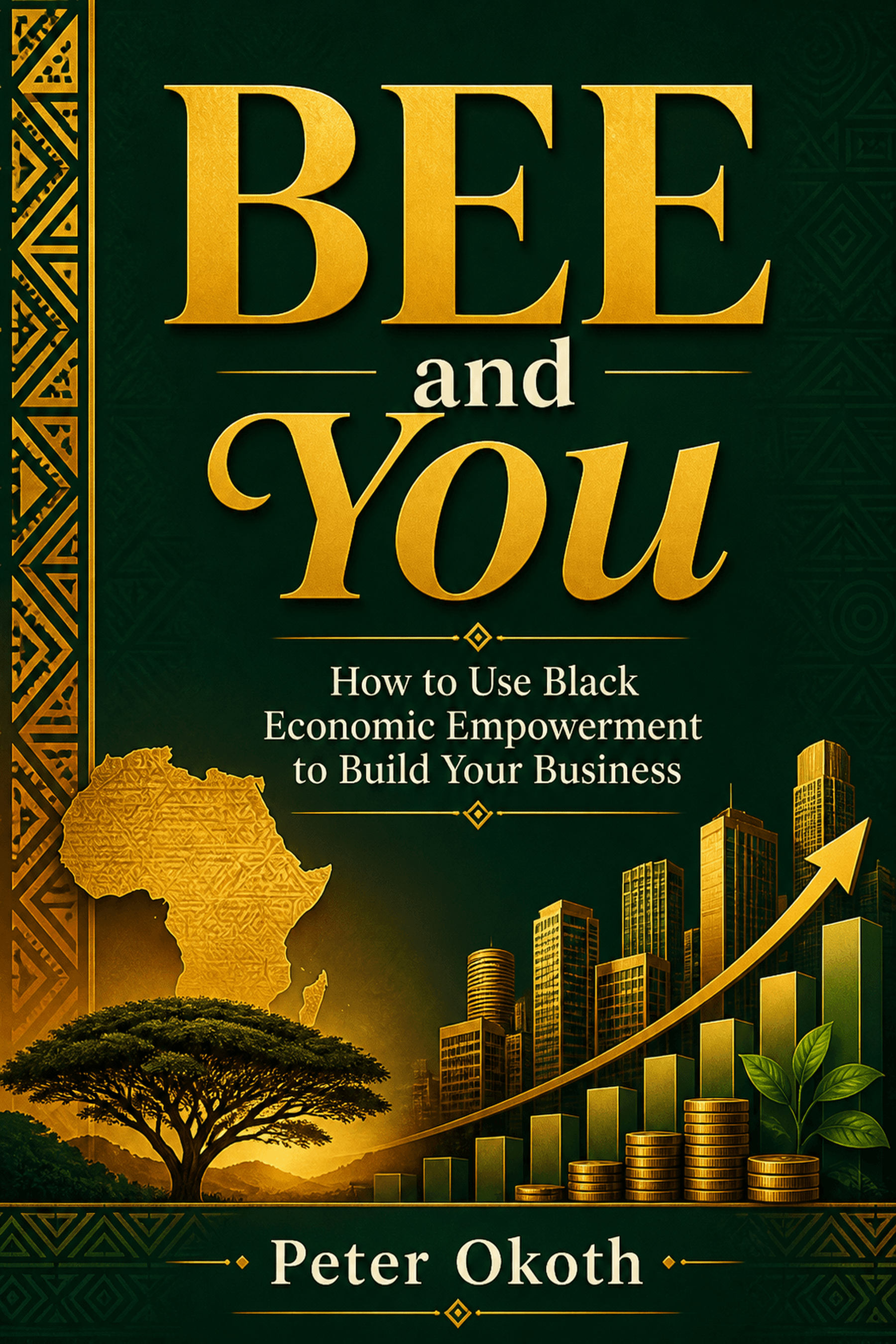
BEE and You
How to Use Black Economic Empowerment to Build Your Business
Read the first chapter in your browser. It's free, with no account and no email needed.
Free to read. No account required.
About this book
Broad-Based Black Economic Empowerment exists to address the economic exclusion that apartheid created, yet many Black business owners never use it. Some find the scorecard confusing, some assume it only helps large companies, and some feel awkward about claiming it. Meanwhile, tenders and procurement opportunities go to businesses that do understand it.
BEE and You is a practical guide to using BEE to build your business, focused on the mechanics rather than the politics. You will start with why BEE is not a handout, then decode the scorecard element by element, including ownership and management control, and skills and enterprise development. You will learn how preferential procurement works for winning contracts and what the EME and QSE categories mean for small businesses. A frank chapter explains BEE fronting and the serious risks it carries.
The final chapter is your BEE action plan, so you can understand your status and put it to work for your enterprise.
Look inside
Preface
BEE is not charity. It is not a favour. It is not something to be embarrassed about.
Broad-Based Black Economic Empowerment exists because apartheid created the most extreme wealth inequality in the world – deliberately, systematically, over decades. White South Africans were given land, education, capital, and exclusive access to the economy. Black South Africans were denied all of it. When apartheid ended, the wealth gap did not end with it. BEE is one of the mechanisms designed to close that gap.
And yet, many Black business owners do not use it. Some do not understand the system. Some think it only benefits big companies. Some are embarrassed – as if using a programme designed to correct historical injustice is somehow shameful.
Haai. Enough of that.
This book is a practical guide to using BEE to build your business. Not the politics of BEE. Not the debate about whether it works. The mechanics: how the scorecard works, what your status is, how to use it to win contracts, access procurement, and grow your enterprise.
Who This Book Is For
- Black South African business owners who want to understand and leverage their BEE status
- Small business owners (EMEs) earning under R10 million who do not know they automatically qualify for Level 1
- Growing businesses (QSEs) earning R10-50 million who need to optimize their scorecard
- Anyone preparing a tender and wondering how BEE affects their bid
What You Will Walk Away With
By the last page, you will know your BEE level, understand every element of the scorecard, know how to use your status to win tenders and contracts, understand the legal line between compliance and fronting, and have a 90-day plan to optimize your BEE position.
The system exists. Use it. Build with it. This book shows you how.
BEE Is Not a Handout
Sipho runs a commercial cleaning company in Johannesburg. Ten employees. Annual turnover: R6 million. He started the business in 2019 with a pressure washer and a bakkie. Now he services offices, retail stores, and small industrial premises across the East Rand.
For two years, he had been bidding on government cleaning contracts – municipal buildings, schools, clinics. He never won. Every time, the contract went to a larger company. Sipho assumed it was about price. He cut his margins thinner and thinner. Still lost.
In 2024, a friend introduced him to an accountant who worked with small businesses. The accountant asked one question: "Do you have your BEE certificate?"
Sipho did not. He did not think BEE applied to him. He thought BEE was for big companies with boards and shareholders. He thought it was political. He thought he was too small.
The accountant explained: Sipho's company, with turnover under R10 million and 100% Black ownership, is an Exempted Micro Enterprise (EME) with automatic Level 1 BEE status. No verification needed. No audit. No cost. He just needed a sworn affidavit confirming his turnover and ownership, and he would have the highest possible BEE rating in the country.
Level 1 status means that any company or government department buying from Sipho can recognise 135% of their procurement spend with him for BEE purposes. In government tenders, his bid would receive preference points that larger, less BEE-compliant competitors could not match.
Sipho got his affidavit. He bid on the next municipal contract. He won. The contract was worth R1.2 million over 12 months – more than any single contract he had ever held.
The BEE system had been designed to give Sipho an advantage. He just did not know it existed.
What You Will Learn
- Why BEE exists and what it actually does
- Why using BEE is not a handout – it is claiming a strategic advantage
- How the BEE framework works at a high level
- Why small businesses have the biggest BEE advantage
Why BEE Exists
BEE exists because apartheid was an economic programme, not just a political one.
The apartheid system did not simply separate races. It systematically transferred wealth from Black South Africans to White South Africans through:
- Land dispossession – the 1913 Natives Land Act restricted Black land ownership to 13% of the country's surface area. The rest was reserved for the White minority.
- Education inequality – Bantu Education deliberately limited Black access to quality education, ensuring a low-skilled, low-wage Black workforce.
- Capital exclusion – Black South Africans were denied bank loans, business licenses in urban areas, and access to the formal economy.
- Labour exploitation – migrant labour systems, pass laws, and wage restrictions ensured Black workers were paid a fraction of White workers for equivalent work.
The result: when apartheid ended in 1994, White South Africans owned the overwhelming majority of land, capital, businesses, and institutional power. That structural advantage does not disappear because legislation changes. It compounds.
BEE is one of the corrective mechanisms designed to address this. It is not charity. It is not a favour. It is a policy response to the most systematic economic exclusion programme in modern history.
And if you are a Black South African business owner, it is a tool you should be using.
Decolonize the Shame
Let us address this directly, because it stops too many people from using BEE.
There is a narrative – promoted by some media, some politicians, and some business leaders – that using BEE is somehow shameful. That it means you cannot compete on merit. That real entrepreneurs do not need "help."
Haai. Sizwe, please.
Using BEE is not asking for help. It is claiming a strategic advantage that was designed specifically for you, to correct an injustice that was designed specifically against you. Nobody tells the child of a Stellenbosch wine farmer to feel ashamed of inheriting land that was stolen from its original owners. Nobody tells the graduate of a historically White university to feel ashamed of the institutional resources that centuries of exclusion funded.
BEE exists because the playing field is not level. It is one of the tools available to tilt it back. Use it the way Sipho did: strategically, proudly, and effectively.
The BEE Framework: A High-Level View
BEE is measured through a scorecard with five elements:
- Ownership — Black ownership of the business — 25 points
- Management control — Black representation in management and board — 19 points
- Skills development — Investment in training Black employees — 20 points
- Enterprise and supplier development — Supporting Black-owned suppliers and enterprises — 40 points
- Socio-economic development — Contributions to community development — 5 points
The total score determines your BEE level (Level 1 being the best, Level 8 being the lowest compliant, and non-compliant if you score too low).
But here is what most small business owners do not know: if your turnover is below R10 million, you are an EME and you do not need to be measured on the full scorecard. You get automatic status:
- 51%+ Black-owned EME = automatic Level 1
- Less than 51% Black-owned EME = automatic Level 2
No verification agency. No audit. No cost. Just a sworn affidavit.
Chapter 2 breaks down the full scorecard. Chapter 6 explains the EME and QSE advantage in detail.
Your Checklist
- ☐ — I understand why BEE exists — Historical economic exclusion, not charity
- ☐ — I know my business turnover — Under R10M = EME, R10-50M = QSE, over R50M = generic enterprise
- ☐ — I know my Black ownership percentage — 51%+ = Level 1 (EME), less = Level 2 (EME)
- ☐ — I have (or will get) my BEE affidavit or certificate — The document that proves my status
Your Move
- If your turnover is under R10 million and you are 51%+ Black-owned: Get a sworn affidavit from a commissioner of oaths. You are Level 1. It costs nothing. Do it this week.
- If your turnover is R10-50 million: Read Chapters 2 and 6 to understand the QSE scorecard.
- If you have been avoiding BEE: Ask yourself why. If it is shame, re-read the section above. If it is confusion, this book fixes that.
Quotes to share
Broad-Based Black Economic Empowerment exists to address the economic exclusion that apartheid created, yet many Black business owners never use it.
Free to read. No account required.