Free first chapter
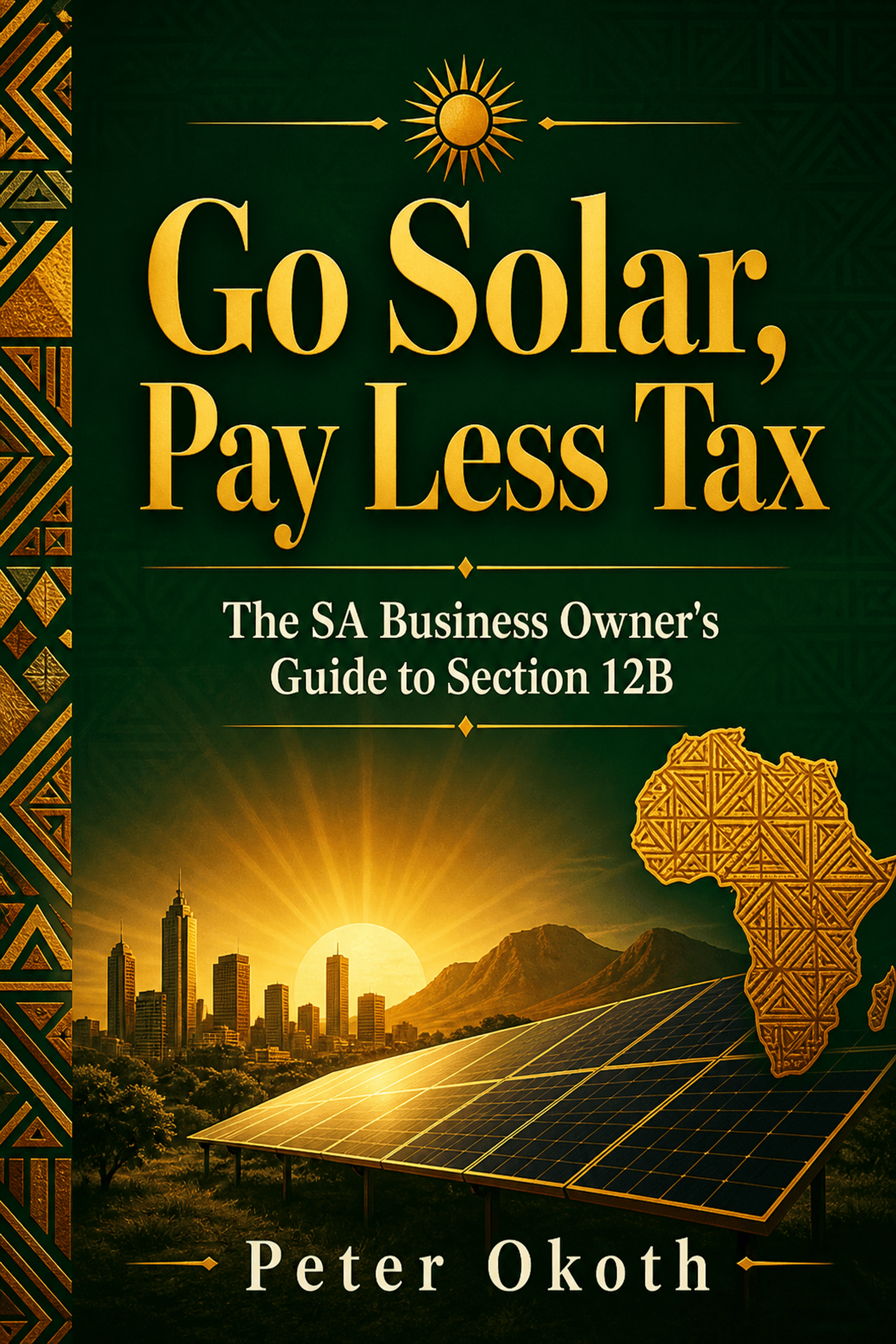
Go Solar, Pay Less Tax
The SA Business Owner's Guide to Section 12B
Read the first chapter in your browser. It's free, with no account and no email needed.
Free to read. No account required.
About this book
Load shedding pushed many South African businesses toward solar, and many of them never learned that the tax system has something to say about it. Section 12B of the Income Tax Act offers a deduction for qualifying renewable energy investments, and plenty of owners either do not know it exists or have installed a system without claiming it.
Go Solar, Pay Less Tax explains the provision for business owners. You will learn how Section 12B actually works, what qualifies, and how to size a solar system with the deduction in mind. The book covers the installation process, shows how to file the deduction on SARS eFiling, and looks at financing solar when you do not have cash on hand. It lists common mistakes and the red flags SARS may notice.
The final chapter helps you build your own solar tax plan. It suits small business owners, self-employed professionals working from home, and the accountants who advise them. Speak to a registered practitioner about your own situation.
Look inside
Preface
The South African government did something remarkable – perhaps by accident. In response to the load shedding crisis, it introduced Section 12B of the Income Tax Act: a provision allowing businesses to deduct 125% of the cost of qualifying renewable energy investments in the first year.
Read that again. One hundred and twenty-five percent. You spend R100,000 on solar panels and batteries. You deduct R125,000 from your taxable income. At a 27% corporate tax rate, that is a R33,750 tax saving – on a R100,000 investment. Your effective cost is R66,250. And you get free electricity for 20-25 years.
No other tax incentive in South Africa comes close. Not accelerated depreciation on other assets. Not R&D deductions. Not urban development zone allowances. Section 12B is the single most powerful tax incentive available to South African businesses right now.
And most business owners do not know about it.
Who This Book Is For
- Small business owners considering solar but unsure about the tax benefit
- Self-employed professionals who work from home and want to claim the solar deduction
- Business owners who have already installed solar but have not claimed the deduction
- Accountants and tax practitioners who want a clear guide for their clients
What You Will Walk Away With
By the last page, you will know exactly how Section 12B works, what qualifies, how to size a system for maximum tax benefit, how to file the deduction on SARS eFiling, what financing options exist, and what mistakes to avoid. Every process reflects SARS requirements as of 2026.
Eskom loses you money. Solar makes it back. SARS helps you keep it. This book connects the dots.
The Tax Incentive Eskom Accidentally Created
Bheki is a plumber in Randburg. He runs a small business – three employees, a bakkie, and a workshop behind his house. His annual turnover is R1.8 million. His electricity bill was R4,200 per month and climbing. Load shedding cost him an additional R2,000-R3,000 per month in lost productivity and generator fuel.
In 2024, he installed a 10kWp solar system with battery storage. Total cost: R120,000.
Then his accountant told him about Section 12B.
Bheki installed the system in 2024, when the enhanced Section 12BA allowed a 125% deduction – meaning he could deduct R150,000 (125% of R120,000) against his business income. At his marginal tax rate, the tax saving was approximately R42,000.
Important: The 125% Deduction Has Expired
The enhanced 125% deduction under Section 12BA was available for renewable energy assets brought into use between 1 March 2023 and 28 February 2025. It was not renewed in the 2025 Budget. If you install solar after 28 February 2025, the standard Section 12B applies: a 100% first-year deduction for solar PV systems under 1MW, or 50%/30%/20% over three years for larger systems. The tax benefit is still substantial – just not the 125% bonus. Last verified: March 2026.
Even under the standard Section 12B, Bheki's numbers work. A 100% deduction on R120,000 gives a tax saving of approximately R33,600 at his marginal rate. His electricity bill dropped to R800 per month – a saving of R3,400 per month, or R40,800 per year.
Bheki's total five-year financial impact (using current Section 12B at 100%):
- Solar system cost — -R120,000
- Tax saving (Section 12B at 100%) — +R33,600
- Electricity savings (5 years) — +R204,000
- Load shedding cost avoidance (5 years) — +R120,000
- Net five-year benefit — +R237,600
A R120,000 investment that generates R237,600 in net benefit over five years. That is not a cost. That is one of the best business investments available in South Africa.
What You Will Learn
- What Section 12B is and why it was introduced
- The basic math of solar investment + tax incentive
- Who qualifies and who does not
- What this book will teach you chapter by chapter
How Eskom Created a Tax Break
Section 12B was not designed as a gift to business owners. It was an emergency response to a national crisis.
When load shedding reached unprecedented levels, the government needed South Africans to reduce their dependence on the grid – fast. The most effective incentive they could offer was a tax deduction so generous that the investment decision became obvious for any business paying tax.
The enhanced 125% deduction (Section 12BA) was introduced in 2023 as an emergency measure during the worst load shedding. It expired on 28 February 2025 and was not renewed. However, the standard Section 12B deduction remains and is still highly valuable:
- Solar PV under 1MW: 100% deduction in the first year of use
- Solar PV over 1MW: 50% in year 1, 30% in year 2, 20% in year 3
On a R100,000 solar system under 1MW, you deduct the full R100,000 in the year you bring it into use. At a marginal tax rate of 28%, that is R28,000 back from SARS. Last verified: March 2026.
Who Qualifies
Businesses and self-employed individuals – any taxpayer who uses the solar system for the purpose of trade (business activity). This includes:
- Sole proprietors
- Partnerships
- Companies (Pty Ltd)
- Trusts that carry on business
- Self-employed professionals (doctors, lawyers, accountants, freelancers)
Individuals (for personal, non-business use) received a separate, less generous incentive under Section 25C – a R15,000 per year credit for solar panels only. The Section 12B business deduction (now 100% for systems under 1MW) is separate and more valuable.
If you work from home and use solar for your home office, a portion may qualify. Chapter 5 covers the apportionment.
Your Checklist
- ☐ — I operate a business or am self-employed — Required for Section 12B
- ☐ — I know my approximate tax rate — Determines the actual rand saving
- ☐ — I am considering or have installed solar — The incentive applies in the year of first use
Your Move
- Ask your accountant about Section 12B. If they do not know about it, find one who does.
- Calculate your potential saving using the formula: System cost x 100% x your marginal tax rate = tax saving (for systems under 1MW brought into use after 28 February 2025).
- Read Chapter 2 for the detailed mechanics of how the deduction works.
Key Terms
Section 12B
kWp
Marginal tax rate
What is Next
Chapter 2 breaks down Section 12B in detail – exactly what qualifies, how to calculate the deduction, and what documentation SARS requires.
Section 12B: How It Actually Works
The Section 12B deduction allows you to write off the cost of qualifying renewable energy assets on an accelerated basis. For solar PV systems under 1MW, that means a 100% deduction in the first year. For larger systems, it is spread 50%/30%/20% over three years. The details matter: what qualifies, how to calculate the deduction, what documentation you need, and what happens if SARS questions your claim.
The 125% Enhanced Deduction (Section 12BA) Has Expired
Between 1 March 2023 and 28 February 2025, an enhanced 125% deduction was available under Section 12BA. This was not renewed in the 2025 Budget. All examples below use the current standard Section 12B deduction. If you installed and brought a system into use before 1 March 2025, you may still claim the enhanced 125% for that installation. Last verified: March 2026.
This chapter is the technical manual.
What You Will Learn
- The exact qualifying criteria for the Section 12B deduction
- How to calculate the deduction at different investment levels
- What documentation SARS requires
- The timing rules – when the deduction applies
What Qualifies
Qualifying Assets
- Solar photovoltaic (PV) panels – the most common qualifying asset
- Wind turbines – for businesses in windy areas
- Concentrated solar power – less common for small businesses
- Battery storage – when used as part of a renewable energy system
- Inverters – when part of a qualifying solar installation
Quotes to share
Load shedding pushed many South African businesses toward solar, and many of them never learned that the tax system has something to say about it.
Free to read. No account required.