Free first chapter
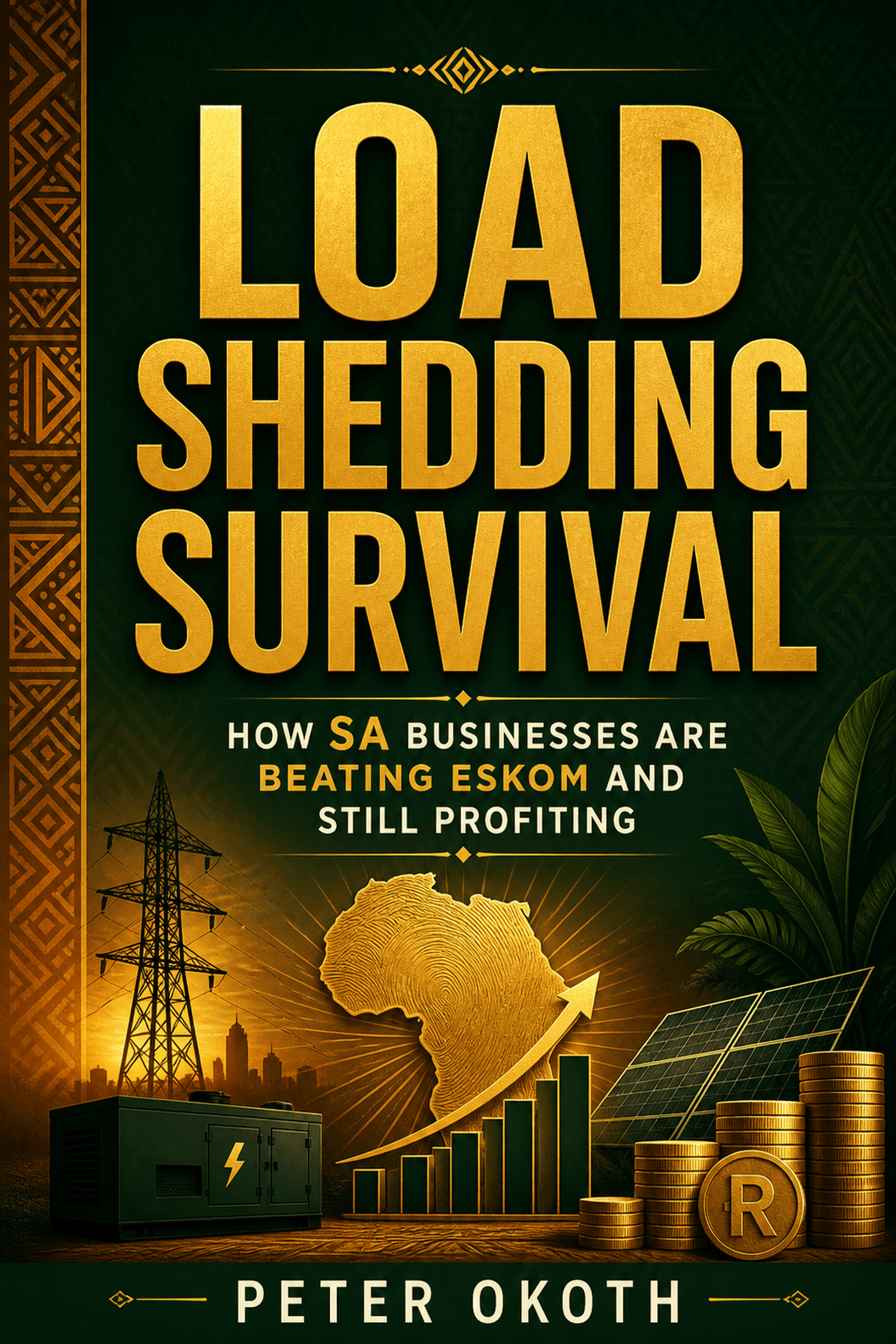
Load Shedding Survival
How SA Businesses Are Beating Eskom and Still Profiting
Read the first chapter in your browser. It's free, with no account and no email needed.
Free to read. No account required.
About this book
The lights go out again. Your fridge stops, your card machine goes offline, and your customers walk to the shop down the road, the one with a generator. For a spaza shop, salon, restaurant or workshop, every stage of load shedding is money leaving your pocket.
Load Shedding Survival is a business owner's guide to energy independence that matches your budget and needs rather than assuming millions in capital. You will start with the Eskom reality and then work out the real cost of load shedding to your own business, including spoiled stock, lost customers and damaged equipment. From there you compare your options: generator economics, the business case for solar and battery, and inverter and UPS solutions. Further chapters show how to run operations that keep trading when the grid does not, how insurance and claims fit in, and how to assemble your own energy independence plan.
Whether load shedding eases or returns, it helps you stop depending entirely on the grid.
Look inside
Preface
The lights went out again. Your fridge stopped running. Your card machine went offline. Your customers walked to the shop down the road – the one with a generator.
Load shedding has cost the South African economy hundreds of billions of rand. For big corporates, it is an inconvenience managed by facilities teams and backup power systems. For small businesses – spaza shops, salons, restaurants, offices, workshops – it is an existential threat. Every stage of load shedding is money leaving your pocket: stock spoiled, customers lost, equipment damaged, productivity killed.
Eskom's problems are structural. The fleet is old. New capacity is late. Maintenance backlogs are measured in years, not months. Whether load shedding reduces or returns, one thing is certain: no South African business can afford to depend entirely on the grid.
This book is the business owner's guide to energy independence – not with millions in capital, but with smart decisions that match your budget and your needs.
Who This Book Is For
- Spaza shop and tuck shop owners losing stock every time the power goes off
- Salon, barbershop, and restaurant owners losing customers during load shedding hours
- Office-based businesses losing productivity and internet connectivity
- Any small business owner who has watched revenue disappear during a power cut
What You Will Walk Away With
By the last page, you will know the actual cost of load shedding to your business (most people underestimate it by 40-60%), which backup power solution fits your budget and needs, how to claim the Section 12B solar tax incentive, how to run operations profitably during power cuts, and what insurance options exist for load shedding damage.
Eskom cannot keep the lights on. You can. This book shows you how.
The Eskom Reality
Bra Mthembu runs a spaza shop in Alexandra, Johannesburg. He sells bread, milk, cold drinks, airtime, and a few cooked meals. His fridge is the backbone of his business – cold drinks are his highest-margin item, and the milk and cooked food depend on refrigeration.
During one week of Stage 6 load shedding in 2023, Bra Mthembu lost R4,500. Two litres of milk spoiled. A batch of cooked chicken went off. Fifteen litres of cold drinks were warm when customers came – and warm drinks do not sell. His card machine was offline for a total of 16 hours that week, and customers who did not have cash walked away.
Down the road, his competitor – another spaza shop of similar size – had installed a small solar panel and battery system six months earlier. Cost: R18,000. During load shedding, his fridge kept running, his lights stayed on, and his card machine worked. He did not lose a single rand to load shedding that week. More importantly, he gained customers who normally went to Bra Mthembu.
That R18,000 investment paid for itself in four months of avoided losses.
What You Will Learn
- The structural reality of South Africa's power system
- Why load shedding is not going away (even if it reduces)
- How energy independence is now a competitive advantage, not a luxury
- The framework this book teaches for beating Eskom
The State of the Grid
South Africa's electricity system has a complicated history – and a cautiously improving present.
Eskom's generating fleet is old. The average coal-fired power station is past its design life. Medupi and Kusile – the two new mega-stations that were supposed to solve the capacity problem – were delivered years late, billions over budget, and with persistent technical problems.
However, by March 2026, the picture has changed. South Africa has gone over 300 consecutive days without load shedding. The Energy Availability Factor is above 65%, unplanned outages have dropped by 53% year-on-year, and an additional 4,400MW of generation capacity is available compared to 2024. Eskom has formally declared the end of load shedding.
That is the good news. The structural risks have not disappeared. The fleet is still ageing, and climate disruption, coal supply issues, or maintenance failures could trigger new crises. Businesses that invested in energy independence during the crisis years are now reaping the benefit of lower electricity costs and resilience against future uncertainty – while also benefiting from solar tax incentives.
For business owners, the message is this: the crisis taught South Africa a lesson. Energy independence is not just protection against load shedding – it is a permanent competitive advantage through lower costs and tax benefits, regardless of Eskom's current performance.
Energy Independence as Competitive Advantage
Bra Mthembu's competitor understood something crucial: backup power is not a cost. It is an investment that generates returns through:
- Revenue protection – sales that continue when competitors are dark
- Customer retention – customers go where the lights are on
- Stock preservation – no spoilage from broken cold chains
- Equipment protection – no damage from power surges
- Productivity maintenance – staff working while others wait
For a small business, the return on a backup power investment is often higher than any other business investment you can make. The R18,000 that Bra Mthembu's competitor spent generates R4,500 per week in avoided losses during heavy load shedding – a payback period measured in months, not years.
What This Book Teaches
This book is not about Eskom's problems. It is about your solutions.
- 2 — The real cost of load shedding to YOUR business – calculated
- 3 — Generator options – when they make sense, running costs, sizing
- 4 — Solar and battery – the business case, Section 12B tax incentive
- 5 — Inverters and UPS – for smaller budgets
- 6 — Operational changes – how to run profitably during power cuts
- 7 — Insurance – what is claimable, what is not
- 8 — Your energy independence plan – decision framework and timeline
Your Checklist
- ☐ — I understand that energy independence has lasting value — Even with 300+ days without load shedding, lower costs and tax benefits remain
- ☐ — I see energy independence as a business investment — Not just a cost
- ☐ — I am ready to calculate the real cost to my business — Chapter 2
Your Move
- Think about your last load shedding week. What did it cost you? Be honest – include lost sales, spoiled stock, and customers who went elsewhere.
- Read Chapter 2 to calculate the actual number. Most business owners underestimate the cost by 40-60%.
- Tell yourself the truth: Eskom is not going to save your business. You are.
Key Terms
Load shedding
Energy independence
Section 12B
What is Next
Chapter 2 calculates the real cost of load shedding to your specific type of business. The number will surprise you – and it will make the investment decision much clearer.
The Real Cost of Load Shedding to Your Business
Most business owners know load shedding costs them money. Very few know how much.
When we ask small business owners to estimate their load shedding losses, they typically say "a few hundred rand per week" or "maybe R1,000 on a bad day." When we help them calculate the actual number – including lost sales, spoiled stock, customer churn, equipment damage, and fuel costs – the real figure is consistently 40-60% higher than their estimate.
This chapter gives you the calculator. Because you cannot make a rational investment decision about backup power until you know what problem you are solving – in rand terms.
What You Will Learn
- Calculate the direct, indirect, and hidden costs of load shedding to your business
- Compare costs across business types (retail, food service, office, salon)
- Use the load shedding cost calculator to get your actual number
- Understand how the cost changes by load shedding stage
The Three Cost Categories
Direct Costs (What You Can See)
- Lost revenue — Customers cannot buy when you are closed or POS is down — R500-R5,000 per outage
- Spoiled stock — Refrigerated/frozen goods go off — R200-R2,000 per outage
- Generator fuel — Diesel or petrol to run a generator — R50-R200 per hour
- Equipment damage — Power surges when power returns — R500-R10,000 per incident
Free to read. No account required.