Free first chapter
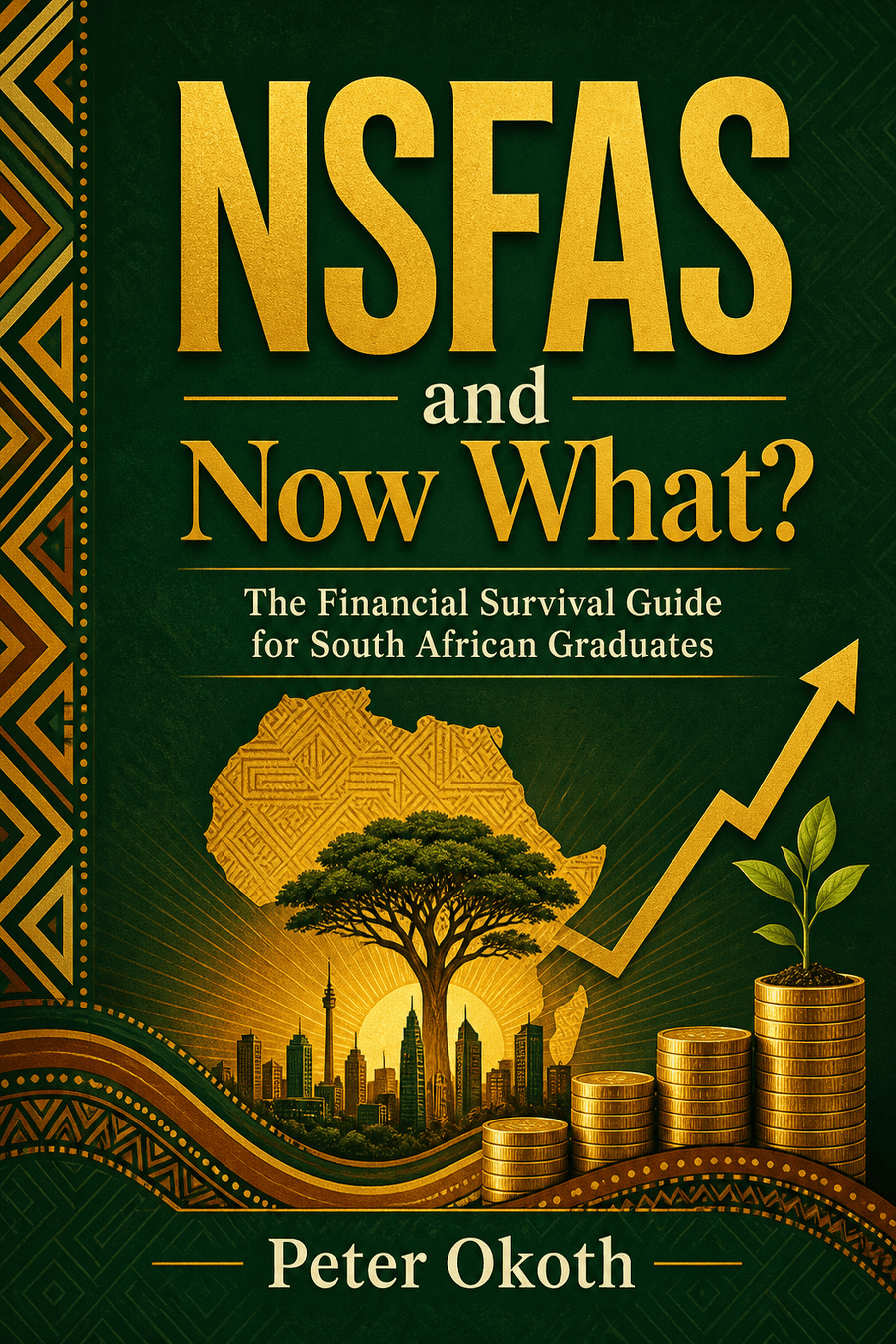
NSFAS and Now What?
The Financial Survival Guide for South African Graduates
Read the first chapter in your browser. It's free, with no account and no email needed.
Free to read. No account required.
About this book
You graduated. You got through the NSFAS applications, the res queues and the Wi-Fi that dropped during online exams. Then your first salary arrives, and between family needs, transport, debt and everyday costs, the money is gone by the middle of the month.
NSFAS and Now What? is a financial survival guide for that moment. It begins with the question of what to do now that you have the degree, then maps out your first salary and where every rand goes. You look at the debt you graduated with, and at how black tax shows up from day one and how to approach it without wrecking your own finances.
You also learn what SARS expects and how to handle your first tax return, how to start saving and investing from month one, and how to avoid the lifestyle inflation trap. The book ends with a first-year financial plan you can follow. It is written for the realities of being a new South African graduate.
Look inside
Preface
You graduated. You survived three or four years of NSFAS applications, res queues, and Wi-Fi that dropped during online exams. You have a degree. Your family is proud. Your mother cried at graduation. Your uncle has already told everyone in the village.
Now the financial reality hits.
Your first salary is R18,000. After tax, UIF, and pension fund contributions, R14,500 hits your account. Your mother needs R3,000. Your younger sibling needs school fees. Your res deposit loan needs to be repaid. You need transport to work. You need professional clothes. You need food.
By the 15th of the month, the money is gone. You graduated to escape this cycle. And here you are – in it.
Nobody prepared you for this. Not university. Not NSFAS. Not your family. The financial literacy you need as a new graduate in South Africa – how your salary actually works, what SARS expects from you, how to manage black tax without destroying your finances, how to start building wealth from R500 a month – is simply not taught anywhere.
This book fills that gap.
Who This Book Is For
- Recent graduates in their first or second year of employment
- NSFAS recipients trying to understand their financial obligations after graduation
- First-generation graduates who are the first in their family to earn a professional salary
- Anyone who has received their first payslip, looked at the deductions, and thought "where did my money go?"
What You Will Walk Away With
An understanding of how your salary actually works (gross vs net, tax, UIF, pension), a plan for managing debt from university, a framework for handling black tax that respects Ubuntu without destroying your finances, your first SARS tax return filed correctly, a savings and investment plan starting from R500 per month, and a month-by-month financial plan for your first year.
You worked for the degree. Now make the degree work for you.
You Have the Degree. Now What?
Zinhle is 24 years old. She graduated from the University of Johannesburg with a BCom degree, funded by NSFAS. She is the first person in her family to hold a university degree. Her mother – a domestic worker in Sandton for 18 years – cried at the graduation ceremony.
Three months later, Zinhle landed a job at an accounting firm in Rosebank. Starting salary: R18,000 per month. She was excited. R18,000! That was more than her mother had ever earned.
Then the first payslip arrived.
Gross salary: R18,000. PAYE (income tax): R1,700. UIF: R180. Pension fund contribution: R1,080. Medical aid (company scheme): R540.
Net salary (what hits the bank account): R14,500.
Her mother needed R3,000. That was agreed before Zinhle even started working – the family had been waiting for this. Her younger brother's school fees: R1,500 per term, and term was starting. Rent for a room in a flat share in Braamfontein: R5,000. Transport (Rea Vaya + Gautrain): R2,000.
R14,500 - R3,000 - R1,500 - R5,000 - R2,000 = R3,000.
Three thousand rand for food, airtime, data, toiletries, work clothes, and everything else. For the entire month.
By the 20th, the money was gone. Zinhle used Capitec's credit facility to cover the last ten days. She started the next month already in the red.
This is not Zinhle's failure. This is the reality for first-generation South African graduates. Nobody teaches you how your salary actually works. Nobody teaches you how to budget with black tax built in. Nobody teaches you that the distance between your first salary and financial freedom is bridged by a system, not willpower.
This book builds that system.
What You Will Learn
- The financial reality of being a new graduate in South Africa
- Why your net salary is much less than your gross salary (and what the deductions mean)
- Why nobody taught you this – and why that is not your fault
- The eight-chapter system this book teaches
The Reality Nobody Prepared You For
University taught you accounting, or engineering, or law, or teaching. It did not teach you:
- How to read a payslip
- What PAYE, UIF, and pension fund contributions are
- How to file a tax return on SARS eFiling
- How to budget when your salary must support more people than just you
- How to save when there is nothing left at the end of the month
- How to invest when you have never had money to invest
- How to say "I cannot afford that" to a parent who sacrificed everything for your education
This gap – between earning a professional salary and knowing how to manage one – is where new graduates lose their footing. The credit card gets maxed. The personal loan gets taken. The lifestyle inflates to match the salary. By year three, you earn R25,000 and owe R40,000.
This book exists so that does not happen to you.
You Are Not Starting From Zero – You Are Starting From Negative
Many graduates enter the workforce with:
- NSFAS obligations – for most recent university graduates, NSFAS funding is a bursary (not repayable). But TVET college students, students who did not complete their qualifications, or students funded under older NSFAS terms may have repayable loans. Check your status.
- Informal debt from university – money borrowed from friends, family, or personal loans taken during student years
- Expected family support – not debt in the legal sense, but a financial obligation that starts on your first payday
- Zero savings and zero emergency fund
You are not starting from R0. You are starting from below R0 and building up. That is harder than what financial advice books written for middle-class Europeans acknowledge. This book acknowledges it.
The Eight-Chapter System
- 2 — Understanding your salary – where R18,000 actually goes
- 3 — Managing debt from university
- 4 — Handling black tax – with love and boundaries
- 5 — Your first SARS tax return (you might get money back)
- 6 — Saving and investing from R500/month
- 7 — Avoiding lifestyle inflation in year 2-3
- 8 — Your first-year financial plan – month by month
Your Checklist
- ☐ — I have read my payslip carefully — I know my gross, net, and every deduction
- ☐ — I know my total monthly obligations — Family support, rent, transport, debt
- ☐ — I know how much I have left after obligations — Even if the number is very small
- ☐ — I am ready to build a system — Not perfect – just functional
Your Move
- Pull out your last payslip. Read every line. Chapter 2 explains each deduction.
- Write down your obligations. Family support, rent, transport, debt. Be honest about the numbers.
- Calculate what is left. That number – even if it is R500 – is where your financial future starts.
Key Terms
Gross salary
Net salary
PAYE
Black tax
What is Next
Chapter 2 is the money map – a line-by-line explanation of where your R18,000 (or whatever your salary is) actually goes, and a budget template designed for South African graduates who support their families.
Your First Salary: The Money Map
Your payslip is the most important financial document in your life right now. More important than your degree certificate. More important than your employment contract. Because every month, it tells you exactly where your money goes – if you know how to read it.
Most new graduates glance at the net amount, transfer money to their mother, pay rent, and pray the rest lasts until the 25th. This chapter replaces prayer with a plan.
What You Will Learn
- Read every line of your payslip and understand what each deduction means
- See where R18,000 actually goes (the full breakdown)
- Build a budget that includes black tax as a real line item
- Create the system that stops the money from disappearing
Free to read. No account required.