Free first chapter
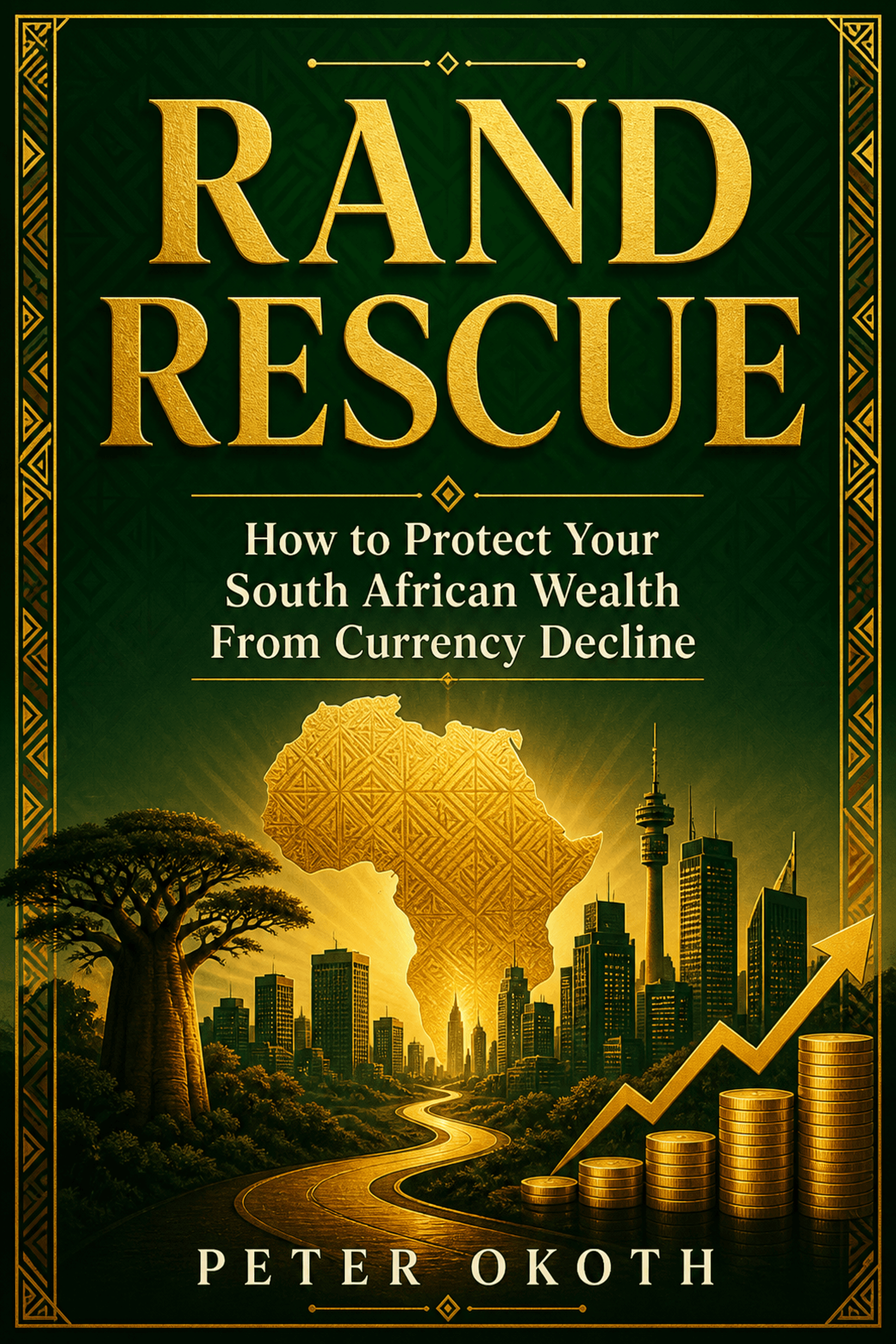
Rand Rescue
How to Protect Your South African Wealth From Currency Decline
Read the first chapter in your browser. It's free, with no account and no email needed.
Free to read. No account required.
About this book
If your savings and investments sit almost entirely in rand, you are carrying a risk you may never have chosen on purpose. A currency that loses ground against the dollar over the years quietly shrinks what your money can buy in the wider world, even when the interest looks healthy.
This book is about managing that concentration risk, not about writing off the rand or the JSE. You start by seeing why your money is losing value and how the rand actually works. Then you explore offshore investing and the legal options available to South Africans, rand-hedge investments on the JSE, and dollar-denominated accounts and instruments.
A full chapter explains the annual foreign investment allowance, and another weighs crypto, gold and other alternative hedges with a sceptical eye. The final chapter helps you pull everything together into your own rand protection plan. It is for readers who want to understand their options clearly before deciding what, if anything, to change.
Look inside
Preface
In 2000, one US dollar cost approximately R6.90. In 2010, approximately R7.30. In 2020, approximately R15.70. By 2026, the rate fluctuates between R17 and R19.
That is not just a number on a screen. That is your wealth – measured in what it can actually buy in the world – shrinking by roughly 50% every decade.
If you have R1 million saved in a rand-denominated account earning 8% interest, you are earning R80,000 per year. But if the rand depreciates by 6% per year against the dollar (which is close to the long-term average), your R1 million has lost R60,000 in international purchasing power. Your real return – what your money can actually buy in global terms – is much smaller than it looks.
Every South African who is building wealth in rand needs to understand this. Not because the rand is "bad." The JSE has delivered strong returns over time. South African property has built generational wealth. The rand economy is where most of us earn, spend, and invest. But concentration risk is real. If 100% of your wealth is in a currency that has depreciated by 60% against the dollar in 20 years, you are taking a risk you may not have consciously chosen.
This book is about managing that risk.
Who This Book Is For
- South Africans with savings and investments who are concentrated in rand assets
- Anyone planning to travel, study abroad, or retire who will need foreign currency
- Parents saving for children's education (international or local fees that track foreign currencies)
- Anyone who has watched the rand weaken and wondered "what can I do about it?"
What You Will Walk Away With
By the last page, you will understand how the rand works and why it trends weaker, know the legal options for diversifying into foreign currency (offshore ETFs, rand-hedge stocks, foreign accounts, the annual allowance), understand the tax implications of each strategy, and have a portfolio allocation framework that balances rand and foreign exposure.
Every strategy in this book is legal, accessible to ordinary South Africans, and practical to implement with the platforms and products available in 2026.
You cannot control the rand. You can control your exposure to it.
Your Money Is Losing Value
In 2010, a used Toyota Corolla cost approximately R100,000. If you had R100,000 in a savings account earning 6% per year, you could have bought that car at any time.
By 2026, the same car costs approximately R220,000. Your R100,000, compounding at 6% for 16 years, grew to approximately R190,000.
You saved diligently. You earned interest every year. And you still cannot afford the car you could have bought in 2010.
That gap – between what your money earned and what things cost – is the combined effect of inflation and currency depreciation. It is invisible. It is slow. And it is relentless.
What You Will Learn
- How the rand has depreciated over time (with real numbers)
- What depreciation means for your savings and investments
- Why even "good" interest rates do not always protect you
- The framework this book teaches for protecting your wealth
The Rand's Track Record
- 2000 — R6.90 — $14,493
- 2005 — R6.35 — $15,748
- 2010 — R7.30 — $13,699
- 2015 — R15.50 — $6,452
- 2020 — R15.70 — $6,369
- 2025 — R18.20 — $5,495
Your R100,000 bought $14,493 worth of goods in 2000. By 2025, the same R100,000 bought $5,495. That is a 62% decline in international purchasing power in 25 years.
This matters even if you never leave South Africa. Because:
- Imported goods (electronics, fuel, food ingredients) are priced in dollars. When the rand weakens, these get more expensive.
- Education – international university fees, online courses, textbooks – all priced in foreign currency.
- Travel – every flight, hotel, and meal abroad costs more in rand terms.
- Retirement – if you plan to live 20-30 more years, your rand savings will buy less and less.
The Double Hit: Inflation + Depreciation
South African inflation runs at 4-7% per year. If your savings earn 6% and inflation is 5.5%, your real return is 0.5%. You are barely keeping up.
Now add currency depreciation. The rand loses approximately 4-6% per year against the dollar over the long term. Even if your savings beat inflation in rand terms, they are losing value in global terms.
This does not mean rand investments are bad. The JSE has delivered excellent long-term returns. South African property builds generational wealth. But concentrating 100% of your wealth in a single depreciating currency is a risk – one you may not have consciously chosen.
The Solution: Diversification, Not Panic
This book is not about abandoning the rand. It is not about moving to New Zealand. It is about intelligent diversification – having some of your wealth in assets that are not entirely dependent on the rand's trajectory.
- 3 — Offshore investing – rand-denominated offshore ETFs, direct offshore accounts
- 4 — Rand-hedge stocks on the JSE – companies earning in foreign currency
- 5 — Dollar-denominated accounts and instruments
- 6 — The annual foreign investment allowance (R10 million/year)
- 7 — Crypto, gold, and alternative hedges
- 8 — Your personal rand protection plan
Your Checklist
- ☐ — I understand that the rand depreciates over time — And what that means for my wealth
- ☐ — I know what percentage of my wealth is in rand — Probably close to 100%
- ☐ — I am ready to explore diversification — Not panic – strategic allocation
Your Move
- Calculate your current rand exposure. What percentage of your wealth (savings, investments, property, pension) is in rand-denominated assets? For most South Africans, the answer is close to 100%.
- Decide on a target. Financial advisors typically suggest 20-40% foreign exposure. This book helps you get there.
- Read Chapter 2 to understand what drives the rand – and why it tends to weaken over time.
Key Terms
Currency depreciation
Purchasing power
Diversification
What is Next
Chapter 2 explains how the rand actually works – what drives it, why it weakens, and what the structural factors are. Understanding the mechanism is the first step to managing the risk.
How the Rand Actually Works
Most South Africans check the rand exchange rate when they are about to travel or when it makes the news. Beyond that, the mechanics of how the currency moves – and why it trends weaker over time – are a mystery.
This chapter demystifies the rand. Not because you need to become a currency trader, but because understanding the drivers allows you to make better investment decisions about your wealth protection strategy.
What You Will Learn
- What determines the rand's value against other currencies
- The structural factors that cause long-term depreciation
- What the South African Reserve Bank (SARB) does and does not do
- How to interpret rand movements for your investment decisions
How Exchange Rates Work
The rand's value against the US dollar (or any other currency) is determined by supply and demand in the foreign exchange market.
The rand strengthens when:
- Foreign investors buy South African assets (shares, bonds, property) – they need to buy rand to do so
- South African exports increase – foreign buyers pay in their currency, which is converted to rand
- Interest rates in South Africa are attractively high relative to other countries
- Commodity prices (especially gold and platinum) rise – SA is a major exporter
- Political stability and positive economic policy signal confidence
The rand weakens when:
- Foreign investors sell South African assets and take their money out
- Imports exceed exports (trade deficit)
- Interest rate differentials narrow (SA rates no longer attract foreign capital)
- Commodity prices fall
- Political instability, policy uncertainty, or governance failures damage confidence
- Load shedding reduces economic output
Quotes to share
If your savings and investments sit almost entirely in rand, you are carrying a risk you may never have chosen on purpose.
A currency that loses ground against the dollar over the years quietly shrinks what your money can buy in the wider world, even when the interest looks healthy.
Free to read. No account required.