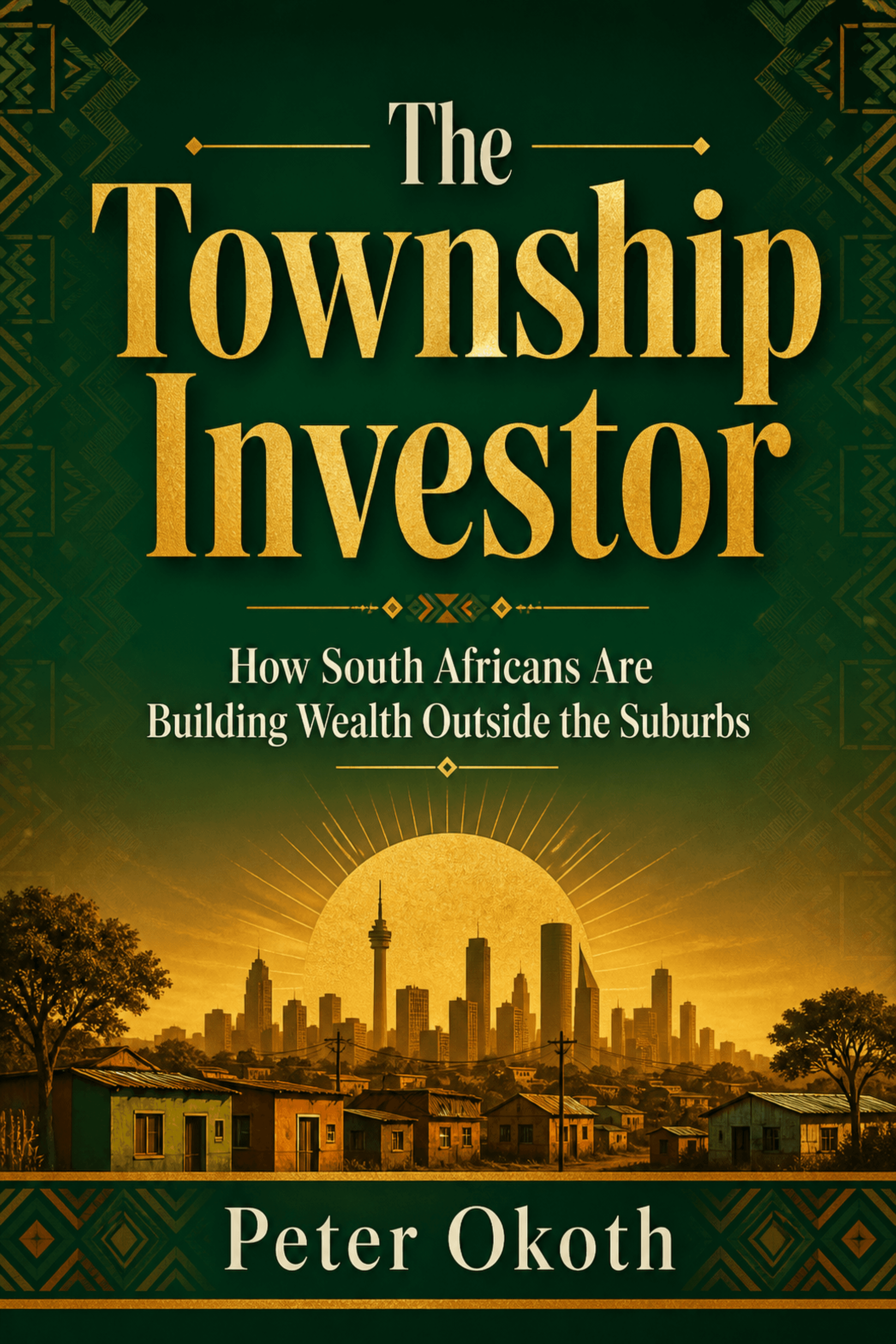
Free first chapter
The Township Investor
How South Africans Are Building Wealth Outside the Suburbs
Read the first chapter in your browser. It's free, with no account and no email needed.
Free to read. No account required.
About this book
When financial advisers talk about investment opportunities, they usually mean Sandton office blocks or listed property funds. They rarely mean a formalised house in Soweto, a container conversion in Khayelitsha, or student rooms near a TVET college. Those opportunities exist, and they sit in communities mainstream finance has overlooked.
The Township Investor looks at how South Africans are building wealth outside the suburbs. You will explore why the township economy matters, the opportunity in formalising township property, and the case for student accommodation. The book examines container conversions and micro-developments, township retail and services, and the practical question of funding these projects. A chapter on risk management and insurance keeps the enthusiasm grounded.
Look inside
Preface
The investment opportunity that most South African investors are ignoring is sitting in the townships they drive past on the highway.
South Africa's township economies move an estimated R200 billion or more per year. That is not marginal. That is a market larger than the GDP of several African countries. Millions of consumers. Thousands of businesses. An entire economic ecosystem operating at scale – with almost no formal investment infrastructure.
When financial advisors talk about "investment opportunities," they mean Sandton office blocks, Western Cape wine farms, or JSE-listed REITs. They do not mean a formalized house in Soweto rented to a young professional for R5,500 a month. They do not mean a container conversion in Khayelitsha housing a successful barbershop. They do not mean student accommodation near a TVET college in Soshanguve.
But those investments exist. They generate returns. And they build wealth in communities that mainstream finance has systematically ignored.
This book is for the investors who see what the mainstream misses.
Who This Book Is For
- Township residents who want to invest in their own communities
- Property investors looking for higher yields than suburban markets offer
- Entrepreneurs considering township-based business investments
- Diaspora South Africans who want to invest in their home townships
- Anyone who believes that wealth can – and should – be built in Black communities
What You Will Walk Away With
By the last page, you will know the investment opportunities in township economies, how to formalize property for title deeds and bank bonds, how to build student accommodation for NSFAS-funded students, how to develop container-based businesses, how to fund township investments, and how to manage the risks specific to these markets.
The suburbs had their turn. The townships are next.
The Township Economy Is Real Money
Nhlanhla is a property investor. He works in IT in Sandton and invests in property on the side. In 2022, he bought a two-bedroom sectional title unit in Randburg for R1.5 million. Monthly rent: R8,500. After bond repayment, levies, rates, and maintenance, his net cash flow is negative R2,100 per month. Gross yield: 6.8%. Net yield after all costs: approximately 4%.
Down the N1, in Soweto, his cousin Mpho bought a three-bedroom house for R350,000. The house had a title deed – formally registered at the Deeds Office. Mpho put R35,000 down and took a bond from Capitec for R315,000. Monthly bond repayment: R3,400. Monthly rent: R5,500. After rates (R350) and maintenance (R300), net cash flow: R1,450 per month. Positive. From day one.
Gross yield: 18.9%. Net yield: approximately 11%.
Same city. Same economy. Dramatically different returns. The difference: Mpho invested in the township.
What You Will Learn
- The scale and economic power of South Africa's township economies
- Why township investment consistently outperforms suburban investment on yield
- Why mainstream investors ignore this market (and why that is their loss)
- The investment opportunities this book covers
The Numbers Nobody Talks About
South Africa's townships house an estimated 15-20 million people. They generate an estimated R200 billion or more in annual economic activity. They have schools, clinics, churches, taxi ranks, shopping centres, and millions of consumers spending money every day.
The township economy is not a separate economy. It is the South African economy. The majority of South African consumers live in townships, shop in townships, and spend in townships. If you ignore township economies, you are ignoring the majority of the market.
And yet, mainstream property investment advice in South Africa focuses almost exclusively on suburban markets: Sandton, Midrand, Centurion, the Northern Suburbs of Cape Town, Umhlanga. These are markets where property prices are high, yields are compressed, and competition is fierce.
Township markets offer:
- Lower entry prices – R200,000-R600,000 for a three-bedroom house
- Higher gross yields – 12-20% compared to 5-8% in suburbs
- Strong rental demand – population growth, urbanization, young demographic
- Formalization opportunity – properties gaining title deeds increase in value 30-50%
- Emerging bank support – Capitec, FNB, and Standard Bank are increasingly lending on titled township properties
Why Mainstream Investors Stay Away
Let us be honest about the barriers – and whether they are real:
- "Township property is risky" — All property is risky. Suburbs have body corporate fraud. Townships have different risks – but they are manageable.
- "You cannot get a bond" — You can – if the property has a title deed. Capitec and FNB are active in this space.
- "Property values do not appreciate" — Formalized township properties have appreciated faster than many suburban markets in the past decade.
- "I do not know the market" — That is what this book is for.
- "Crime and vandalism" — Real risk. Chapter 7 covers insurance and risk management. But crime is not unique to townships – suburban properties get broken into too.
The honest truth: many mainstream investors do not invest in townships because of residual spatial apartheid thinking. The geography of exclusion – suburbs for investment, townships for "those people" – is a mindset, not a fact. This book breaks that mindset with data.
The Investment Opportunities
- Formalized property (buy and rent) — R200,000-R600,000 — 12-20% gross — 2
- Student accommodation near TVET colleges — R300,000-R800,000 — 15-25% gross — 3
- Container conversions (retail/office) — R50,000-R200,000 — Variable — 4
- Township retail and services — R20,000-R200,000 — Variable — 5
Your Checklist
- ☐ — I see township economies as a real investment market — Not a charitable act – a strategic investment
- ☐ — I understand the yield advantage — Higher yields than most suburban markets
- ☐ — I have identified which opportunity interests me — Property, student accommodation, container, retail
Your Move
- Look at property listings in Soweto, Khayelitsha, or Mamelodi on Property24. Compare prices and rental yields to Midrand or Centurion. The math speaks for itself.
- Read Chapter 2 for the formalization opportunity – buying unregistered properties, getting title deeds, and unlocking value.
- Challenge your assumptions. If you grew up in a township and left for the suburbs, consider investing back. The returns are there. The community impact is real.
Key Terms
Township economy
Formalization
Yield
What is Next
Chapter 2 is the formalization opportunity – how to buy township properties without title deeds, navigate the formalization process, and unlock the value that a registered title deed creates.
Township Property: The Formalization Opportunity
There are an estimated 2-3 million residential properties in South Africa that do not have formal title deeds registered at the Deeds Office. Most of them are in townships. Their occupants live in them, maintain them, improve them, and trade them – but without the legal proof of ownership that unlocks the formal financial system.
This gap is a problem for the residents. It is also an opportunity for investors who understand it.
What You Will Learn
- Why 2-3 million South African properties lack title deeds (the apartheid legacy)
- How a title deed increases property value by 30-50%
- The formalization process step by step
- The investment strategy: buy unformalized, formalize, and hold or sell
The Title Deed Gap
Under apartheid, Black South Africans in urban areas were denied property ownership. They were given Permissions to Occupy (PTOs), 99-year leasehold agreements, or simply allowed to occupy houses built by the state. The Deeds Office – the formal register of property ownership – did not include most township properties.
When apartheid ended, the new government inherited millions of occupied houses with no formal title deeds. The process of delivering title deeds to township residents has been underway since the late 1990s – but the backlog is enormous. Provinces have different levels of progress. Some areas are fully formalized. Others have barely started.
Free to read. No account required.