Free first chapter
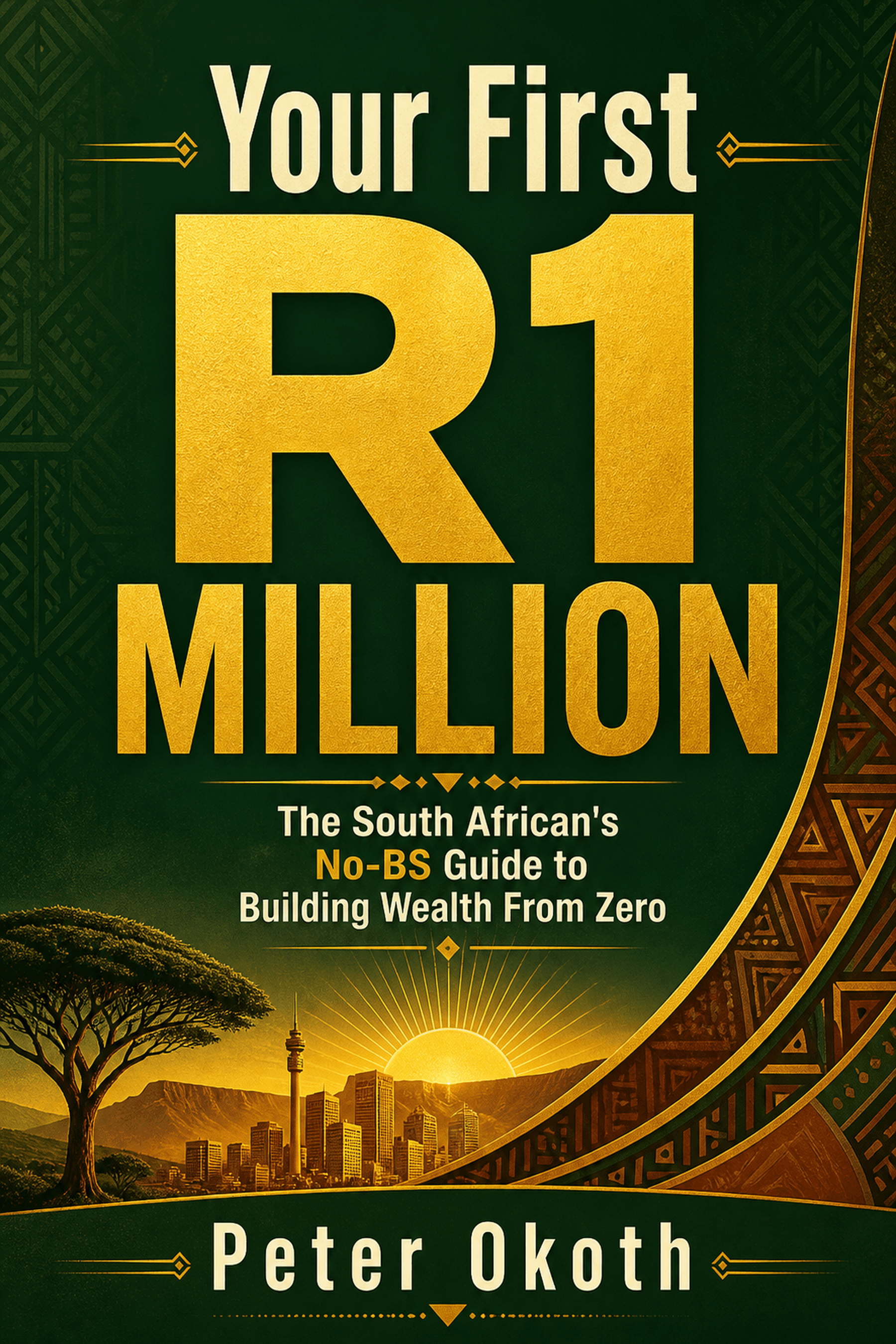
Your First R1 Million
The South African's No-BS Guide to Building Wealth From Zero
Read the first chapter in your browser. It's free, with no account and no email needed.
Free to read. No account required.
About this book
R1 million can feel like a number that belongs to someone else, especially if you grew up where the end of the month arrived on the 20th and saving meant whatever was left after rent, transport and groceries. Nobody at school, university or work teaches the math of building wealth, and the businesses that profit from your debt certainly do not.
Your First R1 Million is a no-nonsense guide for South Africans starting from zero. It opens in Soweto and then moves into the debt detox, a savings system built to survive real life, and investing basics covering the JSE, ETFs and Easy Equities. You will look at property as a wealth builder, side hustles that can scale, the Tax-Free Savings Account, and the honest conversation about black tax and wealth. It also covers protecting what you build through insurance and estate planning, and ends with your own R1 million plan.
It is educational, not personal financial advice, and investing always carries risk.
Look inside
Preface
R1 million.
It sounds like a lot. For most South Africans – especially those of us who grew up in households where R5,000 was a month's budget, where the end of the month came on the 20th, where saving meant having anything left over after rent, transport, and groceries – a million rand feels like a number that belongs to someone else.
It does not. It belongs to you. And it is more achievable than you think.
A South African earning R25,000 per month who saves 15% of their income and invests it in a balanced ETF earning 10% annually will reach R1 million in approximately 12 years. Not 50 years. Not "when you retire." Twelve years.
Bump that savings rate to 20%? Ten years. Add a side hustle generating R5,000 per month? Seven years. Buy an investment property whose tenant pays down the bond? The timeline compresses further.
The math is not the problem. The problem is that nobody teaches you the math. Your school did not teach it. Your university did not teach it. Your employer does not teach it. The banks and retailers who profit from your debt definitely do not teach it.
This book teaches it.
Who This Book Is For
- Young professionals earning R15,000-R50,000 and wondering where all the money goes
- Anyone in debt who wants a plan to get out and start building
- People who "cannot save" because their salary is gone before the month is over
- South Africans dealing with black tax – supporting family while trying to build personal wealth
- Anyone who has opened Easy Equities, stared at the screen, and closed it again
What You Will Walk Away With
A debt elimination plan, an automated savings system, an investment strategy using South African platforms you can access today (Easy Equities, TFSA, unit trusts), a framework for managing black tax without destroying your wealth plan, and a personalized timeline to R1 million.
Every strategy, every product, and every number in this book is South African. No American investment advice. No British pension schemes. Real SA platforms, real SA tax brackets, real SA cultural context.
R1 million is not a dream. It is a plan. This book is that plan.
The Millionaire Next Door Lives in Soweto
Kagiso and Tshepiso graduated from UJ in the same year. Both got jobs earning R30,000 per month. Both live in Johannesburg. Both drive to work. Both have families that expect financial support.
Five years later, their financial positions are dramatically different.
Kagiso saves R4,500 per month (15% of gross). She puts R3,000 into an Easy Equities TFSA invested in a Satrix Top 40 ETF, and R1,500 into a money market account as an emergency fund. She drives a secondhand Polo she bought for R120,000 cash. She sends her mother R3,000 per month. She rents a flat in Midrand for R6,500. Her net worth after five years: approximately R380,000 – and growing at 10%+ per year from investment returns.
Tshepiso earns the same R30,000. She financed a new VW Polo Vivo for R280,000 (monthly payment: R5,200). She has a Woolworths store account (R12,000 balance), a Truworths account (R8,000 balance), and a personal loan of R35,000 she took to furnish her flat. Her monthly debt payments: approximately R7,800. She sends her family R2,500 per month. She has no savings. Her net worth after five years: approximately negative R45,000.
Same salary. Same city. Same starting point. One is building wealth. The other is building debt.
The difference is not intelligence. It is not luck. It is a system – a set of decisions about money that compound over time, in one direction or the other.
What You Will Learn
- Why R1 million is achievable from an ordinary South African salary
- How compound interest works in your favour (or against you)
- The math of wealth building vs the math of debt building
- What this book will teach you chapter by chapter
R1 Million Is Not a Dream
Let us do the math.
If you invest R3,000 per month into a balanced fund earning 10% per year (the long-term average of the JSE):
- 5 — R180,000 — R235,000 — R55,000
- 10 — R360,000 — R620,000 — R260,000
- 12 — R432,000 — R830,000 — R398,000
- 14 — R504,000 — R1,100,000 — R596,000
R1 million in approximately 14 years. From R3,000 per month. That is 10% of a R30,000 salary.
Increase to R5,000 per month? R1 million in approximately 10 years.
Add a side hustle generating R5,000 per month that you invest entirely? R1 million in approximately 7 years.
The math is not the obstacle. The math is on your side. The obstacle is the gap between knowing this and doing it – the debt, the lifestyle inflation, the black tax, the pressure to look like you have made it before you actually have.
This book closes that gap.
The Compound Interest Revolution
Albert Einstein (probably) never said "compound interest is the eighth wonder of the world." But whoever said it was right.
Compound interest means your money earns returns, and then those returns earn returns. It is growth on growth on growth. Over time, the snowball effect is extraordinary.
- R100,000 invested at 10% for 10 years = R259,000
- R100,000 invested at 10% for 20 years = R673,000
- R100,000 invested at 10% for 30 years = R1,745,000
The same R100,000. The only variable is time. This is why starting at 25 is dramatically better than starting at 35 – not because you save more money, but because you give compound interest ten extra years to work.
And here is the cruel flip side: compound interest works on debt too. A R20,000 store account at 20% interest, if you only pay the minimum, costs you R48,000 over five years. Your debt compounds against you.
Every rand you invest today is worth more than every rand you will invest tomorrow. Start now. Start with R500 if that is what you have. Just start.
Your Checklist
- ☐ — I know my net worth (assets minus debts) — Even if the number is negative – that is your starting point
- ☐ — I believe R1 million is achievable — Because the math says it is
- ☐ — I am ready to build a system — Not willpower – a system
Your Move
- Calculate your net worth right now. Everything you own (savings, investments, property equity, car value) minus everything you owe (bonds, personal loans, store accounts, credit cards). Write the number down. That is your starting line.
- If the number is negative: Chapter 2 (The Debt Detox) is your first stop.
- If the number is positive but small: Chapter 3 (The Savings System) shows you how to grow it.
- If you have some savings but are not investing: Chapter 4 gets you started on Easy Equities this week.
Key Terms
Net worth
Compound interest
TFSA
ETF
What is Next
Chapter 2 is the debt detox. Before you can build wealth, you need to stop the bleeding. Every rand going to store account interest, personal loan repayments, and credit card debt is a rand that is not compounding in your favour. Let us fix that.
The Debt Detox
Before you can build wealth, you need to stop losing it. And for millions of South Africans, debt is the machine that eats wealth every month.
The average South African household owes approximately 63% of their disposable income to debt. Store accounts, personal loans, credit cards, car finance – each one charges interest that compounds against you while you sleep.
Free to read. No account required.