Free first chapter
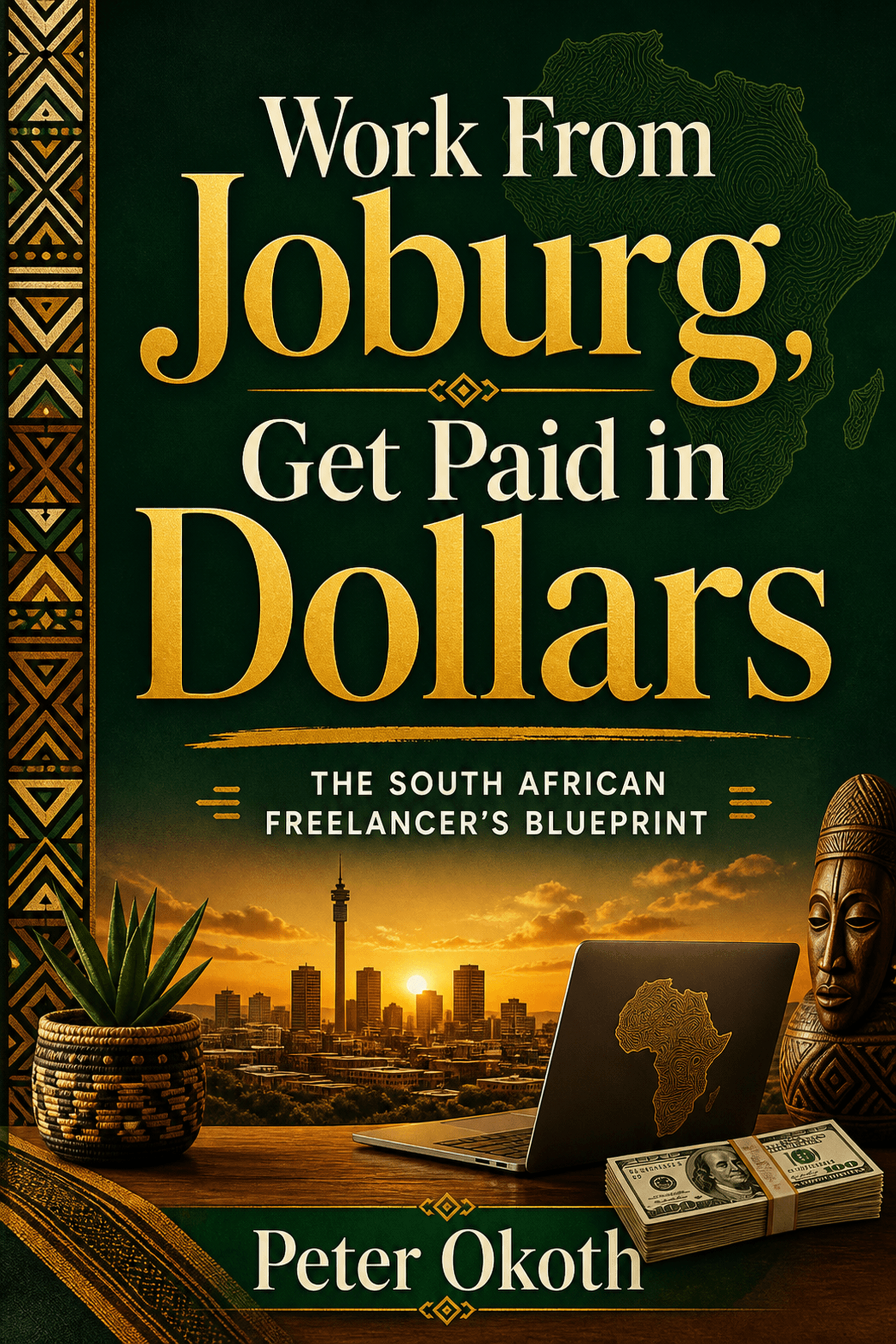
Work From Joburg, Get Paid in Dollars
The South African Freelancer's Blueprint
Read the first chapter in your browser. It's free, with no account and no email needed.
Free to read. No account required.
About this book
Plenty of South African freelancers have real skills and still sit at the bottom of the rate ladder on Upwork or Fiverr. The problem is often not the work. It is how they position themselves, price their services and talk to international clients, in a country where the rand loses ground and dollar income is a hedge.
Work From Joburg, Get Paid in Dollars is a step-by-step blueprint for changing that. You start with the rand gap, then identify skills that sell internationally and build a profile from zero. You learn to write proposals that win, to price without undercutting yourself, and to land and manage your first client.
The later chapters cover getting paid in dollars, building a portfolio when you have nothing to show yet, scaling from freelancer to agency, and an introduction to tax on foreign income. The closing playbook pulls everything into a plan. It is written for South Africans selling to the world.
Look inside
Preface
There are tens of thousands of South African freelancers on Upwork. Most of them earn less than USD 5 per hour.
Not because they lack skill. Not because South African work is inferior. Because nobody taught them how to position themselves, price their services, or communicate with international clients who are willing to pay ten times that rate.
This book is the manual they never got. It is not a motivational speech about "the future of remote work." It is a step-by-step blueprint for building a freelance career that pays in dollars and deposits to your bank account – in a country where the Rand loses ground every year and dollar income is not a luxury, it is a hedge.
Who This Book Is For
- South African freelancers on Upwork or Fiverr who are stuck at USD 3-5/hour and cannot figure out why
- Graduates and young professionals who want international clients but do not know where to start
- Anyone who completed the SA Digital Income series and is ready to scale from basic online income to premium international freelancing
- Employed South Africans who want to build a dollar-denominated side income that hedges against Rand depreciation
- Self-taught professionals – designers, writers, developers, video editors – who have skills but no idea how to sell them globally
What You Will Walk Away With
By the last page, you will have a professional freelance profile that attracts international clients. You will know how to price your services without falling into the "cheap South African freelancer" trap. You will know how to write proposals that win, manage clients across timezones (with SA's excellent Europe/UK overlap as your advantage), handle scope creep, and get paid reliably through Payoneer, Wise, or direct bank transfer. You will understand your SARS obligations on foreign income, including the foreign income exemption. And if you are ready, you will have a roadmap for scaling from solo freelancer to running a remote South African team.
Every platform named in this book is accessible from South Africa. Every amount includes real Rand-to-USD conversions. Every strategy comes from freelancers who are doing this right now, from Johannesburg, Cape Town, Durban, Pretoria, and everywhere in between.
No imported advice. No "just believe in yourself." Let us build.
The Rand Gap
Thandi graduated from the University of Johannesburg with a diploma in Multimedia Design. She could design anything – logos, brochures, social media graphics, website mockups. She was good. Her lecturers said so. Her classmates hired her for their projects.
Six months after graduation, Thandi was still sending CVs. A friend told her about Upwork – a global freelancing platform connecting freelancers with clients. She signed up, set her hourly rate at USD 5, and waited.
Her first job came after three weeks: a logo for a pet grooming company in Ohio. She spent six hours on it. She earned USD 30 – roughly R570 at the time. After Upwork's 20% fee, she took home USD 24. That is R456 for six hours of professional design work.
Thandi thought the rate was the problem. She was half right.
Her Canadian competitor on the same platform – similar quality, similar turnaround time – charged USD 45 per hour. For the same six-hour logo project, the Canadian earned USD 270. Same work. Same client pool. Same platform. The Canadian earned nine times more.
Thandi was not less skilled. She was less positioned.
Here is what Thandi did not know – and what this chapter will teach you.
What You Will Learn
- Calculate what international freelance rates actually mean in Rand monthly income
- Identify the four reasons most South African freelancers earn below their market value
- Define the "cheap SA freelancer" trap and why it costs you thousands of Rand every month
- Understand why the Rand's depreciation makes dollar-earning urgent, not optional
- Separate the real dollar opportunity from get-rich-quick noise
- Assess your starting position using the Freelancer Asset Inventory
Why This Matters
The exchange rate between the US dollar and the South African Rand creates an opportunity that most SA freelancers are not using.
At R19 per dollar, a freelancer earning USD 20 per hour takes home R380 per hour. That is R60,800 per month at 40 hours per week – before platform fees. Even at USD 15 per hour, the monthly figure is R45,600. Compare that to the average starting salary for a university graduate in Johannesburg: R8,000 to R15,000 per month.
Last verified: March 2026. Check xe.com or your Payoneer dashboard for current rates.
The math is not complicated. But here is the problem: tens of thousands of South African freelancers are registered on Upwork, and the majority of them earn less than USD 5 per hour. Not because they lack skill. Because nobody taught them how to position, price, and pitch to international clients who are willing to pay ten times that rate.
That gap – between what SA freelancers earn and what international clients will pay for quality work – is the Rand gap. This book closes it.
New to online income?
If you have never earned money online before, start with the South African Digital Income series. Those books cover the fundamentals of online income – finding your first digital hustle, setting up payment infrastructure, and filtering out scams. This book assumes you have a marketable skill and are ready to sell it internationally.
The Exchange Rate Is Your Superpower – And Your Safety Net
The Reality
Let us do the math. Here is what different hourly rates in USD translate to in monthly Rand income, assuming 160 working hours per month (40 hours/week):
- USD 5 — USD 800 — R15,200 — R12,160 — R13,680
- USD 10 — USD 1,600 — R30,400 — R24,320 — R27,360
- USD 15 — USD 2,400 — R45,600 — R36,480 — R41,040
- USD 20 — USD 3,200 — R60,800 — R48,640 — R54,720
- USD 30 — USD 4,800 — R91,200 — R72,960 — R82,080
- USD 50 — USD 8,000 — R152,000 — R121,600 — R136,800
Last verified: March 2026. Exchange rate fluctuates daily. Upwork charges 20% on the first USD 500 earned with a client, then 10% from USD 500.01 to USD 10,000, then 5% above USD 10,000.
Look at the difference between USD 5/hour and USD 20/hour. The freelancer earning USD 20 takes home four times more – not because they work four times harder, but because they positioned themselves differently.
Now compare these numbers to South African salary benchmarks:
- Fresh graduate (entry-level office job) — R8,000 – R15,000
- Mid-career professional (3-5 years) — R25,000 – R45,000
- Senior professional (8+ years) — R45,000 – R80,000
- Bank teller — R12,000 – R18,000
- High school teacher — R18,000 – R30,000
A freelancer earning USD 15/hour on Upwork – a modest international rate – out-earns most mid-career South African professionals. At USD 20/hour, they are in senior professional territory. At USD 30/hour, they earn more than most department heads.
And they work from home. In Joburg, in Cape Town, in Durban, in Pretoria, in their parents' house in Polokwane. No commute. No office politics. No "jy moet mense ken" – you need connections.
The Rand Depreciation Story
Here is why this is urgent, not just interesting.
In 2011, the Rand traded at roughly R7 per dollar. In 2016, it was R16. In 2021, it was R15. In 2026, it is R19. The long-term trend is clear: the Rand weakens against the dollar.
Quotes to share
The problem is often not the work.
Free to read. No account required.