Free first chapter
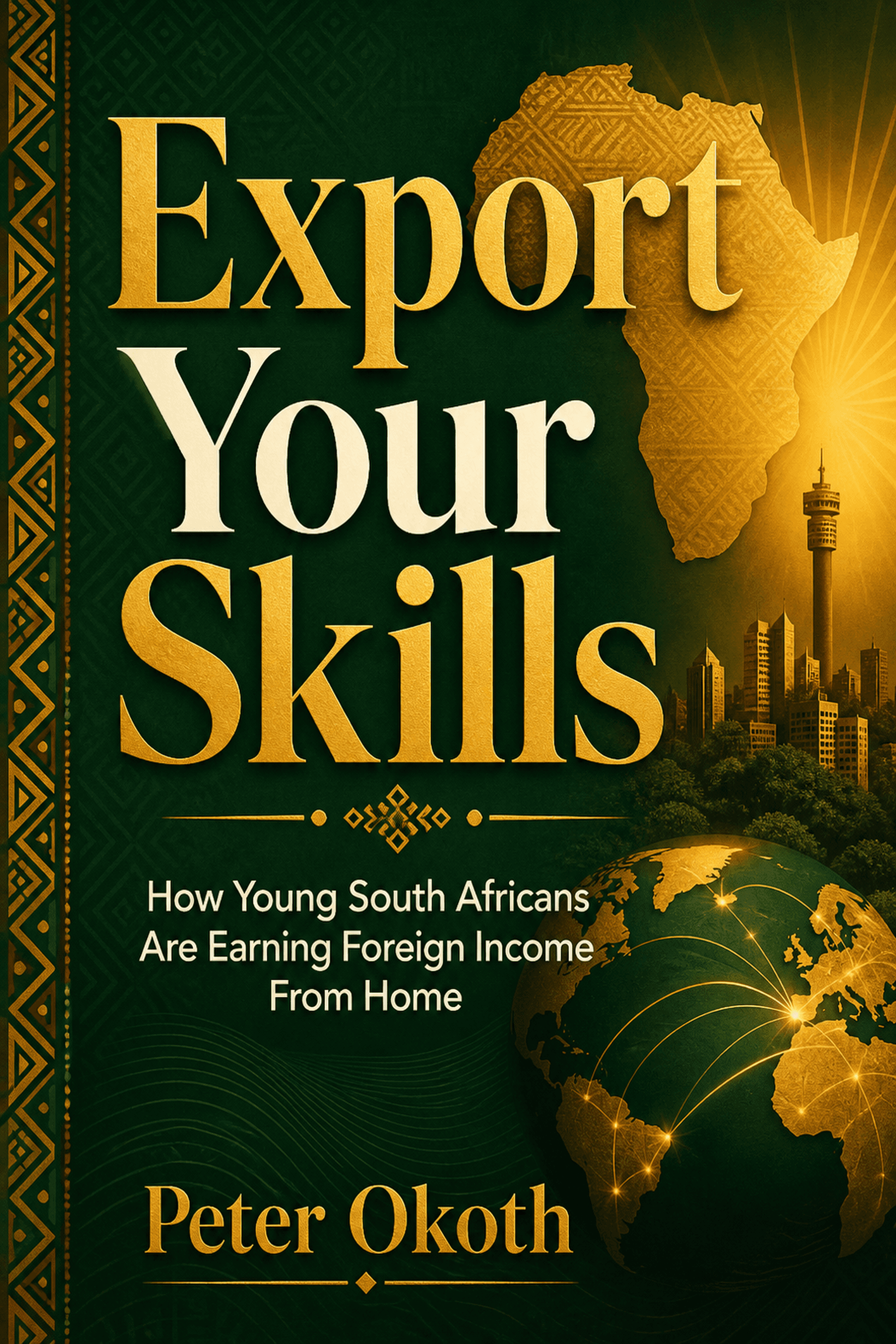
Export Your Skills
How Young South Africans Are Earning Foreign Income From Home
Read the first chapter in your browser. It's free, with no account and no email needed.
Free to read. No account required.
About this book
South Africa exports wine, fruit, and minerals. Your skills can be exported too, to buyers abroad who pay in dollars, pounds, and euros. With a tough job market at home, you may feel stuck waiting for the right opening, when a global marketplace is already open to you.
Export Your Skills reframes online work as exporting a professional service. You will start by recognising that you are already an exporter, then run an export audit to identify which of your skills sell internationally. The book shows you where the buyers are, how to package your skills into a clear offer, and how to set a price that reflects international markets rather than local rates. You will plan your first export, learn to get paid across borders, and build a personal brand that goes beyond geography.
Later chapters cover managing foreign income in two currencies and growing from solo exporter to a small export team, with every platform discussed accessible from South Africa.
Look inside
Preface
South Africa exports wine, fruit, minerals, and automobiles. The next great export is talent.
You have skills that businesses around the world need – and they are willing to pay in dollars, pounds, and euros. Not because they are doing you a favour. Because your work has value on the international market, and the exchange rate means you both win.
This book reframes the entire conversation. You are not begging for online gigs. You are not "trying to make money on the internet." You are a South African professional exporting high-value services to the world – and the Rand's depreciation against the dollar makes this not just smart, but urgent.
Who This Book Is For
- South African graduates and young professionals who have skills but feel stuck in a job market with 33%+ unemployment
- University students and NSFAS graduates exploring income options before or after graduation
- Young professionals in low-paying jobs who want a path to higher earning
- Anyone ready for the mental shift from job-seeker to skill-exporter
What You Will Walk Away With
By the last page, you will know which of your skills have international export value. You will have a packaged service ready for international buyers, profiles on at least two global platforms, and a pricing strategy that reflects international market rates – not Joburg rent. You will understand how to get paid across borders, how to manage income in two currencies, and how to build a personal brand that transcends geography.
Every platform is accessible from South Africa. Every amount includes real Rand conversions. Every strategy comes from South Africans who are doing this right now.
You Are Already an Exporter
South Africa exported R1.6 trillion worth of goods in 2025. Gold. Platinum. Iron ore. Citrus fruit. Wine. Automobiles.
Nobody questions whether these are real exports. Nobody asks the wine farmer if exporting is a "real job." The foreign currency flows in, the economy benefits, and the exporter builds wealth.
Now consider this: Lindiwe, 27, sits in a flat in Observatory, Cape Town. She writes blog posts, email campaigns, and case studies for three software companies in London. She earns USD 3,500 per month – approximately R66,500. That money comes from the UK into South Africa, converted into Rand, and deposited in her FNB account.
Lindiwe is an exporter. Her product is writing. Her shipping method is wifi. Her export revenue is indistinguishable – in economic terms – from a crate of Stellenbosch wine arriving at Heathrow.
The difference is that nobody told Lindiwe she was an exporter. She thinks of herself as "someone who does freelance writing." This chapter changes that.
What You Will Learn
- Reframe freelancing as talent export – what it actually is in economic terms
- Understand why South Africa is uniquely positioned for skill export
- Identify the mental barriers keeping you from earning foreign income
- Calculate the real Rand value of skill export at different income levels
- Begin seeing yourself as a professional exporter, not a gig worker
The Talent Export Opportunity
The Reality
South Africa's unemployment rate exceeds 33%. Among people aged 15-34, it is closer to 60%. The domestic job market cannot absorb the talent this country produces.
But here is what nobody talks about: while the domestic market is saturated, the international market for skilled South African professionals is growing. Businesses in the US, UK, EU, and Australia are increasingly hiring remote freelancers – and they are paying in currencies that are 15-20 times stronger than the Rand.
At R19 per dollar, a South African earning USD 2,000 per month takes home R38,000 – more than many mid-career SA professionals earn in formal employment. At USD 4,000 per month, they earn R76,000. At USD 6,000, they are in senior management territory.
The talent is here. The demand is there. The exchange rate bridges them. All that is missing is the pipeline – and that is what this book builds.
Why South Africa Specifically
Five factors make SA uniquely positioned for talent export:
- English fluency – SA is one of the few African countries where English is a primary language of business and education. This eliminates the biggest barrier most developing-country freelancers face.
- Education quality – SA's universities and technical colleges produce graduates with internationally recognised qualifications, particularly in finance, technology, and creative fields.
- Timezone alignment – GMT+2 overlaps with European and UK business hours. Clients get real-time collaboration without timezone gymnastics.
- Tech infrastructure – Despite load shedding, SA has Africa's most developed internet and tech infrastructure. Fibre is available in urban areas. Mobile data coverage is extensive.
- Professional culture – SA's corporate sector has trained a generation of professionals in Western business norms – meeting etiquette, email communication, project management, deadline discipline.
These are not abstract advantages. They are the specific reasons international clients choose South African freelancers over alternatives from other developing countries.
Your Move
Do this now: Write down three skills you have – professional, technical, or creative. Next to each, write whether you think anyone outside South Africa would pay for it. We will test this properly in Chapter 2, but start thinking like an exporter now.
What is Next
You know the opportunity is real. You know South Africa is positioned for talent export. Now the question is: which of YOUR skills have international market value? In the next chapter, we run the Export Audit – a systematic process for identifying exactly what you can sell to the world.
The Export Audit – What You Can Sell Internationally
Palesa studied journalism at Rhodes University. She could write, research, interview, and edit. For three years after graduation, she applied for media jobs in SA. The industry was shrinking. Newsrooms were cutting staff, not hiring.
Then a friend asked: "Have you considered writing for international companies?"
Palesa had not. She thought her skills were "South African skills" – local knowledge, local contacts, local stories. Who would want that overseas?
As it turned out: fintech companies in London wanted someone who understood African markets. Development organisations wanted writers who could produce reports on Southern Africa. Travel brands wanted content about Cape Town, Kruger, and the Garden Route. Her "local" knowledge was an international asset she had never marketed.
This chapter helps you discover yours.
What You Will Learn
- Conduct a systematic audit of every skill, knowledge area, and experience you have
- Identify which of your skills have international market demand
- Discover "hidden exports" – skills you did not know were valuable internationally
- Understand the difference between skills that export easily and skills that need repackaging
- Complete the Export Inventory with at least two exportable skill packages
The Export Audit Framework
Step 1: List Everything
Write down every skill, area of knowledge, and professional experience you have. Do not filter. Do not judge. Just list.
- Professional skills (from work)
- Technical skills (software, tools, coding)
- Creative skills (writing, design, video)
- Academic knowledge (your degree/diploma area)
- Language skills
- Industry knowledge (sectors you have worked in)
- Cultural/regional knowledge
- Soft skills (communication, project management)
Step 2: The International Demand Test
For each skill, ask these five questions:
- Do businesses outside SA need this? (Not "would they like it" – do they actively search for it and pay for it?)
- Can it be delivered remotely? (Over the internet, without being physically present?)
- Is it in English? (Or can it be adapted to English-language markets?)
- Are there existing platforms where people buy this? (Upwork, Fiverr, direct clients?)
- Would someone pay USD 15+/hour for it? (If the answer is less than USD 10/hour, the market is commoditised and you need to niche up.)
Free to read. No account required.