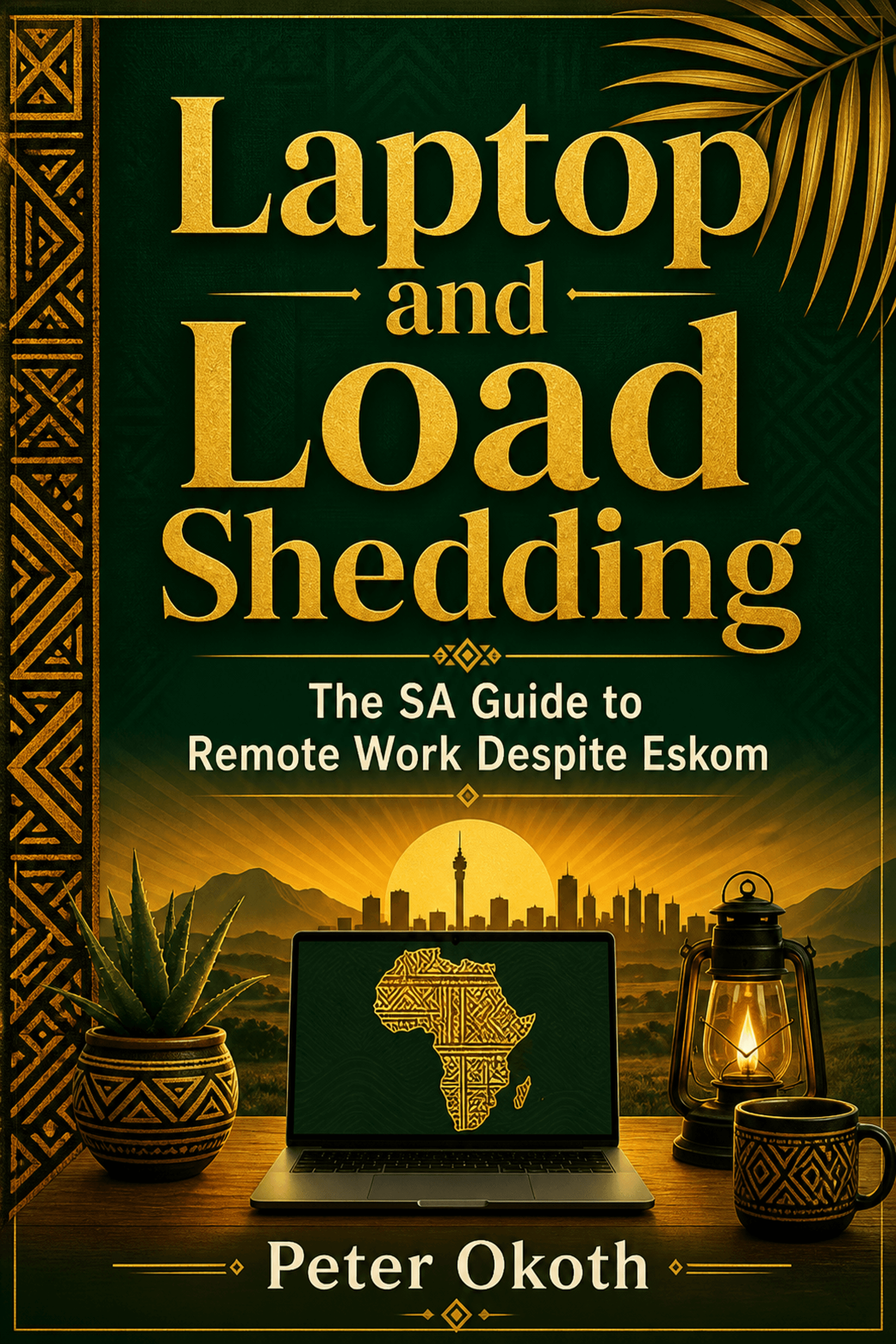
Free first chapter
Laptop and Load Shedding
The SA Guide to Remote Work Despite Eskom
Read the first chapter in your browser. It's free, with no account and no email needed.
Free to read. No account required.
About this book
Stage 4 hits, your UPS has two hours left, your data is running low, and a client deadline is at 5 p.m. Remote work in South Africa has its own challenges, and most remote work guides were not written with Eskom in mind.
Laptop and Load Shedding is the South African guide to building digital income despite those constraints. You begin with the new SA economy and a way to work out which path fits you. You will then set up a remote office designed around load shedding, covering power backup and data costs. The book walks you through four routes: freelancing, remote jobs, digital products, and content.
It also covers staying sane and productive while working from home, getting paid and managing your money, and scaling from side income into a full career. Whether you are in Johannesburg or a smaller town, the focus is on building something that keeps working when the grid does not.
Look inside
Preface
The power went out again. Stage 4. Your UPS has two hours of battery. Your mobile data is running low. And you have a client deadline at 5 p.m.
Welcome to remote work in South Africa.
This book is for every South African who wants to build a digital income – freelancing, remote employment, digital products, or content creation – despite Eskom, despite data costs, despite the infrastructure challenges that make working from home in SA uniquely difficult.
Other countries have remote work guides. This is the South African one. The one that covers power backup options, data cost management, internet alternatives when fibre goes down, and how to keep clients happy when Stage 6 hits in the middle of a deliverable.
Who This Book Is For
- South Africans aged 18-35 who have a laptop and internet and want to explore every way they can earn money online
- Recent graduates facing SA's unemployment crisis and wanting alternatives to the traditional job market
- Side-hustlers looking to upgrade from informal to structured digital income
- South Africans in smaller towns who want access to Joburg-level (and international-level) income from home
What You Will Walk Away With
By the last page, you will have a map of every legitimate digital income path available from South Africa. You will have a load-shedding-proof remote work setup. You will have at least one active income stream generating first earnings. And you will have a payment pipeline, a growth plan, and the knowledge that Eskom is a constraint, not a disqualifier.
No excuses. No waiting for the grid to be fixed. Let us build despite it.
Laptop and Load Shedding – The New SA Economy
It is 2 p.m. on a Tuesday. Your laptop is charged, your fibre is stable, and your UPS sits quietly in the corner – a relic of the load shedding years that you keep plugged in, just in case.
You have a Zoom call with a client in Berlin at 3 p.m. and a deliverable due by 5 p.m. Cape Town time.
Welcome to the South African digital economy – one that survived Stage 6, adapted, and came out stronger.
South Africa has gone over 300 consecutive days without load shedding as of March 2026. The infrastructure crisis that defined 2022-2024 has eased. But the digital economy it forced into existence is not going anywhere – and the opportunity on the other side of that adaptation is enormous. The South Africans who built backup systems, learned to work through power cuts, and developed resilient remote workflows now have a competitive edge that extends well beyond electricity.
What You Will Learn
- Understand the current digital income landscape in South Africa
- Identify how many South Africans are already earning online and what they earn
- Recognise the four digital income paths available from SA
- Understand why load shedding is a constraint, not a disqualifier
- See real examples of South Africans building digital income despite infrastructure challenges
The Digital Income Landscape in SA
The Reality
South Africa has the highest unemployment rate of any G20 country. Over 33% of the workforce is officially unemployed. Among people aged 15-34, it approaches 60%.
At the same time, the global remote work market is growing at 25% per year. International companies are hiring remote workers from everywhere. Freelancing platforms process billions of dollars annually. Digital products generate passive income for creators worldwide.
South Africa sits at the intersection of these two trends: a massive domestic talent surplus and a growing international demand for remote skills. The exchange rate – R19 per dollar – means that even modest international earnings translate to competitive SA income.
What South Africans Are Actually Earning
- Freelancing (Upwork, Fiverr) — R10,000 – R80,000+ — 1-3 months
- Remote employment (international company) — R20,000 – R120,000+ — 1-3 months
- Digital products (courses, templates, e-books) — R2,000 – R40,000+ — 3-6 months
- Content monetisation (YouTube, blogging) — R1,000 – R30,000+ — 6-12 months
These ranges represent realistic outcomes for people with relevant skills who are actively working at it. The top earners in each category earn significantly more. Last verified: March 2026.
The Load Shedding Reality
Let us address Eskom directly. Load shedding is real. It disrupts internet, kills productivity, and makes SA remote workers look unreliable to international clients.
But here is what load shedding is NOT: a reason to give up on digital income.
Tens of thousands of South Africans freelance, work remotely, and build digital businesses right now – during Stage 4 and beyond. They do it with:
- UPS devices (R1,500-R5,000) that keep laptops and routers running for 2-4 hours
- Mobile data backup (Rain, Telkom, MTN) when fibre goes down
- Co-working spaces with generator backup
- Load shedding schedule apps (EskomSePush) to plan work around outages
- Client communication – proactively telling international clients about potential disruptions
Chapter 3 covers the complete load shedding survival kit for remote workers. For now, know this: load shedding is a logistics problem, not an economic one. And logistics problems have solutions.
The Four Digital Income Paths
Path 1: Freelancing
Selling your skills to multiple clients on platforms like Upwork and Fiverr, or directly. You control your rates, your hours, and your clients.
Best for: People with a marketable skill (writing, design, development, data entry, VA work) who want flexibility and potentially high income.
SA advantage: English fluency, timezone overlap with Europe, strong tech reputation.
Path 2: Remote Employment
Working for an international company as a remote employee or contractor. One employer, regular income, structured work.
Best for: People who want stability and are willing to commit to one company's schedule and culture.
SA advantage: OfferZen and similar platforms connect SA developers to international companies. SA professionals are increasingly sought after for remote roles.
Path 3: Digital Products
Creating and selling digital products – e-books, online courses, templates, design assets, software tools. Build once, sell repeatedly.
Best for: People with specialised knowledge who can package it into a product. Requires patience – income takes months to build.
Path 4: Content Monetisation
Building an audience through YouTube, blogging, podcasting, or social media, then monetising through ads, sponsorships, and affiliate marketing.
Best for: People with a topic they are passionate about and the patience to build an audience over 6-12 months.
Your Move
Before you turn the page:
- Review the four paths above. Which one or two interest you most?
- Check your load shedding schedule for this week using EskomSePush. Note your off-grid hours.
- Write down one skill you could potentially sell online. We refine this in Chapter 2.
What is Next
You know the landscape. Now the question is: which path fits YOU? In the next chapter, we build a self-assessment that matches your skills, time, risk tolerance, and resources to the digital income path with the highest chance of success for your specific situation.
Which Path Fits You?
Thandiwe, 24, has a degree in communications from UNISA. She can write, she is comfortable on camera, and she has 3,000 followers on Instagram. She wants to earn online but does not know whether to freelance, apply for remote jobs, create a course, or start a YouTube channel.
Without a framework, she will try everything, finish nothing, and give up in two months.
This chapter gives her – and you – the framework.
What You Will Learn
- Assess your skills, available time, risk tolerance, and resources honestly
- Match your profile to the best-fit digital income path
- Understand the realistic timeline and effort required for each path
- Make a clear decision and commit to one path for the first 90 days
The Digital Income Path Finder
The Assessment
Answer each question honestly. There are no right or wrong answers – only matches.
Quotes to share
Remote work in South Africa has its own challenges, and most remote work guides were not written with Eskom in mind.
Free to read. No account required.