Free first chapter
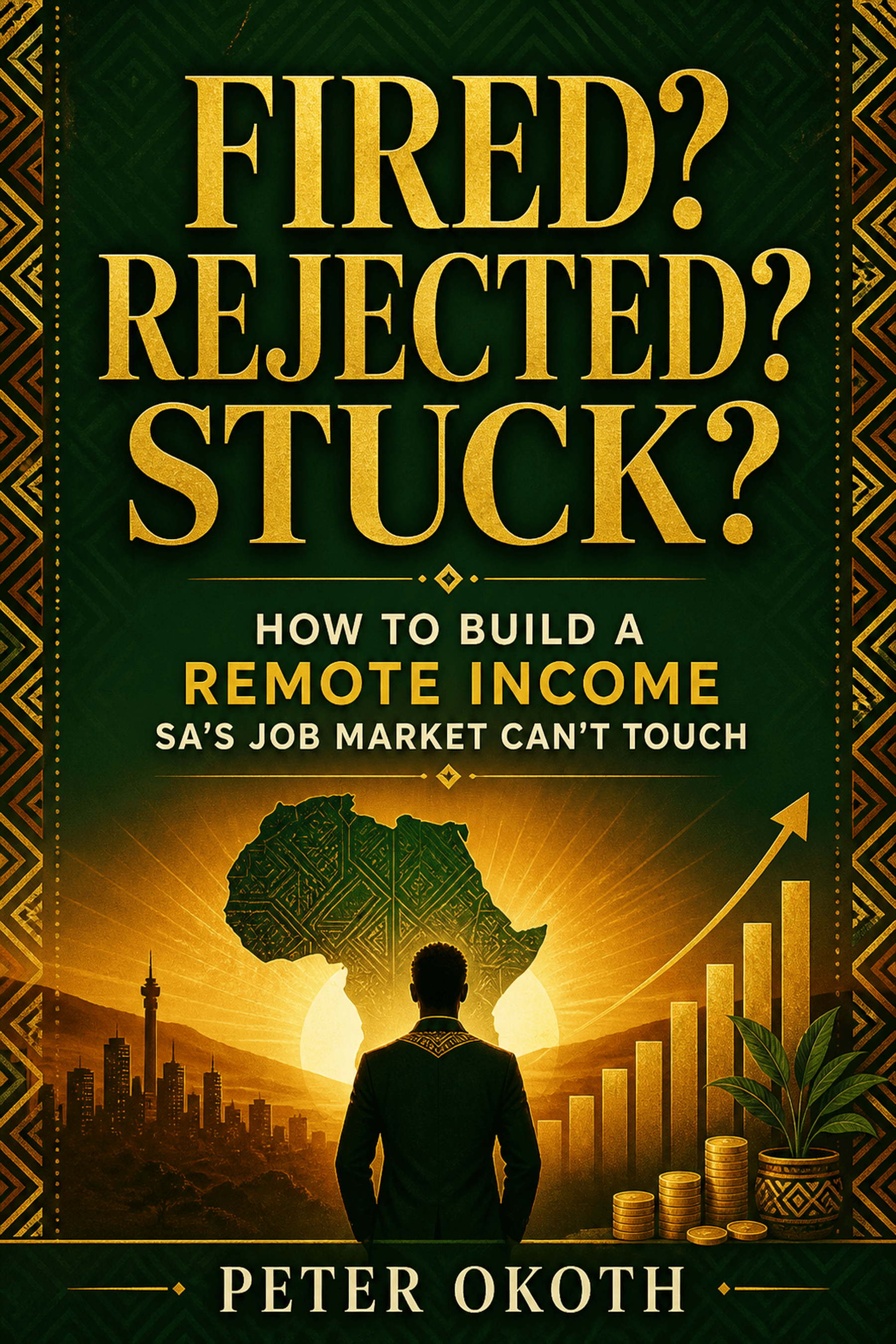
Fired? Rejected? Stuck?
How to Build a Remote Income SA's Job Market Can't Touch
Read the first chapter in your browser. It's free, with no account and no email needed.
Free to read. No account required.
About this book
Maybe you were retrenched, or you graduated into silence, or your job pays less than your transport costs. You are scared, perhaps ashamed, and the savings are running down. You do not need a pep talk. You need a plan.
Fired? Rejected? Stuck? starts exactly where you are. You begin with financial triage, listing what you have, what you owe, and what you need. Then you identify skills you can sell within thirty days, use a seven-day launchpad to get moving, and aim for your first R5,000 online. The book covers getting paid when you need money now, managing money during a crisis, and moving from emergency income to something sustainable.
You will think about building income that no single employer can take away, and finish with a 90-day recovery plan. It is written for South Africans in career crisis, and for the parents or partners supporting them. The focus is on practical steps, one week at a time, not on promises.
Look inside
Preface
South Africa's official unemployment rate is over 33%. Among young people, it is closer to 60%.
If you are reading this book, the statistics might be your life right now. Retrenched. Graduated into nothing. Stuck in a job that pays less than your transport costs. Watching your savings – if you had any – disappear month by month.
This book does not pretend everything is fine. It starts where you actually are: scared, broke, maybe ashamed. Maybe carrying family obligations you cannot meet. Maybe dodging calls from people you owe money to.
Then it gives you a plan.
Not inspiration. Not "10 Ways to Stay Positive During Job Loss." A step-by-step system for building income that no single employer, no single industry, and no SA economic downturn can take from you.
Who This Book Is For
- South Africans in career crisis – recently retrenched, graduated and cannot find work, stuck in a dead-end job
- Anyone who needs income faster than SA's job market can provide
- Graduates 1-3 years post-university who still have not found stable employment
- Parents or spouses supporting someone in career crisis
What You Will Walk Away With
By the last page, you will have identified at least one skill you can monetise within 2-4 weeks. You will have a 30-day emergency income plan and at least one active income stream. You will have a system for managing money in crisis and a roadmap for transitioning from emergency income to a sustainable remote career.
The first R5,000 is the hardest. After that, the system takes over.
You Are Not Finished
Mpho is 28. Three months ago, he was retrenched from a logistics company in Germiston. He had worked there for four years. The letter came on a Friday afternoon. By Monday, his access card was deactivated.
He has been applying for jobs since. Forty-seven applications. Three interviews. Zero offers. His UIF runs out in two months. His rent is R5,500. His mother in Limpopo needs R3,000 every month. His savings are down to R8,400.
He has not told his friends. He is embarrassed to be seen at home during work hours. His mother calls every week – he pretends everything is fine. Some mornings he does not get out of bed until noon because there is nowhere to go.
Mpho is not lazy. Mpho is not broken. Mpho is in a country with 33% unemployment and a job market that has no space for him right now.
This book does not pretend that is okay. It does not offer "10 Tips for Staying Positive." It offers a plan.
What You Will Learn
- Name what you are going through without shame – career crisis is structural in SA, not personal
- Understand why remote income is different from job-seeking (and why it works faster)
- See real examples of South Africans who were where you are and built their way out
- Set realistic expectations: this is a 30-day plan to first income, 90 days to stability
- Take the first step today – not tomorrow, not next week
Why This Is Not Your Fault
The Reality
South Africa's unemployment crisis is structural. It is not about you.
- Official unemployment: 33%+
- Youth unemployment (15-34): approaching 60%
- Expanded unemployment (including those who have stopped looking): over 42%
These numbers mean that for every job opening, there are dozens of qualified applicants. You can have the right degree, the right experience, and the right attitude – and still lose out because there simply are not enough positions.
This is not a motivational speech. This is economic reality. And accepting it is the first step to working around it.
The Remote Income Alternative
Here is what the job market cannot do: absorb all of South Africa's talent. Here is what the global market CAN do: pay South Africans in dollars for skills they already have.
A virtual assistant in SA earning USD 12/hour takes home approximately R228/hour – roughly R36,000/month at full-time hours. A content writer earning USD 15/hour takes home approximately R285/hour. These are entry-level international rates that exceed what many mid-career SA professionals earn.
The global market does not care about SA's unemployment rate. It cares about quality, communication, and reliability. If you can deliver those three things, you can earn.
Real Stories
Nomvula – Retrenched Retail Manager
Retrenched from a clothing chain in 2024. Applied for 60 jobs in 3 months. Zero offers. Started learning Canva and social media management from YouTube. Created an Upwork profile. First client within 5 weeks – a small US e-commerce company needing social media posts. Started at USD 8/hour. Within 6 months, raised to USD 18/hour with three regular clients. Current monthly income: approximately R45,000.
Thabo – Engineering Graduate, No Job
Graduated with a BTech from TUT in 2023. Could not find engineering work. Had strong Excel and data analysis skills from his degree. Positioned himself as a data analysis freelancer on Upwork. First R5,000 came in month two from a data cleaning project. Now earns USD 22/hour doing financial data analysis for UK companies.
These are not fairy tales. These are the realistic timelines when you follow a system.
The 30-Day and 90-Day Promise
This book makes two promises:
By Day 30: You will have at least one active income stream generating your first Rand from remote work. It might be R2,000. It might be R5,000. It will be real money, earned from a skill you already have or can learn in 2-4 weeks.
By Day 90: You will have a sustainable remote income system – regular clients or ongoing work, a payment pipeline, and a growth plan. The crisis will not be over, but the trajectory will be clear.
These are not guarantees. They are targets. Hitting them requires effort – consistent daily effort. But the effort is specific, structured, and this book lays out every step.
Your Checklist
- ☐ — I have named my situation honestly — Retrenched, unemployed, underemployed, or stuck – without shame
- ☐ — I understand why remote income is different — Global demand, dollar exchange rate, skills-based not connections-based
- ☐ — I am committed to the 30/90-day plan — 30 days to first income, 90 days to stability
- ☐ — I have told one person I trust — Accountability matters. Tell someone what you are building.
Your Move
Before you turn the page:
- Write down your current financial reality. How much cash do you have? How much do you need per month to survive? When does the money run out? Be honest. No rounding up.
- Open a notes app or take a piece of paper. Write today's date. Write: "Day 1 of building remote income." This is your starting marker. You will look back at it.
What is Next
You have named the situation. Now we need to understand exactly where you stand financially – what you have, what you owe, and what you need to survive while building income. In the next chapter, we do financial triage: the Oxygen Mask Budget that keeps you alive while you build.
Financial Triage – What You Have, What You Owe, What You Need
Zanele was retrenched from a call centre three months ago. She has R6,200 left in her Capitec account. She owes R2,800 on a clothing account. Her rent is R4,000. Her phone is R350. Transport to interviews: R600. Food: R2,500.
Her UIF payments are R2,800 per month. She has two months of UIF left.
Zanele does not have a financial plan. She has a countdown. At current burn rate, she runs out of money in 5 weeks.
Free to read. No account required.