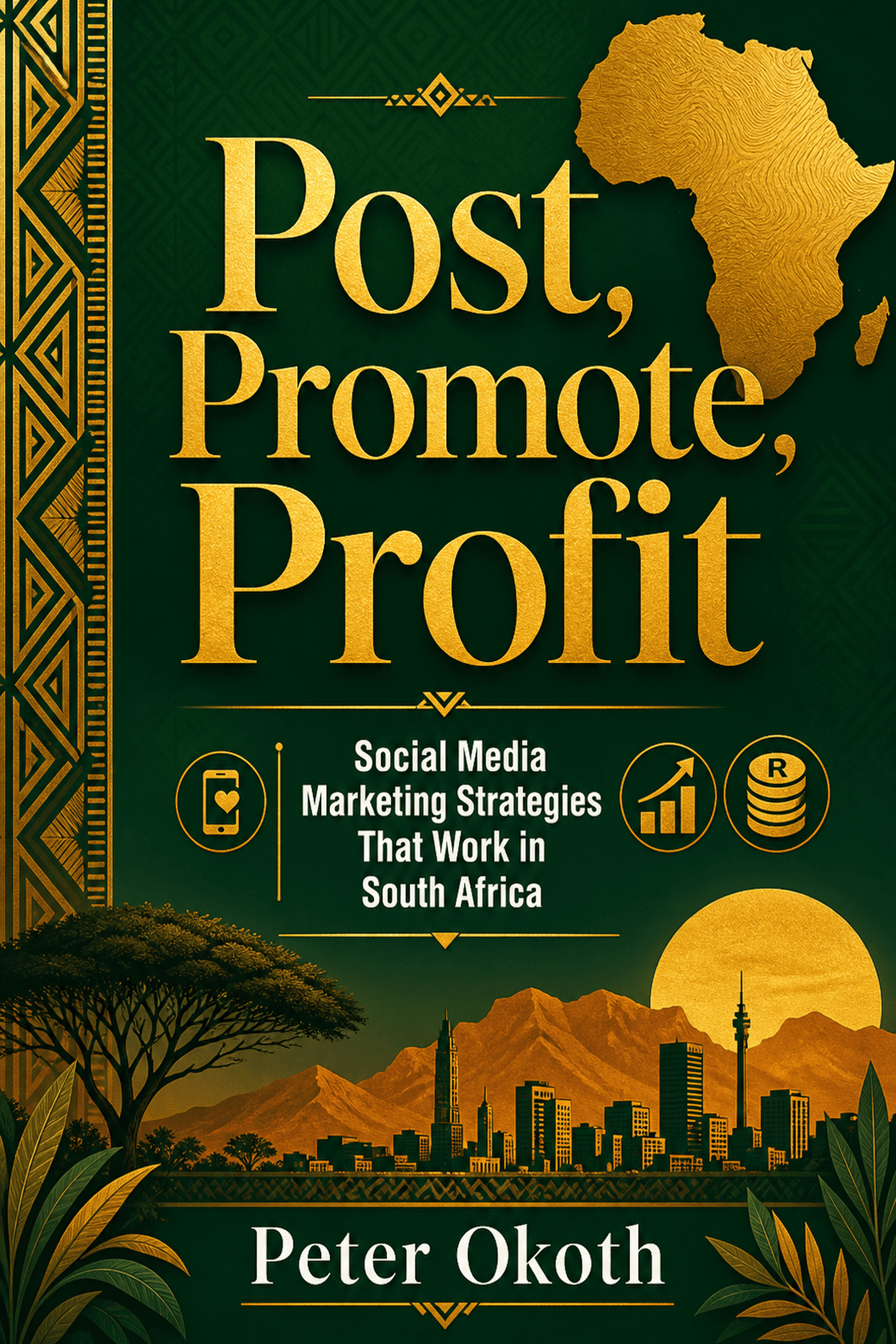
Free first chapter
Post, Promote, Profit
Social Media Marketing Strategies That Work in South Africa
Read the first chapter in your browser. It's free, with no account and no email needed.
Free to read. No account required.
About this book
You have been posting. A product photo here, a motivational quote there, a happy weekend message that earns a few likes from friends and no sales. That is noise, not marketing. Marketing is a system you can run whether you feel creative or not.
Post, Promote, Profit gives you that system, built for South African businesses, customers and budgets. You begin with the post-promote-profit cycle and learn to know your South African customer. Then you set up content pillars and a content factory that keeps production manageable, and a platform playbook for organic reach.
The book covers a paid promotion playbook for the South African ad market, monthly campaign planning, and the handful of numbers that actually matter. It ends with a 90-day marketing plan, with exercises along the way. Every strategy works from a phone and every example comes from Mzansi, so you can turn social media from a chore into a steady source of customers.
Look inside
Preface
You have been posting. Randomly. A product photo here, a motivational quote there, a "happy weekend" post that gets 20 likes from your friends and zero sales from anyone.
This is not marketing. This is noise.
Marketing is a system: you research your audience, create content they want to see, promote what works, and track what makes money. The system runs whether you feel creative or not, whether you had a good day or a bad one, whether you posted last week or not.
This book gives you that system. Built for South African businesses, South African customers, and South African budgets.
Who This Book Is For
- Business owners who are already online but not getting results
- Anyone who posts irregularly and wonders why nothing sells
- Book 1 readers who set up their platforms and now need a systematic approach
- Marketing assistants at small SA businesses who need a framework
What You Will Walk Away With
A documented audience profile. A content strategy with pillars. A production system. A paid promotion playbook. A measurement dashboard. And a 90-day plan that turns social media from a chore into a revenue engine.
Every Rand amount is South African. Every strategy works from a phone. Every example is from Mzansi.
Post. Promote. Profit. In that order.
The Post-Promote-Profit Cycle
Palesa runs a clothing boutique in Bloemfontein. She sells affordable fashion – dresses, two-pieces, and accessories – from a small shop and through Instagram. She has 2,000 followers. She posts when she remembers to, which is two or three times per week. Sometimes a product photo. Sometimes a motivational quote. Sometimes a selfie with a new arrival.
Her Instagram generates about 5 sales per month. R2,500 in revenue from 2,000 followers. She knows it should be more. She just does not know what she is doing wrong.
Here is what she is doing wrong: she is posting. She is not marketing.
Posting is putting content online and hoping something happens. Marketing is a system that makes something happen – specifically, that makes people find you, trust you, and pay you. The difference between Palesa's 5 sales and the 20 sales she could be getting is not more followers. It is a system.
This chapter gives you that system.
What You Will Learn
- Why random posting produces random results (and why most SA businesses do it)
- The Post-Promote-Profit cycle: the three-stage system that turns content into revenue
- What each stage looks like in practice for a South African small business
- How to diagnose which stage of the cycle is broken in your current marketing
Why Random Posting Fails
Most South African small businesses approach social media like this:
- Wake up. Think: "I should post something."
- Take a quick photo of a product or the shop.
- Write a caption: "New stock! DM for prices."
- Post it. Get 30 likes from friends.
- Get 0 sales.
- Conclude: "Social media does not work for my business."
This is not marketing. This is noise. And noise does not sell.
The problem is not the platform, the product, or the audience. The problem is that there is no system connecting the post to a sale. The post goes up. It floats in the feed. Nobody takes action because nobody was asked to take a specific action, shown a reason to trust, or given a path from "that looks nice" to "I am going to buy it."
The Three-Stage Cycle
Stage 1: Post (Create With Purpose)
Every piece of content you create should serve one of three purposes from the Know-Trust-Buy framework (introduced in Book 1):
- Know content – reaches new people. Gets discovered. (Examples: Reels that show your work, TikTok tutorials, Facebook Marketplace listings)
- Trust content – builds credibility with people who already know you. (Examples: customer testimonials, behind-the-scenes, your story)
- Buy content – asks for the sale. Clear pricing, clear call to action, clear path to WhatsApp or payment. (Examples: product showcases with prices, limited-time offers, "order now" posts)
Most businesses post only Buy content – product photos with "DM for price." That is like shouting "BUY FROM ME" at strangers on the street. You need Know content to find them, Trust content to convince them, and Buy content to close them.
The ratio: For every 1 Buy post, create 2-3 Know or Trust posts. This is the system that converts.
Stage 2: Promote (Amplify What Works)
Not all content performs equally. Some posts get shared. Some get ignored. The system identifies winners and gives them more reach.
Organic promotion: Repost your best-performing content. Share it to Stories. Pin it to your profile. Cross-post it to other platforms. If a Reel got 500 views when your average is 100, repost a variation. The algorithm already told you it works.
Paid promotion (when ready): When you have R50-R200/day to spend, boost your best organic content. Do not create ads from scratch – promote what already proved itself. Chapter 6 covers this in detail.
Stage 3: Profit (Track Revenue, Not Vanity)
Likes are not profit. Followers are not profit. Comments saying "nice!" are not profit.
Profit is: how many WhatsApp inquiries did you get this week? How many converted to sales? How much revenue came from each platform? Which type of content generated the most sales?
If you cannot answer these questions, you are flying blind. Chapter 8 gives you a simple tracking system. For now, know this: every piece of content should eventually be traced to revenue. If it does not lead to money – directly or indirectly – stop creating it.
The Cycle in Action
Here is what Palesa's marketing looked like before and after applying the PPP cycle:
- Post — Random: product photos, quotes, selfies — Planned: 3 Know posts, 2 Trust posts, 2 Buy posts per week
- Promote — None. Post and forget. — Best Reel each week reposted to Stories and WhatsApp Status
- Profit — No tracking. "I think we got some sales from Instagram." — Every WhatsApp inquiry tagged by source. Revenue tracked weekly.
- Result — 5 sales/month. R2,500 revenue. — 20 sales/month. R10,000 revenue. Same 2,000 followers.
Palesa did not gain followers. She did not run ads. She applied a system. The system quadrupled her conversion.
Diagnose Your Cycle
Which stage is broken for you?
- Nobody sees your content — Post – your content does not reach new people — Create more Know content (Reels, TikToks, Marketplace listings)
- People see but do not engage — Post – your content does not build trust — Add Trust content (testimonials, process videos, your face)
- People engage but do not buy — Post + Profit – no clear path from content to sale — Add Buy content with specific CTAs; track inquiries
- Some content works, most does not — Promote – you are not amplifying winners — Repost best content. Cross-platform. Consider boosting.
- You do not know what works — Profit – no tracking — Start asking "how did you find us?" Track by platform.
Your Checklist
- ☐ — I understand the three stages — Post (create with purpose), Promote (amplify winners), Profit (track revenue)
- ☐ — I can diagnose my broken stage — From the symptom table
- ☐ — I know the Know-Trust-Buy content ratio — 2-3 Know/Trust posts for every 1 Buy post
Your Move
- Look at your last 10 posts on your main platform. Categorize each: Know, Trust, or Buy. If most are Buy, you have found the problem.
- Identify your broken stage from the diagnostic table. That is where you start fixing.
- Turn to Chapter 2. Before you can post with purpose, you need to know who you are posting for. Audience research – free, fast, and game-changing.
Quotes to share
Marketing is a system you can run whether you feel creative or not.
Free to read. No account required.