Free first chapter
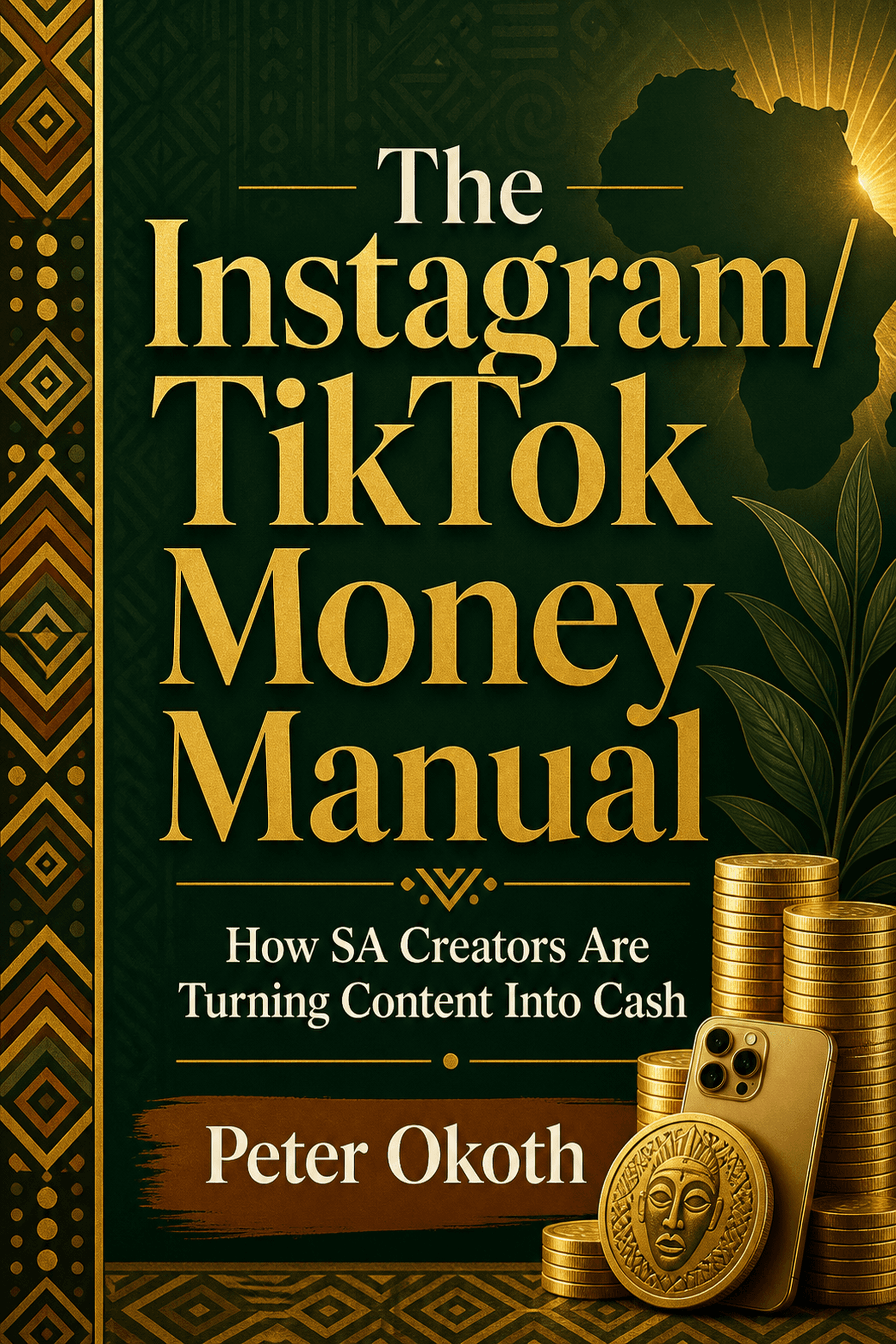
The Instagram/TikTok Money Manual
How SA Creators Are Turning Content Into Cash
Read the first chapter in your browser. It's free, with no account and no email needed.
Free to read. No account required.
About this book
You have the followers, the likes, and the comments that say "fire!" But your bank account hasn't noticed. Many South African creators are well known in their niche and still earn little from it.
The Instagram/TikTok Money Manual shows how to close that gap. It starts with the creator economy in South Africa and why followers are not money. You will see the main ways creators earn, then dig into brand deals, from setting rates in Rand to negotiating. The book covers affiliate marketing for creators, digital products you can sell to your audience, and how to grow from creator to business owner.
It also looks at managing irregular income, and at contracts, rights, and legal protection so you understand what you are agreeing to. It ends with a 90-day plan to move from content hobby toward content income. Every example is grounded in the South African market.
Look inside
Preface
You have the followers. You have the likes. You have the comments that say "fire!" and "this is amazing!"
And you have R0 from all of it.
You are not alone. Most South African content creators with 5,000, 10,000, even 50,000 followers earn nothing – or next to nothing – from their content. They are famous in their niche and broke in their bank account. The "famous but poor" problem.
This book fixes that.
Who This Book Is For
- Creators with 1,000-50,000 followers who have not figured out consistent monetization
- Creators who get occasional brand deals but cannot predict their income
- Aspiring creators who want to understand the business before going full-time
- Anyone who has been told they are "too small" for brand deals and believed it
What You Will Walk Away With
A monetization strategy that matches your niche and audience size. A rate card with real Rand figures. Negotiation scripts for brand deals. At least one non-brand-deal income stream. A financial system for irregular income. An understanding of contracts and legal protection. And a 90-day plan to go from content hobby to content income.
Every Rand figure in this book is from the South African market. Every rate benchmark is by follower count and niche. Every strategy has been used by SA creators earning real money.
Imali ayizicosheli – money does not pick itself up. You have to go get it. Here is how.
The Creator Economy Is Real – And It Pays in Rands
Zanele is a food content creator in Durban. She has 12,000 Instagram followers and 8,000 on TikTok. She makes beautiful food content – plating videos, recipe reels, restaurant reviews. Her content gets consistent engagement: 500-800 likes per post, 50-100 comments, decent shares.
In the past 12 months, she has earned R15,000 from content. Total. Not per month – total. That is R1,250 per month from 20,000 combined followers and hours of daily work.
Meanwhile, a creator she follows – Mpumi, also a food creator, also in KZN – has 5,000 Instagram followers. Half of Zanele's audience. But Mpumi earns R6,000-R8,000 per month. Consistently. Every month.
Zanele has more followers. Mpumi has more income. Why?
Because followers are not money. And most South African creators have not learned the systems that turn content into cash.
This book teaches those systems.
What You Will Learn
- How much money actually flows through the South African creator economy
- Who gets paid, how much, and for what – with real Rand figures
- The "famous but poor" problem: why 50,000 followers can mean R0 income
- The five monetization streams this book covers
- Why this is a business book, not a content creation guide
The SA Creator Economy – The Numbers
South Africa's creator economy is still young compared to the US or UK, but it is growing fast. Here is what we know:
Brand spending on influencer marketing in SA is estimated at R1-R2 billion per year (2025-2026), growing 20-30% annually. That money goes to creators who feature brands in their content.
Who gets most of it? The top 5% of creators – those with 100,000+ followers and established brand relationships – capture the majority. But the fastest-growing segment is micro-influencers (5,000-50,000 followers), because brands are learning that smaller creators often deliver better engagement and conversion.
The opportunity for mid-tier SA creators is significant and underexploited. Most creators in the 5,000-50,000 range earn nothing or very little – not because the money is not there, but because they do not know how to access it.
Income Benchmarks by Follower Count
Here is what South African creators can realistically earn at different audience sizes, across all five monetization streams:
- 1,000-5,000 — R300-R1,000 — R500-R3,000 — Mostly UGC and small local brands
- 5,000-10,000 — R1,000-R3,000 — R2,000-R8,000 — Local and some national brands
- 10,000-50,000 — R3,000-R10,000 — R5,000-R25,000 — National brands, regular deals
- 50,000-100,000 — R10,000-R25,000 — R15,000-R60,000 — Major brands, multi-platform deals
- 100,000+ — R25,000-R80,000+ — R30,000-R150,000+ — Premium rates, exclusivity deals
Last verified: March 2026. Ranges vary by niche, engagement rate, and negotiation skills.
Look at the "Monthly Total" column for 5,000-10,000 followers: R2,000-R8,000. That range is wide because it depends entirely on whether you have a monetization system or not. Without one: R0-R500 (Zanele's situation). With one: R5,000-R8,000 (Mpumi's situation).
The system is what this book teaches.
The "Famous But Poor" Problem
You know them. Maybe you are one of them. Creators with 30,000, 40,000, even 50,000 followers who cannot pay their rent from content. They get free products – free meals, free clothes, free tech gadgets – but not cash. They have influence but no income.
Why?
1. They never ask for money. They accept free products because they do not know they can ask for cash. Brands happily pay in product because it costs them less. Chapter 4 teaches you to negotiate cash.
2. They have no other income streams. Brand deals are irregular. If you rely on them alone, you have feast-or-famine months. The solution: diversify. Chapters 5-7 cover affiliate marketing, digital products, and building your own business.
3. They do not track the business side. They do not know their engagement rate, their conversion metrics, or their value per post. Without data, they cannot negotiate. Chapter 2 fixes this.
4. They have followers but not a brand. A brand is a clear niche, a recognizable identity, and an audience that trusts your recommendations. Followers without a brand are vanity metrics. Chapter 2 builds your brand.
The Five Money Streams
This book covers five ways to monetize your content:
Stream 1: Brand Deals and Sponsored Content
Companies pay you to feature their products. The most visible stream. Covered in Chapter 4.
Stream 2: Affiliate Marketing
You earn commissions by recommending products through tracking links. Covered in Chapter 5.
Stream 3: Digital Products
You create and sell ebooks, templates, presets, courses. Create once, sell forever. Covered in Chapter 6.
Stream 4: Creator Funds and Platform Payments
TikTok Creator Fund, YouTube ad revenue. Small but passive. Covered in Chapter 3 (overview).
Stream 5: Your Own Business
Launch a product, service, or brand built on your audience. The highest-ceiling stream. Covered in Chapter 7.
Mpumi – the creator earning R6,000-R8,000/month with 5,000 followers – uses three of these five streams: brand deals (R3,000-R4,000/month), affiliate marketing (R1,000-R2,000/month), and digital products (a recipe ebook that earns R1,500-R2,000/month). Zanele uses one: occasional brand deals.
This Is a Business Book
Let us be clear about what this book is and is not.
It is not a guide to creating better content, growing followers, or going viral. There are excellent resources for that. This book assumes you can already create content that people engage with.
It is a guide to turning that content into money. Pricing, negotiation, contracts, financial management, tax obligations, and the systems that convert audience into income.
If you have 1,000+ followers and some engagement, you have enough audience to start monetizing. The question is not "am I big enough?" The question is "do I have the system?"
Your Checklist
- ☐ — I know the income benchmarks for my follower range — From the table above
- ☐ — I understand the "famous but poor" problem — Followers without systems = no income
- ☐ — I know the five money streams — Brand deals, affiliate, digital products, platform, own business
- ☐ — I understand this is a business book — Systems, not content tips
Quotes to share
Many South African creators are well known in their niche and still earn little from it.
Free to read. No account required.