Free first chapter
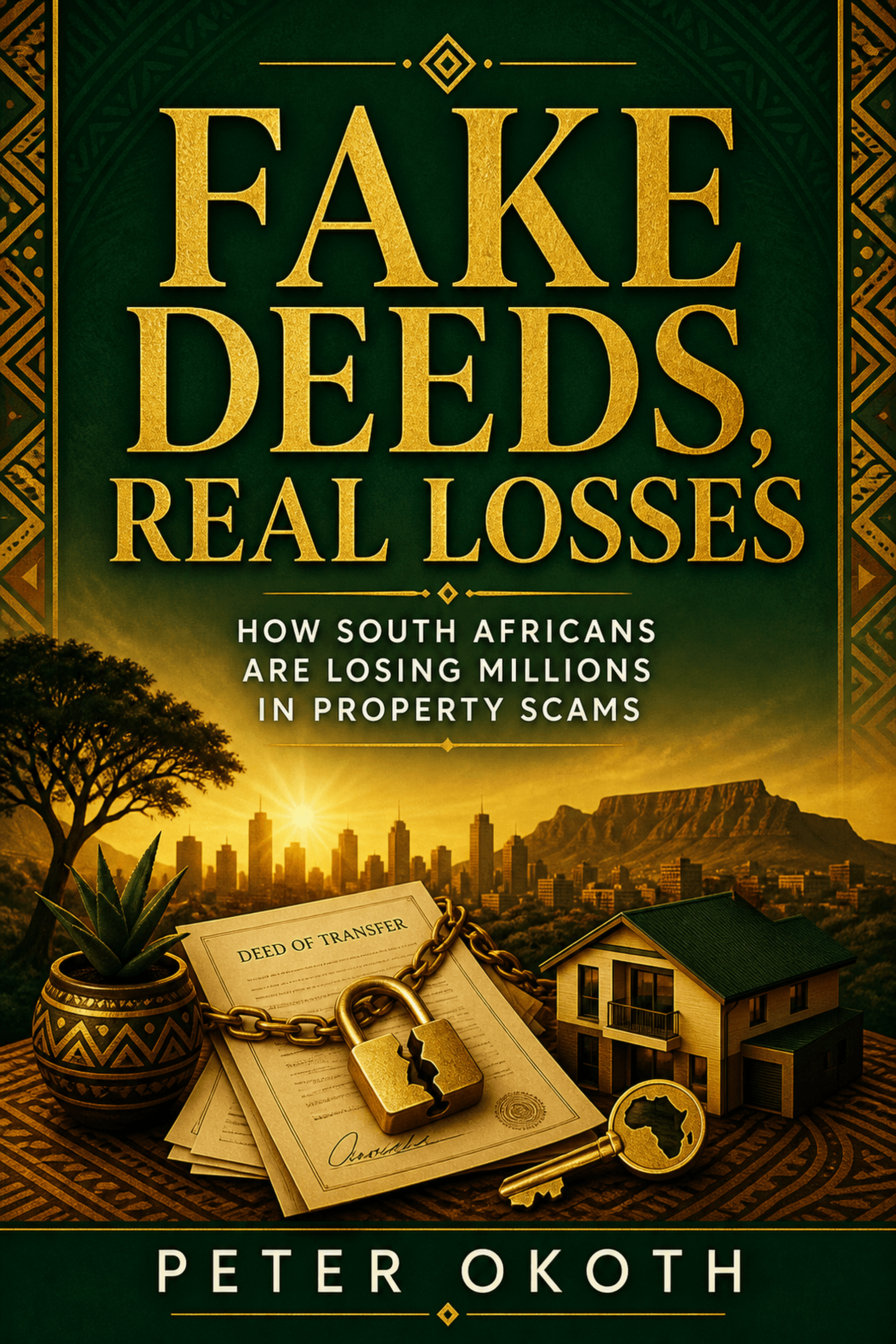
Fake Deeds, Real Losses
How South Africans Are Losing Millions in Property Scams
Read the first chapter in your browser. It's free, with no account and no email needed.
Free to read. No account required.
About this book
The title deed looked real. The seller seemed legitimate, the agent had a website, the house existed, and still the buyer lost everything. For most South Africans, a loss like that is a lifetime of savings, or a stokvel's collective effort.
Fake Deeds, Real Losses documents the major property scam patterns operating in South Africa, how they work, who runs them, and how to spot them. You will see how title deed fraud actually works, the RDP resale racket, and how body corporate trustees can quietly drain levy funds. The book covers township property fraud, developers who collect deposits and vanish, syndication schemes built on guaranteed returns, and the hijacking of inner-city buildings. It also explains what to do if you have already been scammed, and closes with a fraud prevention playbook you can use before you commit to any deal.
It is written for buyers, investors, stokvel members and families who want to protect what they have worked for.
Look inside
Preface
The title deed looked real. The seller seemed legitimate. The agent had a website. The house existed. And still, the buyer lost everything.
This is not a rare story in South Africa. It happens every week – in Gauteng, in the Western Cape, in KwaZulu-Natal, in Limpopo. Property fraud in this country has become industrialized. Syndicates forge title deeds with professional printing equipment. Criminals impersonate property owners using stolen identity documents. RDP houses are sold in violation of the law, and the buyer has no legal recourse. Body corporate trustees steal levy funds for years before anyone notices. Developers collect deposits and vanish. Buildings in Johannesburg's inner city are hijacked by criminal groups who collect rent from desperate tenants.
The losses are not small. They are R200,000. R500,000. R2 million. For most South Africans, that is not money they can recover from. That is a lifetime of savings. A stokvel's collective effort. A family's future.
This book documents every major property scam pattern operating in South Africa as of 2026. Not theory. Not warnings from abroad. The actual scams that are taking South Africans' money right now – how they work, who runs them, how to spot them, and how to protect yourself.
Who This Book Is For
- Anyone about to buy property who wants to know what the scams look like before they encounter one
- Township residents buying or selling houses in areas where informal transactions are common
- Sectional title owners who suspect something is wrong with their body corporate
- RDP house owners who have been approached by buyers or agents
- Anyone who has already been scammed and needs to know their options
- Estate agents and conveyancers who want a reference guide for client protection
What You Will Walk Away With
By the last page, you will know the ten most common property fraud patterns in South Africa, the red flags for each one, the verification steps that would have stopped them, and the reporting and legal channels available to victims. You will also have a master fraud prevention checklist that you can use for any property transaction.
Every scam pattern in this book is based on reported cases and documented fraud methods. Where we cannot name specific parties, we use composite stories that accurately represent the pattern.
Knowing the scam is the vaccine. This book is a full course of shots.
The Deed That Looked Perfect
Zanele had done everything she was supposed to do. She saved for six years. She worked double shifts at Steve Biko Academic Hospital in Pretoria. She put money into her Capitec savings account every month without fail. She did not take personal loans. She did not chase quick money. She was a nurse who believed in the long game.
By 2024, she had R450,000. Enough for a modest house in Mamelodi East – the kind of three-bedroom that young professionals buy as a first home. Not fancy. Just hers.
She found the listing on Facebook Marketplace. A three-bedroom house in Mamelodi for R430,000. Below market, but not impossibly so – the seller said he was relocating to Cape Town for work. Zanele called the number. The man who answered was polite, professional, and patient. He arranged a viewing.
Zanele visited the house. It was real. It had furniture. The garden was maintained. The man who met her had a South African ID, a title deed, and a sale agreement prepared by a lawyer – or what looked like a lawyer's letterhead. He explained the transfer process. He even recommended a conveyancer.
Zanele paid R430,000 in two EFT payments. The first R100,000 as a deposit, the balance three weeks later. She signed the sale agreement. She received a copy of the title deed. She started telling her family she had bought a house.
The conveyancer she had been recommended did not exist. The phone number went to a man who said he had never heard of her. Zanele found her own conveyancer. That conveyancer ran a Deeds Office search.
The title deed was forged. The registered owner of the house was an 81-year-old man named Petrus Mabaso who had been in a care facility in Pretoria North for two years. He had never authorized any sale. His identity documents had been used to create a fake ID. The man Zanele met at the house was not Petrus Mabaso. The title deed she was shown was a sophisticated forgery – same paper, same format, same stamps. But the Deeds Office had no record of any transfer, because no transfer had ever been initiated.
Zanele lost R430,000. Six years of saving. The police case is open. The man she met has not been found.
Here is what Zanele did not know – and what this book will teach you.
What You Will Learn
- Understand the scale and mechanics of property fraud in South Africa
- Identify the six major fraud categories this book covers
- Recognize why property fraud targets specific communities
- Know the single verification step that would have protected Zanele
The Scale of the Problem
Property fraud in South Africa is not a fringe issue affecting a few unlucky people. It is an industry.
The South African Police Service receives thousands of property-related fraud complaints annually. The Deeds Office regularly flags suspicious transfer attempts. Conveyancers report that identity fraud in property transactions has increased significantly over the past decade. The Law Society of South Africa has flagged property fraud as one of the most common areas of consumer complaint in the legal profession.
The numbers that surface publicly are only a fraction of the reality. Most victims never report. They are ashamed. They do not know where to report. They assume the police cannot help – and often, they are right: property fraud cases are complex, cross-jurisdictional, and slow-moving. By the time a case reaches court, the perpetrator has moved on.
The losses are devastating:
- Title deed fraud: R200,000-R3 million per transaction
- RDP resale fraud: R100,000-R500,000 per house
- Body corporate fraud: R500,000-R10 million per scheme (across all owners)
- Developer and syndication fraud: R10 million-R500 million per scheme
- Building hijacking: incalculable (entire buildings, hundreds of occupants)
These are not abstractions. These are stokvel payouts. These are the proceeds of a house sold in Soweto to fund a deposit on a flat in Midrand. These are family savings pooled across three generations. This is real money from real people who did real work.
Why South Africa Is Uniquely Vulnerable
The Two-System Problem
South Africa's property market operates on two parallel tracks – and the gap between them is where fraud lives.
Track 1: The formal system. The Deeds Office, conveyancers, transfer duty, SARS compliance, bank bonds. This system is robust. It has checks. It works – for properties that are in it.
Track 2: The informal system. RDP houses where title deeds were never delivered. Township properties passed down for generations without formal transfer. Tribal land where the Deeds Office has no record. Permission to Occupy documents that confer no ownership. Handshake sales between neighbours.
An estimated 2-3 million residential properties in South Africa are outside the formal Deeds Office system. Their residents live in them, maintain them, improve them, buy and sell them – but without the protections that the formal system provides. In this space, a forged document is hard to distinguish from a real one, because the real one may not exist either.
Free to read. No account required.