Free first chapter
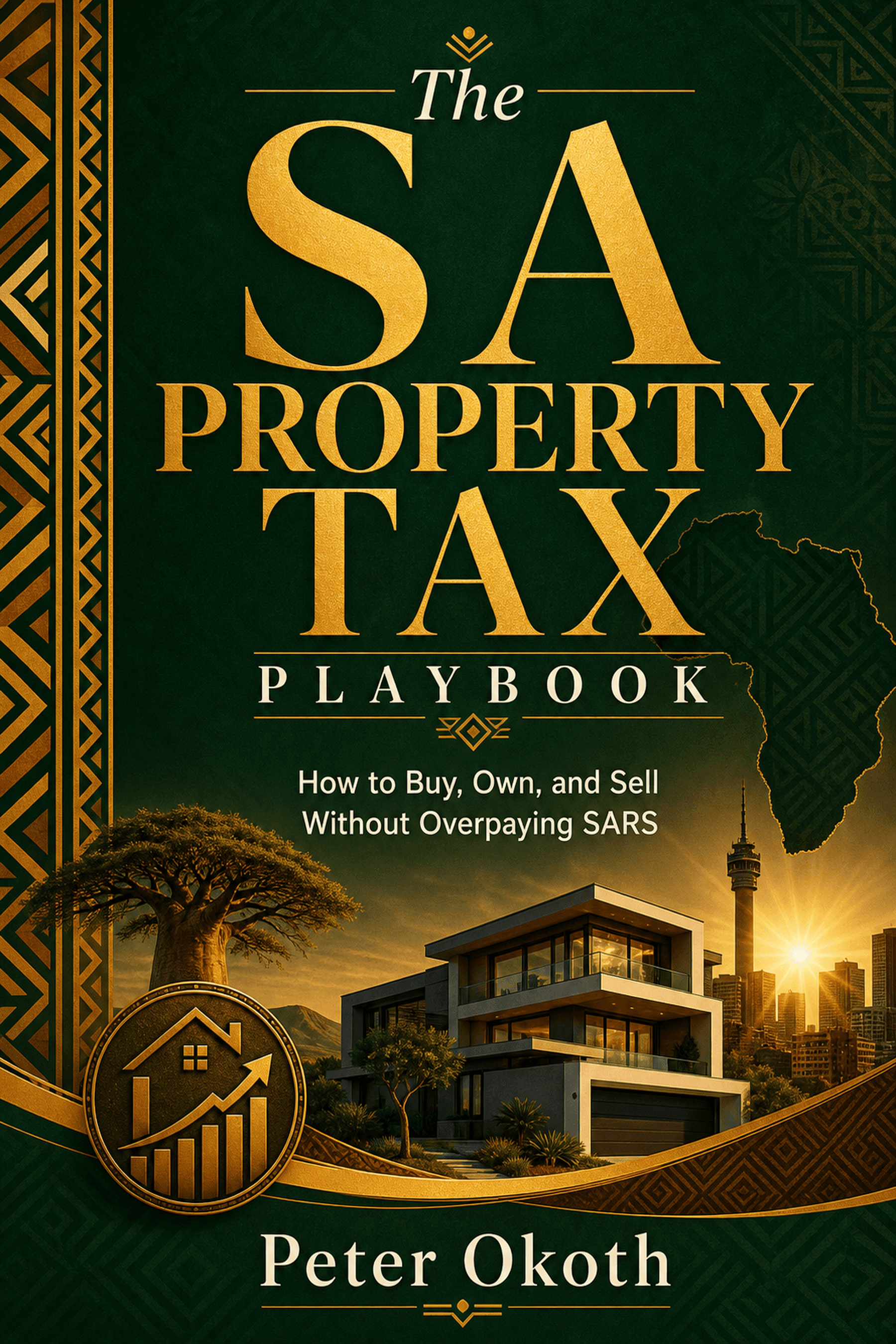
The SA Property Tax Playbook
How to Buy, Own, and Sell Without Overpaying SARS
Read the first chapter in your browser. It's free, with no account and no email needed.
Free to read. No account required.
About this book
You know about the deposit and the bond repayments, and your conveyancer mentioned transfer duty. What nobody mentions is the rest of the tax picture, including what happens when you sell, how rental income is treated, and how your choice of ownership changes everything. South African property tax is not that complicated, but it is poorly explained.
The SA Property Tax Playbook explains it in plain language. You start with the tax bill nobody warned you about, then work through transfer duty and capital gains tax when you sell. You learn how rental income is taxed, how municipal rates and body corporate levies behave, and how to compare ownership as an individual, a trust or a company.
The book also covers the primary residence exclusion, using SARS eFiling as a property owner, and a closing property tax war plan to organize what you have learned. It is education about how the rules work, not personal tax advice.
Look inside
Preface
Lindiwe bought a house in Centurion for R1.2 million. She knew about the bond repayment. She knew about the deposit. She even knew about transfer duty – her conveyancer told her.
What she did not know: she would owe SARS capital gains tax when she eventually sold the house, and the calculation was more complex than she thought. She did not know her rental income from the flatlet she built in the back was taxable – and that she should have been declaring it for three years. She did not know that her municipal rates could be challenged if the valuation was too high. She did not know that putting the property in a trust would have changed her entire tax picture.
Nobody told her. Not the agent. Not the conveyancer. Not the bank. Definitely not SARS.
This book tells you.
South Africa's property tax system is not complicated – it is just poorly explained. Transfer duty follows a clear sliding scale. Capital gains tax has generous exclusions that most people do not claim correctly. Rental income has deductions that most landlords miss. Municipal rates can be challenged. Ownership structures have tax consequences that should be decided before purchase, not after.
The difference between a property owner who understands the tax system and one who does not is tens of thousands of rand. Sometimes hundreds of thousands. Over a property-owning lifetime, it is the difference between building wealth and subsidizing it away.
Who This Book Is For
- First-time buyers who want to understand their tax obligations before they buy
- Existing homeowners who have never fully understood their property tax picture
- Small landlords renting out a room, a flatlet, or an investment property
- Anyone planning to sell who wants to minimize capital gains tax legally
- Stokvel property buyers who need to understand the tax implications of group ownership
- Anyone who looks at their municipal rates bill, their transfer duty, or their tax return and thinks "this does not look right"
What You Will Walk Away With
By the last page, you will know how to calculate transfer duty on any property purchase, how capital gains tax works and how to use the primary residence exclusion, how to declare rental income and claim every allowable deduction, how to challenge a municipal valuation that is too high, whether an individual, trust, or company ownership structure is best for your situation, and how to file everything on SARS eFiling.
Every rate, threshold, and calculation in this book reflects South African tax law as of March 2026. Where rates change annually, we give you the formula and tell you where to check for updates.
SARS is going to take its share. This book makes sure it takes exactly its share – and not a cent more.
The Tax Bill Nobody Warned You About
Lindiwe bought a three-bedroom house in Centurion in 2020 for R1.2 million. She put down a R120,000 deposit she had saved over three years, took a bond from FNB, and moved in. She built a flatlet in the back yard and rented it out for R4,500 per month – good supplementary income that helped with the bond repayments. For five years, she felt like she was building wealth.
In 2025, she decided to sell. A Midrand townhouse had caught her eye – better location, closer to work, more space. Her Centurion house was valued at R1.8 million. A R600,000 profit on a five-year hold. She started calculating how much deposit she could put down on the new place.
Then her accountant made a phone call.
First: capital gains tax. Lindiwe's R600,000 profit was not all hers. After the primary residence exclusion of R2 million (which covered her, since her gain was below that), she thought she was clear. But the flatlet complicated things. The flatlet portion of the property was not her primary residence – it was a rental property. SARS could apportion the gain, and the flatlet's share would not qualify for the full exclusion.
Second: rental income. For five years, Lindiwe had collected R4,500 per month from the flatlet tenant. That was R270,000 in rental income she had never declared to SARS. She did not know she had to. Nobody told her. Now she owed tax on that income, plus interest, plus potential penalties for non-disclosure.
Third: municipal rates. Her property was valued by the City of Tshwane at R1.4 million for rates purposes – higher than her original purchase price and higher than comparable properties on her street. She had been overpaying municipal rates for three years. She could have challenged the valuation and paid less. She did not know that was possible.
Fourth: the sale itself. Transfer duty on her new townhouse, conveyancer fees, compliance certificates, and the bond registration costs for the new property. Thousands of rand she had not budgeted for.
By the time Lindiwe's accountant finished, her R600,000 "profit" had been significantly eroded. Not by fraud. Not by bad luck. By taxes, obligations, and costs she did not know existed.
Haai. Somebody should have told her. This book is that somebody.
What You Will Learn
- Identify every tax and levy attached to buying, owning, and selling property in South Africa
- Understand which taxes apply at which stage
- Know why most property owners overpay or under-declare
- Map the rest of this book to your specific situation
The Property Tax Lifecycle
Most South Africans think of property tax as a single thing – "rates." In reality, property in South Africa attracts multiple taxes and obligations across three phases:
Phase 1: When You Buy
- Transfer duty — Tax on acquisition, paid to SARS — 0-13% on sliding scale
- Conveyancer fees — Legal fees for transfer and bond registration — R8,000-R40,000
- Deeds Office fees — Registration fees — R500-R2,000
- Bond costs — Initiation fee, valuation — R5,000-R10,000
Phase 2: While You Own
- Municipal rates — Annual property tax to municipality — R500-R3,000/month
- Body corporate levies — Sectional title management costs — R1,500-R6,000/month
- Rental income tax — Tax on income from renting out property — Your marginal tax rate
- Insurance — Building insurance (required for bonded properties) — R300-R1,500/month
Phase 3: When You Sell
- Capital gains tax — Tax on profit from the sale — 0-18% effective rate
- Agent commission — If using an estate agent — 5-7.5% of sale price
- Compliance certificates — Electrical, plumbing, gas, beetle, electric fence — R3,000-R10,000
- Rates clearance — Outstanding rates must be paid before transfer — Variable
- Bond cancellation — Penalty for early bond cancellation — R1,000-R5,000
This is the full picture. Most property owners only know about one or two of these items. By the end of this book, you will know them all – and know how to minimize each one legally.
Why Most South Africans Get This Wrong
Problem 1: Overpaying Transfer Duty
Many buyers do not know that properties below R1,100,001 attract zero transfer duty. If you are buying at or near this threshold, the difference of R1 matters. If you are buying from a VAT-registered developer, you pay VAT instead of transfer duty – and the VAT is included in the purchase price, not added on top.
Problem 2: Not Declaring Rental Income
If you rent out a room, a flatlet, a granny flat, or an entire property, that income is taxable. SARS knows this. Your tenant might be using your address for deliveries. Your bank statements show regular deposits. The question is not whether SARS will find out – it is when.
Free to read. No account required.