Free first chapter
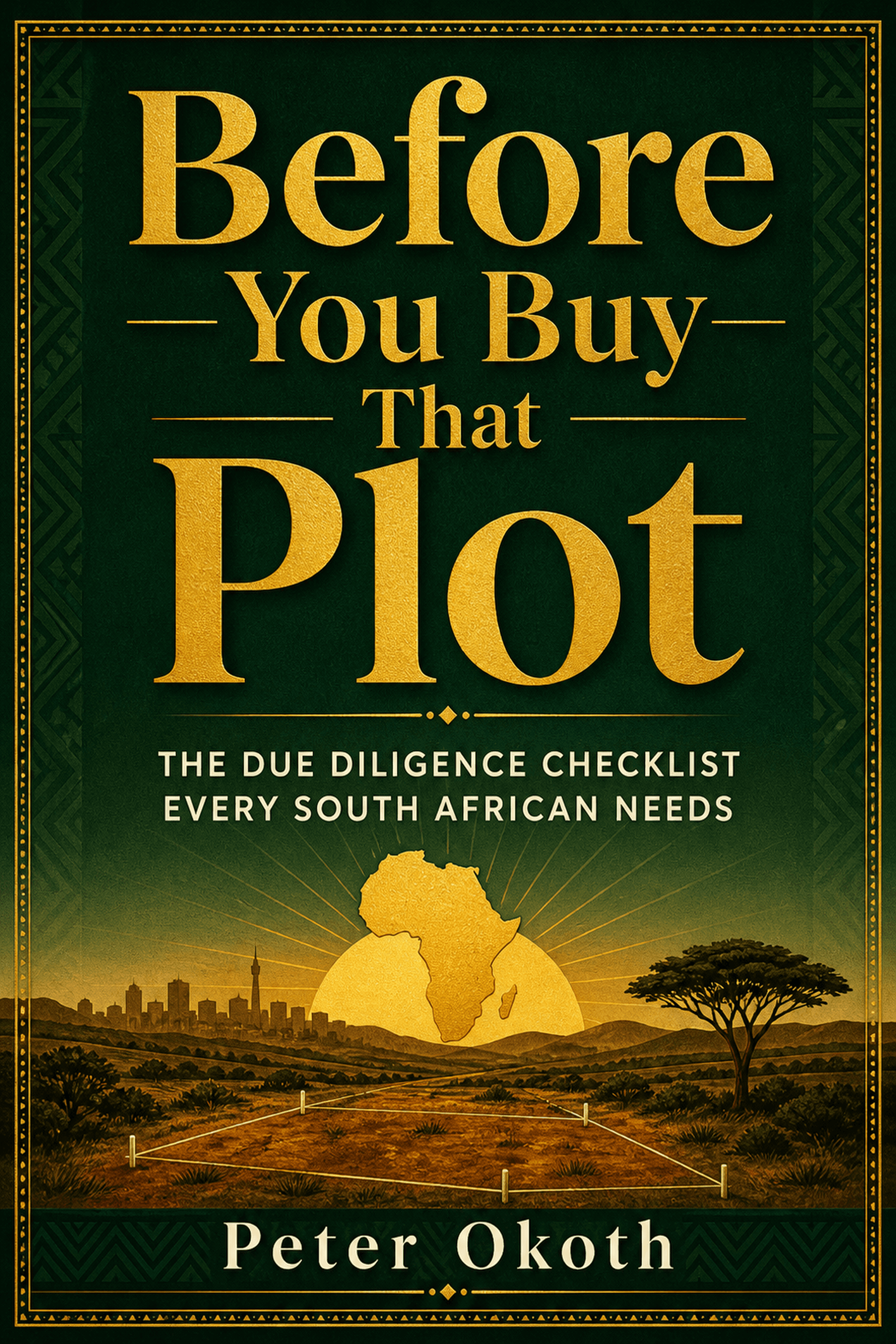
Before You Buy That Plot
The Due Diligence Checklist Every South African Needs
Read the first chapter in your browser. It's free, with no account and no email needed.
Free to read. No account required.
About this book
Every property scam in South Africa, from the forged title deed to the seller who was not the owner, could have been caught by someone who checked. The information exists, but it is scattered across government websites, brochures and advice from people who learned the hard way.
This book puts it in one place as a checklist you can follow yourself. You start with the checklist that saves everything, then learn a Deeds Office search, a seller verification protocol and a physical inspection. You see how to check the survey and boundaries, confirm municipal compliance and investigate a body corporate before you commit.
It also covers RDP and township property verification, where the formal system can be incomplete, and explains why the conveyancer is your most important hire. A master due diligence checklist at the end gives you something to use every time you consider buying. It is written in plain language for first-time buyers, experienced buyers and groups buying together.
Look inside
Preface
This book is a checklist. The most important checklist you will ever use.
Not because it is complicated – it is not. Every step in this book is something you can do yourself, with a phone, a few hundred rand, and a couple of weeks. But the property market rewards people who check, and destroys people who do not.
Every property scam in South Africa – the forged title deed, the RDP house sold illegally, the body corporate that stole the levy fund, the seller who was not the owner – could have been caught by basic due diligence. Not expert investigation. Not hiring a private detective. Just following a systematic process of verification before handing over your money.
This is that process.
We wrote this book because the information exists, but it is scattered across government websites, conveyancer brochures, estate agent training manuals, and whispered advice from people who learned the hard way. Nobody has put it all in one place, in plain language, with step-by-step instructions that any South African can follow.
Who This Book Is For
- First-time buyers who have never bought property and have no idea where to start with verification
- Township buyers purchasing in areas where the formal system is incomplete
- Experienced buyers who want a thorough, systematic process they can follow every time
- Stokvel groups buying property collectively who need a verification protocol everyone can agree on
- Anyone who has been told "just trust the agent" and knows that is not enough
What You Will Walk Away With
A ten-step due diligence protocol that covers every type of property purchase in South Africa – full title houses, sectional title units, RDP houses (after the restriction period), township properties, and vacant stands. Each step includes what to check, how to check it, what it costs, how long it takes, and what the red flags are.
Chapter 10 is a printable master checklist. Take it with you to every property transaction.
The property market does not reward trust. It rewards verification. This book makes verification easy.
The Checklist That Saves Everything
Two buyers. Same suburb in Kempton Park. Same month. Both found three-bedroom houses listed at similar prices. Both used estate agents. Both viewed the properties and liked what they saw.
Buyer A followed a checklist. Before signing the offer to purchase, she did a Deeds Office search (R200 online through WinDeed). She discovered a bond of R380,000 still registered against the property. She asked the seller about it. The seller admitted the bond was outstanding. Buyer A renegotiated – the purchase price was reduced to account for the bond settlement, and the conveyancer was instructed to settle the bond from the proceeds before transfer. Total cost of the checklist: R200 and two days. Saving: R380,000 in risk avoided.
Buyer B trusted the agent. The agent said the house was "clean." Buyer B signed the offer to purchase and paid a R50,000 deposit. During the transfer process, the conveyancer discovered a bond of R420,000 and a caveat filed by the seller's ex-spouse. The transfer could not proceed until the bond was settled and the caveat was resolved. The seller could not settle the bond. The ex-spouse refused to lift the caveat. Buyer B was stuck for 14 months – R50,000 deposit paid, no house, and legal costs mounting. She eventually recovered most of her deposit, but lost R18,000 in legal fees and 14 months of her life.
The difference between these two outcomes was not luck. It was a R200 search and a systematic process.
What You Will Learn
- Why systematic due diligence is more reliable than trust or reputation
- The 10-step due diligence protocol this book teaches
- How long each step takes and what it costs
- How to use this book for your specific situation
The 10-Step Protocol
Every property purchase in South Africa – whether it is a R500,000 RDP house or a R5 million estate property – should go through these ten verification steps before you sign the offer to purchase or pay any money.
- 1. Deeds Office search — Ownership, bonds, conditions, caveats — R50-R500 — 1-3 days
- 2. Seller verification — Identity, authority to sell, deceased estate status — Free-R200 — 1-2 days
- 3. Physical inspection — Structural condition, visible defects, improvements — Free — 1-2 hours
- 4. Survey and boundaries — Property size, boundary accuracy, SG diagram match — R3,000-R8,000 — 1-2 weeks
- 5. Municipal compliance — Building plans, zoning, outstanding accounts — R100-R500 — 1-2 weeks
- 6. Body corporate check — Financials, levies, special levies, litigation — Free (request documents) — 1 week
- 7. RDP/township check — Sale restriction status, PTO conversion, formalization — R100-R500 — 1-2 weeks
- 8. Conveyancer engagement — Transfer preparation, trust account, FICA — R8,000-R25,000 (transfer fees) — Ongoing
- 9. Bond pre-approval — Affordability confirmation — Free (bank pre-approval) — 1-2 weeks
- 10. Final review — All steps confirmed, offer to purchase prepared — Free — 1 day
Total due diligence cost (excluding conveyancer and surveyor): R250-R1,200
Total time: 2-4 weeks, running steps in parallel
This is less than 1% of the purchase price on any property over R100,000. The cost of skipping it is 100%.
How to Use This Book
Each of Chapters 2 through 9 covers one step in detail. Each chapter includes:
- What it is and why it matters
- Step-by-step instructions – exactly what to do, where to go, what to ask
- What the results look like – how to read and interpret what you find
- Red flags – what should stop the deal
- Cost and time – realistic estimates
- A step-specific checklist – items to tick off
Chapter 10 combines all step-specific checklists into a single Master Due Diligence Checklist that you can print and use for any transaction.
Priority Guide
Not every step applies to every purchase:
- Buying a full title house: Steps 1-5, 8-10 (skip 6 and 7)
- Buying a sectional title unit: Steps 1-3, 6, 8-10 (skip 4-5 unless vacant land; step 7 only if relevant)
- Buying an RDP or township property: All steps, especially 7
- Buying vacant land: Steps 1-2, 4-5, 8-10
Your Checklist
- ☐ — I know which steps apply to my purchase type — Full title, sectional title, RDP, or vacant land
- ☐ — I have set aside R500-R1,000 for due diligence costs — Deeds Office search, municipal checks
- ☐ — I have allowed 2-4 weeks for the process — Before signing or paying anything
- ☐ — I have identified which chapter to read first — Based on my purchase type
Your Move
- Do not sign the offer to purchase yet. Complete at least Steps 1-3 before committing.
- Start with Chapter 2 – the Deeds Office search. This single step catches the majority of fraud and problems.
- Run steps in parallel where possible. While waiting for the Deeds Office search results, you can do the physical inspection and request body corporate documents.
Key Terms
Due diligence
Offer to purchase (OTP)
Deeds Office search
What is Next
Chapter 2 takes you through the most important single step in the protocol: the Deeds Office search. This is the step that catches forged title deeds, undisclosed bonds, ownership disputes, and restriction violations. It costs less than R500 and takes less than three days. There is no excuse for skipping it.
The Deeds Office Search Masterclass
If you learn one thing from this entire book, learn this: do a Deeds Office search before you pay for any property. It is the single most effective protection against property fraud in South Africa. It takes one to three days. It costs R50-R500. And it would have prevented the majority of property fraud cases that South African courts deal with every year.
Free to read. No account required.