Free first chapter
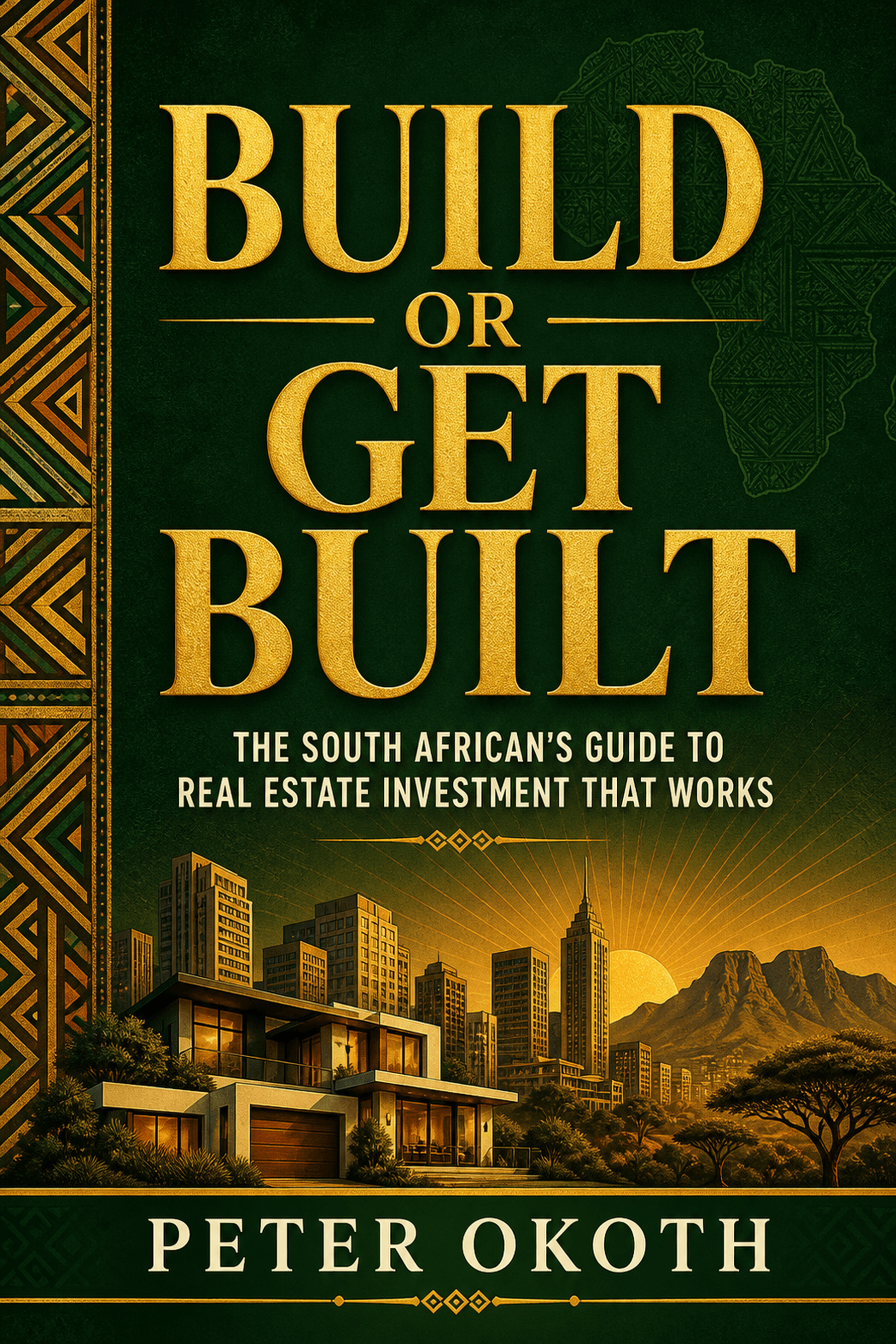
Build or Get Built
The South African's Guide to Real Estate Investment That Works
Read the first chapter in your browser. It's free, with no account and no email needed.
Free to read. No account required.
About this book
Property is often called the safe road to wealth, but the picture painted online skips the real work: choosing a location, running the numbers, finding tenants, and covering maintenance. If you want to invest in South African property, you need to know whether the maths works before you sign anything.
Build or Get Built is about the maths. You start with why property and why now, then work through the investment calculations many people skip. You will learn how to analyse a location, calculate rental yield, and understand funding through bonds, stokvels, and creative structures. The book gives the full picture on buy-to-let, compares building with buying, and takes a careful look at township property as an emerging asset class. A chapter covers the tax side of owning rentals.
Look inside
Preface
There is a woman in Soweto who owns four rental properties. She bought the first one in 2018 for R280,000 – a small house she fixed up and rented to a young couple for R3,500 a month. She used the rental income to help service the bond on her second property. Then a third. Then a fourth. Her rental income now exceeds her salary as a school administrator.
She did not inherit money. She did not have a rich husband. She did not get lucky on the stock market. She bought property systematically, in locations where the numbers worked, using funding structures that were available to her. She is not a genius. She just understood the math.
This book is about the math.
South Africa's property market is massive, diverse, and full of opportunity for investors who understand how it actually works. Not the Instagram version – "passive income from property!" – but the real version: location analysis, rental yield calculations, tenant management, maintenance costs, tax implications, and the hard work of building a portfolio one property at a time.
Who This Book Is For
- First-time property investors who own (or are buying) a primary residence and want to add investment properties
- Small landlords with one or two rental properties who want to scale intelligently
- Stokvel groups exploring property as a collective investment
- Township residents who see property investment as a path to generational wealth
- Anyone who has heard "buy property" as investment advice and wants to know if the numbers actually work
What You Will Walk Away With
By the last page, you will know how to evaluate any property as an investment using real math – not gut feeling. You will know where in South Africa rental yields are strongest, how to fund investment properties through bank bonds and creative structures, how to manage tenants and properties profitably, how build-vs-buy compares in the current market, why township property is an emerging investment category, and how to structure your ownership and taxes for maximum after-tax return.
Every number in this book is calculated from real South African market data as of 2026. Every strategy has been used by actual South African investors. Where markets change, we give you the formula and tell you where to get updated data.
Property does not make you rich. The math behind property makes you rich. This book teaches you the math.
Why Property – And Why Now
Thembi teaches at a primary school in Soweto. She earns R28,000 a month. She drives a ten-year-old Polo. She does not wear designer clothes or eat at fancy restaurants. By every visible measure, she looks like a regular middle-class South African.
She owns four rental properties worth a combined R1.8 million. They generate R14,000 a month in net rental income after bond repayments, rates, and maintenance. That rental income is half her teaching salary – earned while she sleeps.
She started in 2018 with one property: a two-bedroom house in Protea Glen that she bought for R280,000. She put down R28,000 (10% deposit) and took a bond from Capitec for R252,000. Her bond repayment was approximately R2,800 per month. She rented the house for R3,500. After rates and maintenance, she was making roughly R400 per month in cash flow. Not much – but the property was paying for itself while appreciating in value.
She used the equity in that first property, plus savings from her salary and rental income, to buy a second property two years later. Then a third. Then a fourth. Each purchase followed the same formula: find a property where the rental yield covers the bond repayment plus costs. Buy it. Rent it. Let the tenant pay off the bond. Repeat.
Thembi is not a financial genius. She understands one thing: the math of property investment in South Africa favours the buyer who understands leverage, yield, and time.
This book teaches you that math.
What You Will Learn
- Why property investment works in South Africa
- How property compares to other SA investment options
- Why leverage is the property investor's greatest advantage
- Who should invest in property (and who should wait)
The Case for Property
1. Leverage – The Multiplier
When you invest R100,000 in shares on the JSE, you own R100,000 worth of shares. If they grow by 10%, you have R110,000. Your return: R10,000.
When you invest R100,000 as a deposit on a R1,000,000 property, you control R1,000,000 worth of property. If it grows by 10%, the property is worth R1,100,000. Your equity: R200,000 (your R100,000 deposit plus R100,000 in appreciation). Your return on your R100,000 investment: 100%.
That is leverage. A bank will lend you 90% of a property's value. They will not lend you 90% to buy shares. This asymmetry is what makes property the primary wealth-building tool for ordinary South Africans.
Of course, leverage works both ways. If the property drops 10% in value, your equity goes from R100,000 to R0. The risk is real. But over any 10-year period in South African history, residential property values have increased. The key is time – and not being forced to sell in a downturn.
2. Rental Income – The Bond Gets Paid by Someone Else
Shares do not pay your bond. A tenant does.
When Thembi bought her first property for R280,000, her bond repayment was R2,800 per month. Her tenant paid R3,500 per month. After rates (R300) and maintenance (R200 average), she had R200 left over. But the real value was not the R200 surplus. The real value was that her tenant was paying off R2,800 per month of her bond – building Thembi's equity in the property without Thembi paying from her salary.
After five years, the bond balance had decreased by approximately R70,000, and the property had appreciated by approximately R120,000. Thembi's total return – from a R28,000 deposit – was nearly R190,000. That is a return of over 670% on her initial investment over five years.
No unit trust, no savings account, and no stokvel payout delivers those returns.
3. Tangible and Controllable
Property is real. You can see it, touch it, improve it. If the paint is peeling, you can repaint it and increase the rental value. If the area is improving, your property appreciates. If you add a room or a flatlet, you create more rental income.
You cannot repaint a share certificate. You cannot add a room to an ETF.
This tangibility is why South Africans – particularly Black South Africans for whom property ownership was denied for generations – connect with property as an investment. It is generational wealth you can point to.
Property vs Other SA Investments
- Residential property — 5-8% appreciation + 5-10% rental yield — Yes (90% bond) — Yes (rent) — High — R28,000+ (deposit)
- JSE Top 40 ETF — 8-12% total return — No — Yes (dividends, ~3%) — None — R500+ (Easy Equities)
- Money market fund — 7-9% (interest rate dependent) — No — Yes (interest) — None — R500+
- Stokvel (savings) — 0% real (inflation erodes) — No — No — Medium — R100+/month
- Fixed deposit — 8-10% — No — Yes (interest) — None — R1,000+
The table shows why property is different: leverage. Without leverage, property returns (5-8% appreciation) are competitive but not exceptional. With leverage – buying a R1 million property with R100,000 of your own money – the returns on your invested capital are dramatically higher.
Free to read. No account required.