Free first chapter
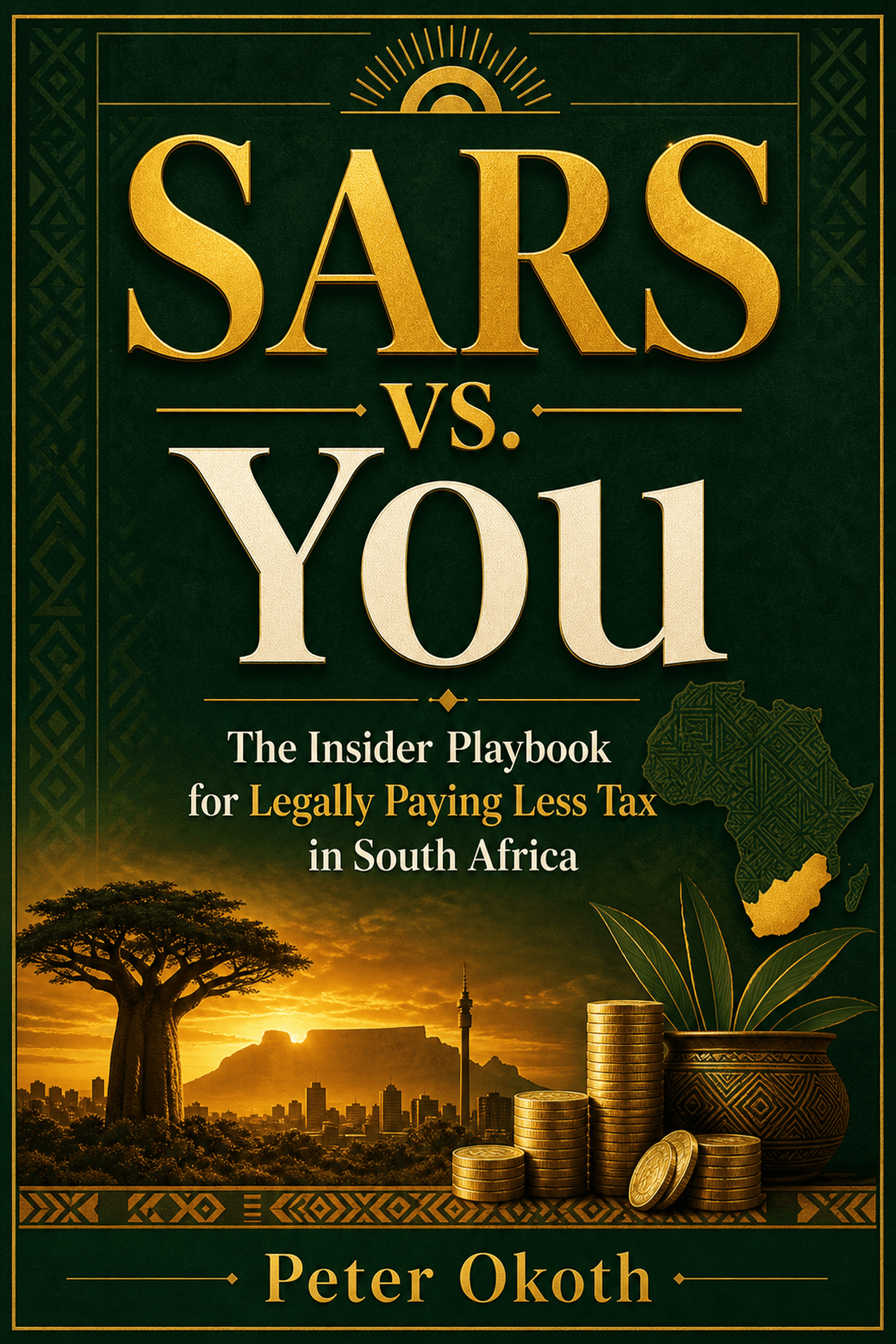
SARS vs. You
The Insider Playbook for Legally Paying Less Tax in South Africa
Read the first chapter in your browser. It's free, with no account and no email needed.
Free to read. No account required.
About this book
You may be paying more tax than you need to, simply because nobody explained the legal options. The rules are public, but they are written in a way that most people never get around to reading.
SARS vs. You is a practical guide to understanding the South African tax system well enough to use the deductions, thresholds, and structures the law already provides. It opens with how SARS really works, then helps you get set up properly with your tax number and eFiling. You will decode income tax and PAYE, compare Turnover Tax and VAT, and learn which deductions are allowable. The book explains TFSAs and retirement annuities, looks at strategies for different sectors, and covers freelance and digital income.
It also prepares you for SARS audits and disputes, and ends with a tax planning calendar for the year. This is general education, so check your own circumstances with a registered tax practitioner.
Look inside
Preface
You are not paying too much tax because you earn too much. You are paying too much tax because nobody ever showed you the legal options sitting right in front of you.
This book is not about breaking the law. It is not about hiding money. It is about understanding the South African tax system well enough to use every deduction, every threshold, and every structure the law already provides — the same ones the Big Four accounting firms use for their wealthiest clients.
Every year, millions of South Africans hand the South African Revenue Service (SARS) more money than they legally owe. Not because they are generous — because nobody taught them otherwise. The Income Tax Act, the VAT Act, and the Tax Administration Act are all public documents. The allowable deductions are written in plain English. The thresholds and exemptions are published on the SARS website. But somehow, this information never reaches the people who need it most.
Eish — that ends here.
Who This Book Is For
- Salaried professionals who watch PAYE eat their payslip every month and wonder if there is another way
- Small business owners drowning in provisional tax, VAT confusion, and Turnover Tax questions
- Freelancers and online earners making money from clients abroad and hoping SARS does not notice
- Side hustlers turning a profit but filing nothing
- Anyone who has ever received a SARS penalty and thought, "I did not even know I owed that"
What You Will Walk Away With
By the last page, you will know exactly how your taxes are calculated, which deductions you qualify for, how to file correctly on eFiling, how to handle an audit without panicking, and how to structure your income so you keep more of what you earn — all within the law.
Every strategy in this book is legal. Every number is based on South African tax law as of March 2026. Where rates and thresholds change, we tell you exactly where to check for updates.
Let us get into it.
How SARS Really Works
Lindiwe runs a hair salon in Soweto. Four stylists, a small reception area, loyal customers. She pulls about R28,000 per month in revenue — solid for a township salon.
Two years ago, a man in a sharp suit walked into her shop and offered to "handle SARS" for her. He said he was a tax consultant. He charged her R800 per month, showed up once every few months to "check things," and told her not to worry.
Last month, Lindiwe needed a tax compliance status — a confirmation from the South African Revenue Service (SARS) that all her tax obligations are current. She needed it to bid on a Gauteng provincial government contract to supply hair products to a skills training centre. Big opportunity. R600,000 contract.
She logged into eFiling — SARS's online tax management system — for the first time. What she found made her stomach drop.
The "consultant" had been filing nil returns for 24 months. Zero income declared. Zero tax paid. Meanwhile, her FNB business account transactions and her SnapScan and Yoco payments were fully visible to SARS — every payment from every customer, sitting in their system. SARS's records showed income. Her returns showed nothing. The mismatch had triggered penalties. She owed R32,000 in penalties alone, plus the actual tax she should have been paying all along.
The R19,200 she had paid the consultant over two years? Gone. The government contract? She could not get the tax compliance status. Gone too.
Eish. Here is what Lindiwe did not know — and what this chapter will teach you.
What You Will Learn
- Identify exactly which taxes apply to your specific income type
- Describe the main tax categories in South Africa and when each one kicks in
- Explain the difference between tax avoidance (legal, smart) and tax evasion (criminal, stupid)
- Navigate SARS's structure so you know who to deal with and where to go
- Read a basic tax obligation summary without your eyes glazing over
Why This Matters
Every year, SARS collects over R2 trillion in taxes. Some of that money comes from you — whether you know it or not.
If you are employed, your employer deducts PAYE (Pay As You Earn) from your salary before you see it. If you run a business, you owe income tax or Turnover Tax on your revenue. If you sell goods or services above a certain threshold, you owe VAT (Value Added Tax). If you rent out property, you owe income tax on that rental income. If you sell property or shares, you owe capital gains tax. If you receive dividends from a company, dividends tax has already been deducted.
The problem is not that these taxes exist. The problem is that most South Africans do not understand which ones apply to them, how much they actually owe, and — critically — how much they could legally avoid paying.
That ignorance is expensive. Lindiwe's situation is not unusual. Thousands of South Africans are either paying the wrong amount, paying the wrong tax, or paying nothing and hoping SARS does not notice. All three approaches end badly.
This chapter maps the entire terrain. By the end, you will know exactly what SARS collects, which of those taxes apply to you, and where the legal boundaries sit.
The Taxes Every South African Should Understand
The Reality
Walk into any spaza shop, salon, or shisa nyama in Mzansi and ask the owner what taxes they pay. Most will say "SARS" — as if SARS is a single tax. It is not. SARS is the collector. The taxes themselves are different animals with different rules, different rates, and different deadlines.
Not knowing the difference is how people like Lindiwe end up in trouble. Her salon should have been paying Turnover Tax or income tax on her profits. Instead, her fake consultant filed nil income tax returns — the wrong approach entirely.
How It Actually Works
SARS collects several categories of tax. Here is what each one is and when it applies to you.
1. Income Tax (Including PAYE)
This is the big one. If you earn money in South Africa, you owe income tax. But "income tax" covers several sub-types:
- PAYE — Salaried employees — 18% to 45% (graduated brackets) — Deducted by your employer before you get paid
- Business income tax (individuals) — Self-employed individuals, sole proprietors — 18% to 45% on taxable profits — You calculate profit, file an annual return, pay tax
- Company income tax (CIT) — Registered companies (Pty Ltd) — 27% flat rate on taxable profits — Company calculates profit, files annual return, pays tax
- Turnover Tax — Micro businesses (under R2.3M annual turnover) — 0% to 3% graduated on turnover (first R600,000 tax-free) — A simplified alternative — no deductions, just a percentage of everything you earn
Last verified: March 2026. Check the SARS website (sars.gov.za) for current rates.
Here is what most people get wrong: they think income tax is only PAYE. If you are employed AND you rent out a flat AND you do freelance work on the side, you have three income streams — and each one has tax implications. PAYE alone does not cover it.
2. Value Added Tax (VAT)
VAT is a 15% tax on most goods and services. If your business turns over more than R1 million per year, you must register for VAT. Once registered, you charge 15% on top of your prices, collect it from your customers, and remit it to SARS — minus the VAT you paid on your own business purchases (called input VAT).
Quotes to share
The rules are public, but they are written in a way that most people never get around to reading.
Free to read. No account required.