Free first chapter
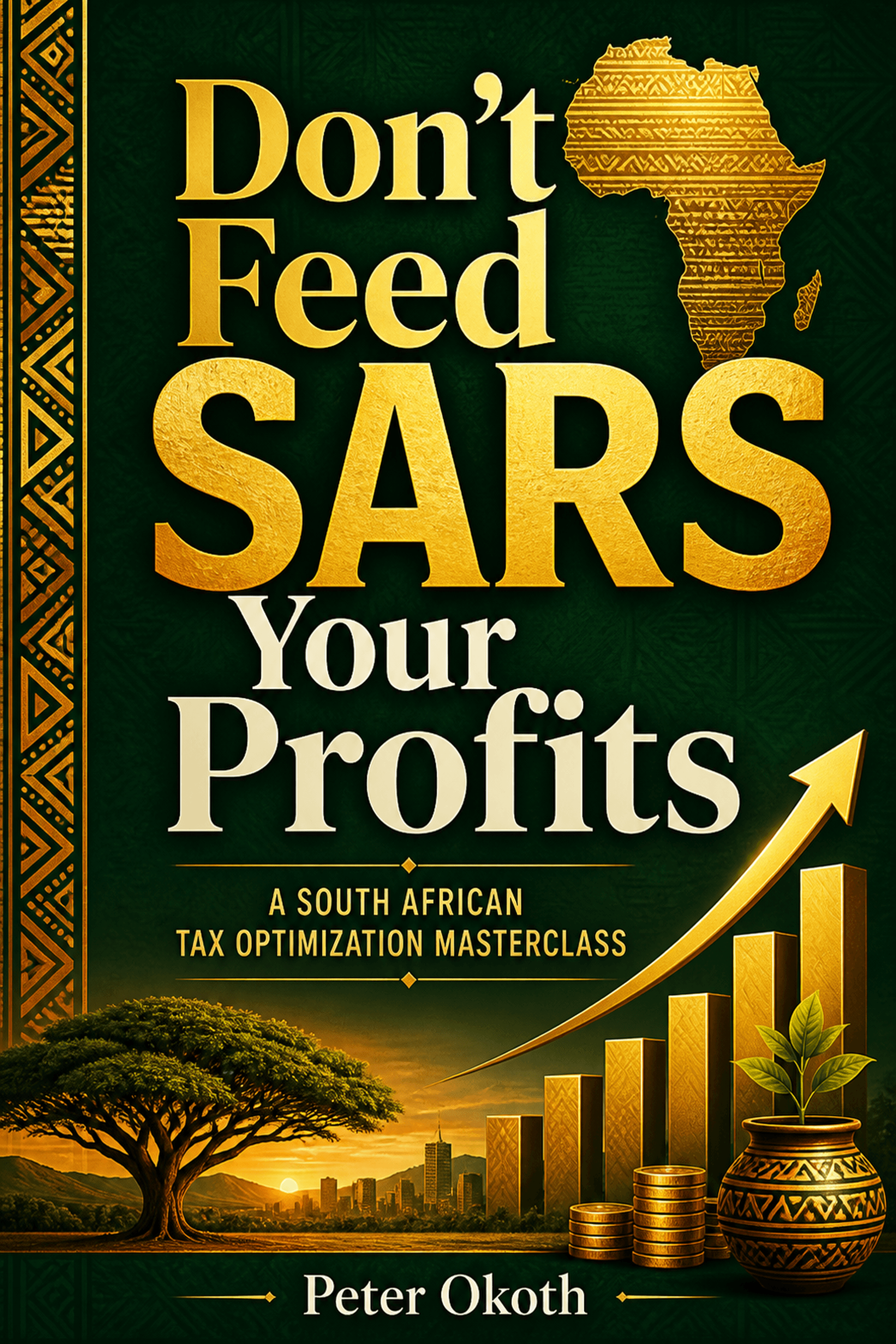
Don't Feed SARS Your Profits
A South African Tax Optimization Masterclass
Read the first chapter in your browser. It's free, with no account and no email needed.
Free to read. No account required.
About this book
Being compliant means giving SARS what it asks for. Optimizing means understanding exactly what you are entitled to and planning around it. If you already file your returns and know the basics, this is the next step up.
Don't Feed SARS Your Profits is a masterclass for readers who are already tax-literate. It begins with the optimization mindset, then looks at entity structure and how it affects tax. You study retirement annuity deductions, Section 12J and other investment incentives, and turnover tax in depth. The VAT input and output chapter, provisional tax strategy, and assessed losses with carryforwards show how the pieces fit together over time.
A further chapter covers international income and expat tax, and the final chapter helps you build your own optimization system. It is written around South African law and rates, and it is education rather than personal tax advice, so you can have an informed conversation with your adviser. It assumes you are ready for depth.
Look inside
Preface
If you are reading this book, you already know the basics. You file your returns. You pay your tax. You are compliant.
But compliant is not the same as optimized. Compliance means giving SARS what they ask for. Optimization means giving SARS exactly what they are entitled to — and not a single Rand more.
The difference between a compliant taxpayer and an optimized taxpayer at R1.5 million annual income is roughly R80,000 to R150,000 per year. That is not a rounding error. That is a deposit on a property. That is a year of retirement annuity contributions that will compound for decades. That is the difference between building wealth and running in place.
This book is the masterclass. It covers entity structuring, retirement annuity maximization, investment incentives, provisional tax strategy, assessed losses, and international income planning. Every strategy is legal, every number is current, and every move is backed by a specific section of the Income Tax Act.
This is not for beginners. If you need the tax system explained from scratch, start with SARS vs. You (Book 1). If you want basic business strategies, see What SARS Doesn't Tell You (Book 2). This book assumes you are tax-literate and ready to build a system.
Who This Book Is For
- High-income professionals in the 41-45% marginal bracket who want to bring their effective rate below 30%
- Business owners earning R500,000+ who want structural optimization, not just deduction-hunting
- Investors with multiple income streams who want to shelter growth legally
- Expats and semi-emigrants navigating SA tax residency and the exit charge
What You Will Walk Away With
A Tax Optimization System — an annual review framework you run every February and July to evaluate your structure, contributions, and timing. The system pays for this book many times over, every year.
The Optimization Mindset
Nomvula is a management consultant in Durban. She left a corporate job three years ago to start her own practice. Last year, she billed R1.8 million. After business expenses — office rent, a virtual assistant, software subscriptions, travel — her taxable income was R1.4 million.
Her tax bill: R437,000. Effective tax rate: 31%. Marginal rate: 41%.
Nomvula paid every Rand she owed. She was compliant. She was also leaving roughly R150,000 per year on the table.
Here is what she was not doing:
- She was not maximising her retirement annuity contribution. She contributed R5,000 per month (R60,000/year). Her deductible limit was R350,000. That unused R290,000 in potential RA contributions was costing her R119,000 in tax savings she never captured.
- She was operating as a sole proprietor at a 41% marginal rate when a Pty Ltd at 27% CIT would have saved her money on retained profits.
- She was not claiming her home office deduction — she worked from home three days a week.
- She had never heard of the Section 12J venture capital deduction or explored energy efficiency incentives.
After a session with a tax advisor (not the compliance accountant who filed her returns — a strategic advisor), Nomvula restructured. Within one tax year, her effective rate dropped from 31% to 22%. She saved R126,000. Same income. Same business. Different approach.
Here is the mindset that made the difference.
What You Will Learn
- Distinguish between tax compliance (filing correctly) and tax optimization (filing strategically)
- Identify the four pillars of legal tax optimization: structure, deductions, timing, and investment vehicles
- Calculate your current effective tax rate and set a target
- Understand the anti-avoidance rules so you never cross the line
- Map your personal optimization opportunities before diving into specific strategies
Compliance vs. Optimization
Most South Africans — and most South African accountants — focus on compliance. Did you file on time? Did you pay the right amount? Is SARS happy?
Compliance is the floor. Optimization is the ceiling.
Compliance means: I calculated my tax correctly and paid what I owed.
Optimization means: I structured my affairs so that what I legally owe is the minimum amount permitted by the Income Tax Act.
Both are legal. Both are ethical. The difference is that compliance accepts the tax bill as given, while optimization actively uses the tools in the tax code — deductions, rebates, entity structures, timing, and investment vehicles — to reduce it.
Every strategy in this book is on the optimization side of the line. Nothing in these pages requires you to hide income, fake invoices, or misrepresent anything to SARS. It requires you to know the law better than the average taxpayer — and to act on that knowledge.
The Four Pillars
Every tax optimization strategy in South Africa fits into one of four categories:
1. Structure
How your income is earned and through which entity. A sole proprietor at R1.4 million taxable income pays a 41% marginal rate. A Pty Ltd pays 27% CIT on the same profit. A combination of salary and retained earnings can reduce the blended rate further. Chapter 2 covers this.
2. Deductions
What you subtract from taxable income before tax is calculated. Retirement annuity contributions (up to R350,000/year), medical aid credits, wear-and-tear allowances, home office deductions, learnership allowances, and Section 11A pre-trade expenditure. Chapters 3-4 cover these.
3. Timing
When you make payments, claim deductions, and trigger tax events. A lump-sum RA contribution in February (before tax year-end) versus spreading it over 12 months can change which tax year captures the deduction. Provisional tax timing affects interest charges. Chapters 5-7 cover these.
4. Investment Vehicles
Where you put money so it grows tax-free or tax-efficiently. TFSA (completely tax-free), retirement annuities (tax-deductible going in, tax-deferred on growth), Section 12J VCC investments (100% deductible), and endowment policies (taxed inside the policy at a flat 30%). Chapters 3-4 cover these.
Your Current Tax Position
Before you optimize anything, you need to know your starting point. Fill in this worksheet:
- Annual gross income — R
- Less: allowable deductions currently claimed — R
- Taxable income — R
- Tax paid last year (from assessment) — R
- Effective tax rate (tax ÷ gross income) — %
- Marginal tax rate (from brackets) — %
Your effective rate is the number you are trying to reduce. Your marginal rate tells you how much each additional Rand of deduction saves you — if your marginal rate is 41%, every R1,000 in additional deductions saves you R410.
Your Checklist
- ☐ — I know my effective tax rate — Tax paid ÷ gross income
- ☐ — I know my marginal tax rate — From the tax brackets
- ☐ — I have listed my current deductions — RA, medical, pension, others
- ☐ — I understand the four pillars — Structure, deductions, timing, investment vehicles
- ☐ — I know the difference between compliance and optimization — Filing correctly vs filing strategically
Your Move
- Calculate your effective tax rate from your last SARS assessment.
- Set a target. If your effective rate is 31%, aim for 25%. If it is 25%, aim for 20%. Each chapter in this book will chip away at the gap.
- List every deduction you currently claim. We will identify the gaps in the chapters that follow.
Key Terms
Effective tax rate
Marginal tax rate
Tax optimization
What is Next
The first and most impactful optimization is structural. In Chapter 2, we examine whether your current business entity — sole prop, Pty Ltd, trust, or personal service provider — is the most tax-efficient vehicle for your income. For many readers, this single chapter will identify the biggest saving.
Entity Structure for Tax Efficiency
Dr. Khumalo is a specialist physician in Johannesburg. He earns R2.4 million per year from his private practice. He operates as a sole proprietor. His marginal tax rate: 45%. His effective tax rate: 37%. His annual tax bill: approximately R888,000.
Quotes to share
Being compliant means giving SARS what it asks for.
Optimizing means understanding exactly what you are entitled to and planning around it.
Free to read. No account required.