Free first chapter
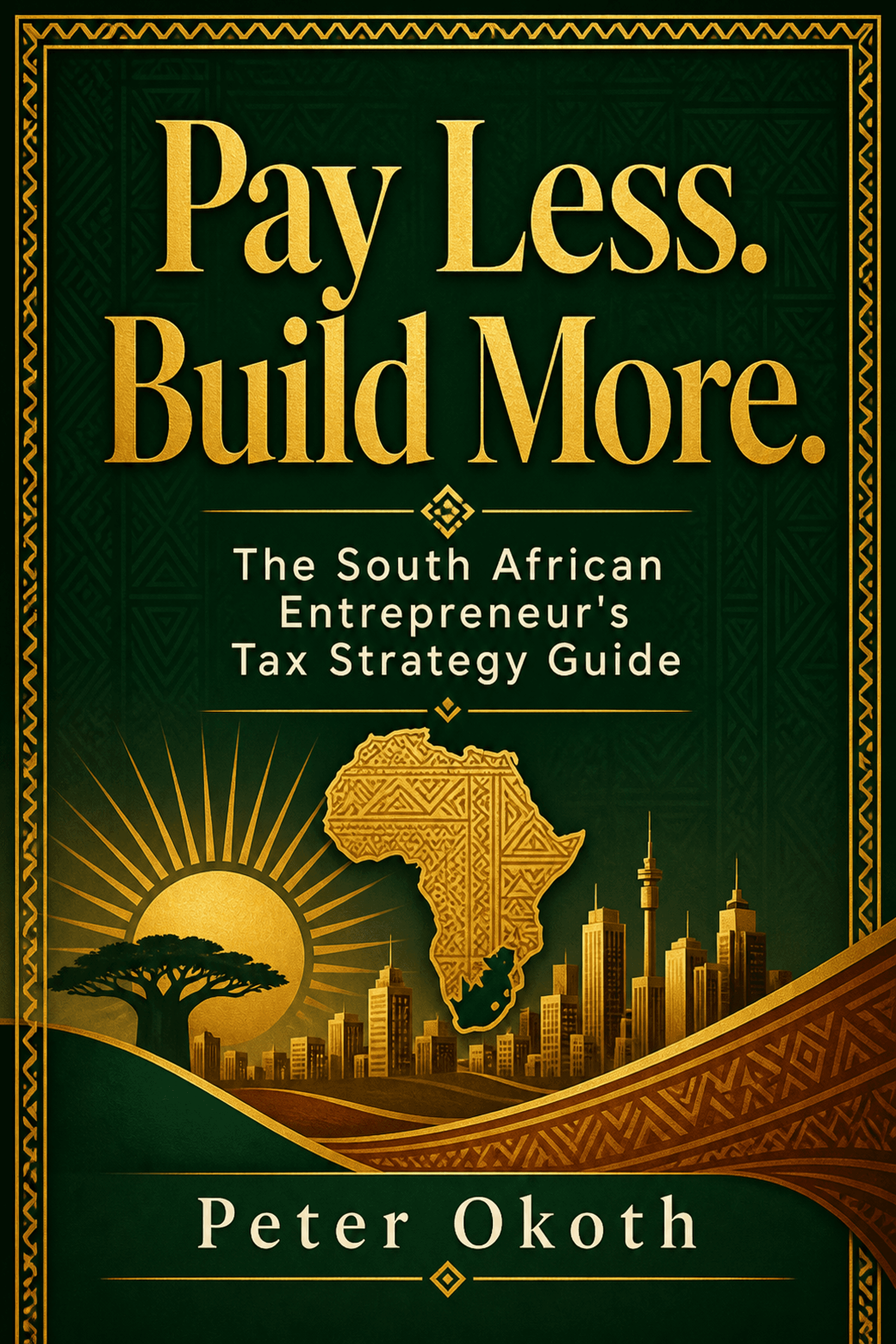
Pay Less. Build More.
The South African Entrepreneur's Tax Strategy Guide
Read the first chapter in your browser. It's free, with no account and no email needed.
Free to read. No account required.
About this book
Starting a business in South Africa is hard enough without the paperwork piling up. Between CIPC registration, SARS eFiling, UIF, SDL, provisional tax and the Turnover Tax decision, a new entrepreneur faces a month of obligations before the first profit arrives.
This book explains how tax works before you need to know. It begins with the entrepreneurial tax reality, then helps you think through choosing a business structure and walks through CIPC registration and SARS setup. You learn how Turnover Tax works for startups, which deductions entrepreneurs often miss, and how BEE scoring and tax benefits fit into the picture.
Later chapters cover hiring and payroll tax, scaling from sole proprietor to Pty Ltd, and tax planning for growth. It ends with a first-year tax roadmap, with real rand examples throughout. Whether you run a spaza shop in Mamelodi or a consultancy in Sandton, you get a clear map to take to your accountant, so you can ask better questions.
Look inside
Preface
Starting a business in South Africa is hard enough without SARS making it harder.
Between CIPC registration, SARS eFiling setup, UIF, SDL, provisional tax, and the Turnover Tax decision, a new entrepreneur faces more compliance obligations in their first month than most employees face in a decade. Get it wrong and the penalties start before the profits do.
This book exists because nobody teaches South African entrepreneurs how tax works before they need to know. Business schools talk strategy. YouTube talks motivation. But nobody sits you down and says: "Here is exactly what happens with SARS when you start earning, here is what it costs, here is when to pay, and here is how to set it up so you keep more of what you build."
That is what this book does. From your first CIPC registration to your first annual return, every step is mapped, every deadline is listed, and every decision is framed with real Rand numbers.
Whether you are running a spaza shop in Mamelodi, a tech startup in Woodstock, or a consulting practice in Sandton — the tax system treats you all the same. Understanding it is the difference between building something that lasts and funding SARS's next office renovation.
Mzansi needs more businesses, not more tax casualties. Pay less. Build more.
Who This Book Is For
- New entrepreneurs registering their first business and overwhelmed by SARS obligations
- Side hustlers going full-time and needing to formalize
- Township business owners moving from informal to formal
- Sole proprietors wondering if Pty Ltd conversion would save them money
- Stokvel groups considering formalizing into a business entity
What You Will Walk Away With
A First-Year Tax Roadmap — a month-by-month guide from CIPC registration through your first annual return, with every form, every deadline, and every estimated cost. Plus the confidence to handle SARS yourself, at least until the business is big enough to justify a tax practitioner.
The Entrepreneurial Tax Reality
Sipho started fixing mobile phones from his grandmother's house in Khayelitsha. A small table, a heat gun, a set of precision screwdrivers, and a talent for bringing dead screens back to life. Word spread. Within a year, he was repairing 15 phones a day at R350 each. Revenue: about R80,000 per month.
He was proud. He was building something. He told everyone he was a business owner.
Then the SARS letter arrived.
Not a fine. Not yet. A "notice of non-compliance." SARS had matched his FNB account activity — regular deposits of R2,000 to R5,000 from SnapScan and EFT payments — against his tax records. There were no records. Sipho had never registered as a taxpayer for his business. He had never filed a return. He had never paid a cent of income tax on his R960,000 annual revenue.
The notice estimated his tax liability at R127,000 — based on SARS's own calculation of his profit. They added R47,000 in penalties and interest. Total demand: R174,000.
Sipho did not have R174,000. He had R22,000 in savings. His business, which had been funding his life and his family's needs, suddenly had a debt that could destroy everything he had built.
Eish. Here is what Sipho did not know — and what this chapter will teach you.
What You Will Learn
- Identify every tax obligation that kicks in the moment you start earning business income
- Understand the registration requirements at SARS and CIPC
- Know the deadlines and penalties for non-compliance
- Map the tax journey from first sale to first annual return
- Avoid the common traps that destroy new South African businesses
Why This Matters
South Africa needs entrepreneurs. The country's unemployment rate is above 30%. Every person who starts a business — from a spaza shop in Mamelodi to a tech startup in Woodstock — is part of the solution.
But the tax system does not wait for you to figure it out. The moment you earn business income, you have obligations. Miss them, and SARS does not care that you are creating jobs. They will issue penalties, charge interest, and — in serious cases — pursue criminal prosecution.
This book is a shield. It protects your business by making sure SARS never has a reason to come after you — and that you never pay more than the law requires.
What Happens the Moment You Start Earning
As a Sole Proprietor (No Company Registration)
If you start earning business income without registering a company — like Sipho — your obligations are:
- Register with SARS. You need a tax reference number if you do not have one (Chapter 3 walks through this). If you already have one from employment, you need to add "provisional tax" to your registered tax types.
- Pay provisional tax. As a self-employed person, you must make advance income tax payments twice a year — in August and February. Failure to register and pay provisional tax is the single most common mistake new entrepreneurs make.
- File an annual income tax return. Due during the filing season (typically July-November). You declare all business income and claim deductions for business expenses.
- Register for VAT if turnover exceeds R1 million. Below R1 million, VAT registration is voluntary. Above R1 million, it is mandatory.
- Consider Turnover Tax if turnover is below R2.3 million. A simpler alternative that replaces income tax, VAT, and provisional tax with a single graduated tax on turnover.
As a Pty Ltd Company
If you register a company at CIPC (Companies and Intellectual Property Commission), additional obligations apply:
- Register the company with SARS for company income tax (CIT).
- Register for PAYE, UIF, and SDL if you have employees — including yourself if you draw a salary from the company.
- File monthly EMP201 returns if you have employees.
- File an annual company income tax return (ITR14).
- File an annual CIPC return and keep the company in good standing.
The Timeline That Matters
- First business sale — Register with SARS — Within 60 days — Penalties and interest from SARS
- Revenue hits R1 million — VAT registration — Within 21 days — 10% penalty on VAT owed
- First employee hired — PAYE/UIF/SDL registration — Before first salary payment — Penalties on late submissions
- Six months into tax year — First provisional tax payment — End of August (for Feb year-end) — Interest on underpayment
- End of tax year — Second provisional tax payment — End of February — Interest on underpayment
- Filing season — Annual income tax return — July-November — Administrative penalties
Last verified: March 2026.
Common Trap: "I Will Sort Out Tax When the Business Is Bigger"
This is the trap that caught Sipho. SARS does not have a "starter discount." The obligations apply from the first Rand of business income. The longer you wait to register and file, the bigger the penalty pile becomes — and unlike the business itself, tax penalties compound.
The rule: Register with SARS before you make your first sale, or within 60 days of starting to earn. It costs nothing. It takes less than an hour. It prevents the SARS letter that can destroy your business.
Your Checklist
- ☐ — I know my business structure (or intended structure) — Sole prop or Pty Ltd
- ☐ — I know my approximate annual revenue — Or expected revenue
- ☐ — I have a tax reference number — Or I will register this week
- ☐ — I know if I need to register for provisional tax — Yes if self-employed
- ☐ — I know if I need to register for VAT — Yes if turnover above R1 million
- ☐ — I know my filing deadlines — From the table above
Your Move
Before you turn the page:
- If you are earning business income and not registered with SARS: Stop reading. Go to sarsefiling.co.za and register. This is not optional. This is urgent.
- If you are registered but have not been filing: Chapter 3 walks through getting compliant. SARS has the voluntary disclosure programme for non-filers — use it before SARS comes to you.
- If you are planning to start a business: Read Chapter 2 (choosing your structure) and Chapter 3 (registration) before your first sale.
Quotes to share
Starting a business in South Africa is hard enough without the paperwork piling up.
Free to read. No account required.