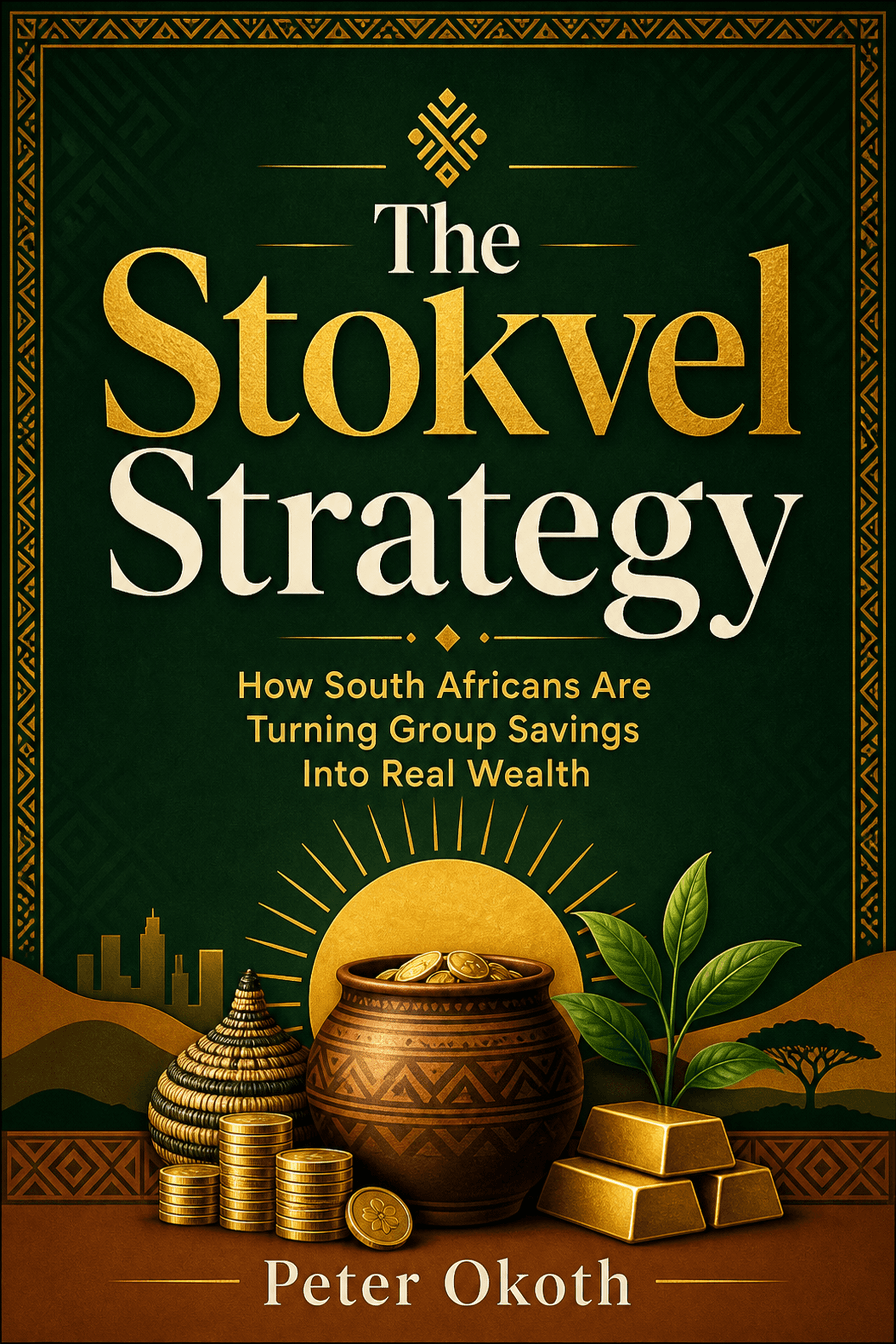
Free first chapter
The Stokvel Strategy
How South Africans Are Turning Group Savings Into Real Wealth
Read the first chapter in your browser. It's free, with no account and no email needed.
Free to read. No account required.
About this book
After PAYE and deductions, your salary looks decent. Then your mother needs support, your sibling's fees are due, a cousin's wedding contribution lands in the family group, and an aunt calls about a hospital bill. By month-end there is little left, and saving feels like something for people with fewer obligations.
The Stokvel Strategy is a system for carrying that weight without being crushed. You start by naming it, then audit your family obligations and build a black tax budget that makes room for your own future. You will learn what makes stokvels work and how to turn them into a wealth engine. The book explains where to park your money, from TFSAs to unit trusts and fixed deposits, takes you through your first JSE share, and covers using your bank account well.
Further chapters cover an emergency fund and insurance, budgeting on an irregular income, property basics, and a final plan that ties it all together.
Look inside
Preface
Lerato is 29. She works as a marketing coordinator at a firm in Sandton. Her gross salary is R35,000. After PAYE, UIF, and medical aid deductions, she takes home about R28,000.
Here is where it goes.
Rent in Randburg: R6,500. Transport: R2,500. Food and household: R4,000. Phone and data: R800. That is R13,800 on herself.
Now the other column.
Her mother in Limpopo needs R5,000 every month. Non-negotiable – mum is 61 and her pension does not cover everything. Her younger brother is at TVET college. Fees plus upkeep: R3,000 per term, but the WhatsApp requests come every month. Her cousin is getting married – the family group says R2,000 minimum contribution. And her aunt called about a hospital bill.
By the time Lerato finishes being everyone's plan, she has about R2,500 left. Some months, less. She has been working for five years. She has zero savings. Zero investments. Zero emergency fund. Not because she wastes money. Not because she earns too little. Because nobody ever showed her how to carry the weight without being crushed by it.
This book is the system she needed.
Who This Book Is For
- South African professionals carrying black tax – supporting parents, siblings, extended family while trying to build their own future
- Stokvel members who want to go beyond savings circles to real wealth-building
- Young professionals navigating family obligations for the first time
- Anyone who wants to build wealth through SA investment vehicles – stokvels, TFSAs, ETFs, unit trusts, government bonds, and property
What You Will Walk Away With
By the last page, you will have a family obligations budget with defined boundaries. You will have an emergency fund target and a plan to reach it. You will have at least two active investment vehicles. And you will have a 12-month wealth-building calendar that works alongside your family obligations – not against them.
Because in South Africa, Ubuntu means you do not build alone. But it does not mean you build for everyone else and nothing for yourself.
The Weight You Carry
Lerato is 29. She works as a marketing coordinator at a firm in Sandton. Her gross salary is R35,000. After PAYE, UIF, and medical aid deductions, she takes home about R28,000.
Here is where it goes.
Rent in Randburg: R6,500. Transport: R2,500. Food and household: R4,000. Phone and data: R800. That is R13,800 on herself.
Now the other column.
Her mother in Limpopo needs R5,000 every month. Non-negotiable – mum is 61, hypertensive, and the old-age pension does not cover her medication. Her younger brother Thabo is at a TVET college in Pretoria. Fees plus upkeep: R4,000 per quarter, but the WhatsApp requests come every month – R1,000 here, R800 there. Last month it was R3,000 because his laptop screen cracked. Her cousin in Mpumalanga is getting married – the family group says R2,000 minimum contribution. And her aunt called twice this week about a hospital bill.
By the time Lerato finishes being everyone's plan, she has about R2,500 left. Some months, less. She has been working for five years. She has zero savings. Zero investments. Zero emergency fund. Not because she wastes money. Not because she earns too little. Because nobody ever showed her how to carry the weight without being crushed by it.
Sound familiar?
Here is what Lerato did not know – and what this chapter will teach you.
What You Will Learn
- Name the real cost of unmanaged family support over 5, 10, and 20 years
- Distinguish between the three types of family obligations and why each needs a different strategy
- Understand why "just stop sending money" is not a strategy – and what actually works
- Begin mapping your own black tax reality so you can manage it
Why This Matters
Let us do some uncomfortable math.
Lerato sends roughly R8,000 to R12,000 per month to family, depending on the month. Call it R10,000 as an average. That is R120,000 per year. Over ten years, that is R1.2 million.
Now imagine she had invested even half of that – R5,000 per month – into a TFSA (Tax-Free Savings Account), an investment account where returns are completely tax-free, invested in an ETF (Exchange-Traded Fund) tracking the JSE Top 40. At a conservative 10% annual return, after ten years she would have approximately R1 million.
She does not have that. She has zero.
This is not a guilt exercise. Lerato's mother needed that money. Thabo needed those college fees. The wedding contribution maintained a relationship that matters. The problem is not that Lerato supports her family. The problem is that she has no system for doing it without destroying her own financial future.
That is what black tax is – the financial obligations to support extended family members that millions of South Africans carry every single month. It is not a formal tax. No one files a return. But for most working South Africans, it is the single largest recurring expense after rent.
And almost nobody budgets for it.
What Black Tax Actually Is
The Reality
Walk into any office in Sandton, Rosebank, or the Cape Town CBD and ask the twenty-somethings how much they send home. Some will tell you immediately. Most will change the subject. A few will laugh – the kind of laugh that is not really funny.
Black tax is the unwritten obligation to financially support your extended family once you start earning. Parents, siblings, cousins, uncles, in-laws, and sometimes the entire village WhatsApp group. It starts the month you get your first job – sometimes before.
But here is what makes it different from paying your electricity bill: black tax is not just money. It is a weight that sits on three levels.
The financial weight. The obvious one. The bank transfers, the school fees, the hospital bills, the funeral contributions, the stokvel obligations. Real Rand leaving your account every month.
The mental weight. The calculations you run at 2 a.m. The guilt when you buy yourself something nice. The anxiety when your phone rings and it is a number from back home. The spreadsheet in your head that tracks who you have helped and who is next in line.
The social weight. The WhatsApp group where contributions are announced publicly. The family gathering where your success is measured by what you can give. The subtle pressure from relatives who see your job title and your suburb and assume your bank account matches.
Black tax is all three. And until you see all three clearly, you cannot manage any of them.
Why "Just Stop Sending Money" Is Not the Answer
The Reality
Every few months, a financial influencer on SA Twitter or TikTok posts something like: "Stop being a family ATM. Set boundaries. Say no."
The replies are predictable. Half agree loudly. Half are furious. And the advice misses the point entirely.
How It Actually Works
"Just say no" is advice that ignores South African reality. It works in a country with state pensions that cover living costs, public healthcare that actually functions, unemployment insurance that lasts, and a social safety net that catches people.
South Africa does not have those things. Not at the level that matters.
Your mother's old-age pension is R2,180 per month. Her medication costs more than that. There is no government programme that will pay Thabo's TVET fees. When your aunt gets sick, the public hospital queue is three months long. The safety net in South Africa is the family. You are the safety net.
Quotes to share
By month-end there is little left, and saving feels like something for people with fewer obligations.
Free to read. No account required.