Free first chapter
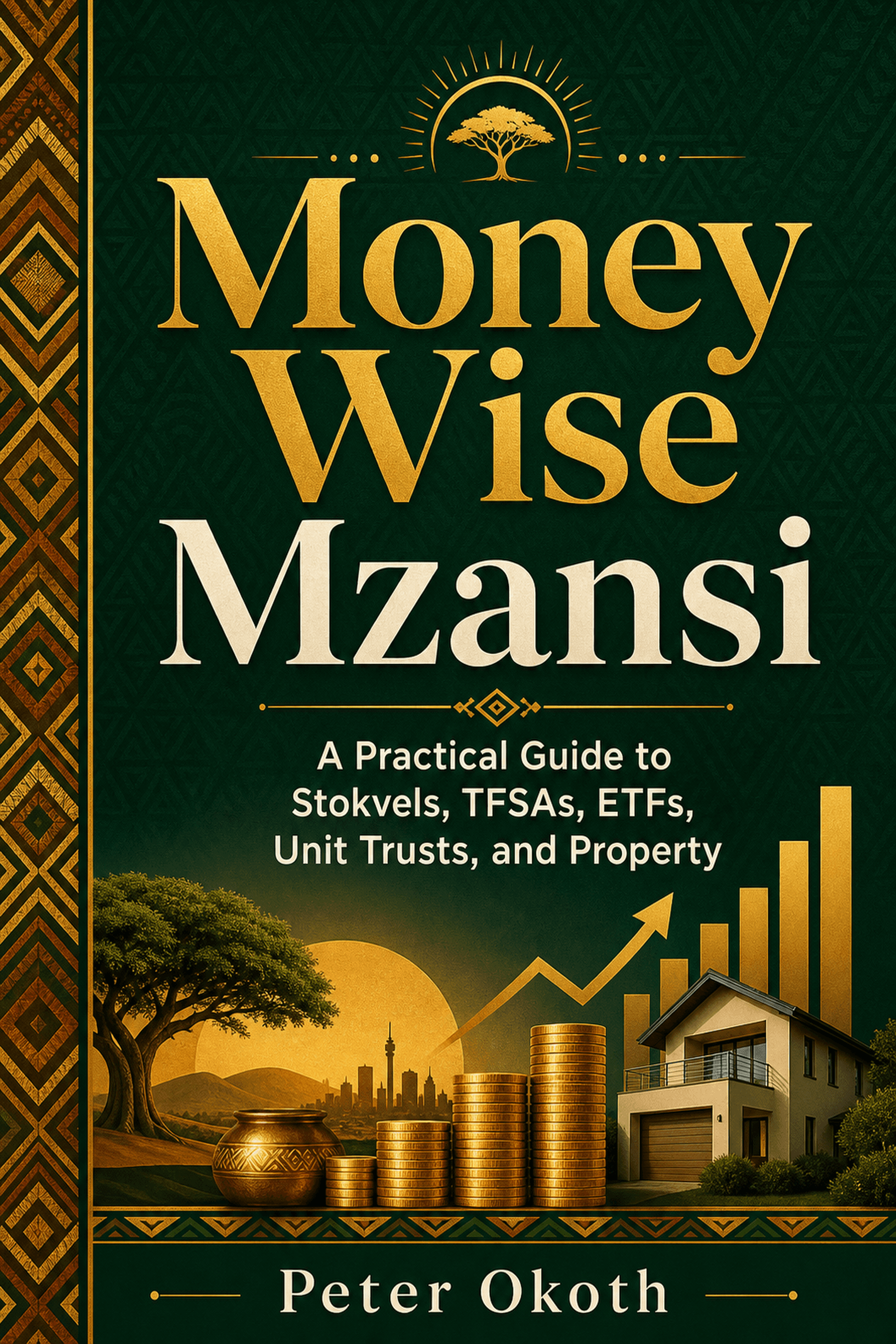
Money Wise Mzansi
A Practical Guide to Stokvels, TFSAs, ETFs, Unit Trusts, and Property
Read the first chapter in your browser. It's free, with no account and no email needed.
Free to read. No account required.
About this book
Your money sits in a savings account while prices keep rising, and every year it buys a little less. You know you should invest, but the options and jargon can feel like a maze.
Money Wise Mzansi is a practical guide to the vehicles open to ordinary South Africans, explained in plain language with Rand amounts and clear steps. You begin by seeing where money is slipping away, then look at stokvels, Tax-Free Savings Accounts, and government retail savings bonds. You will learn how to buy your first share on the JSE and what to think about before investing in property. A chapter on stokvel investing covers pooling money with a group.
The book then shows how to build a diversified portfolio the South African way, protect your wealth, and put everything into a personal investment plan. It is a general education guide, not personalised financial advice.
Look inside
Preface
You have money sitting in a bank savings account earning 5% while inflation runs at 6%. Every year, your savings buy less.
This is not a lecture about the time value of money. This is a practical guide to every investment vehicle available to ordinary South Africans – stokvels, Tax-Free Savings Accounts, ETFs on Easy Equities, unit trusts, government retail savings bonds, JSE shares, retirement annuities, and property – explained in plain language, with real Rand numbers, real steps, and real returns.
Who This Book Is For
- South African professionals and hustlers aged 23-45 earning R8,000-R80,000/month who have money to invest but do not know where to put it
- Stokvel members who want to understand what their group could invest in
- First-time investors who have heard of TFSAs and ETFs but have never opened an account
- Anyone who has read *The Stokvel Strategy* and is ready for the vehicle-by-vehicle deep dive
What You Will Walk Away With
By the last page, you will understand every major investment option available in South Africa. You will know the real returns, the real costs, and the exact steps to open each account. You will have a personalised investment plan with a risk profile, at least two active vehicles, and a 12-month calendar of investment actions.
Every product named in this book is accessible from South Africa. Every amount is in Rand. Every step has been verified.
The Money You Are Leaving on the Table
Ayanda is 32. She works as an accountant earning R40,000 per month after deductions. She has been saving R3,000 per month in her Capitec savings account for five years. She has approximately R185,000 saved. She is proud of that number.
Here is what Ayanda does not know: if she had put the same R3,000 per month into a TFSA invested in a JSE Top 40 ETF earning 10% per year, she would have approximately R235,000 – R50,000 more. And every cent of that growth would be tax-free.
If she had split her savings between a TFSA and RSA Retail Savings Bonds, she would have earned even more, with zero risk on the bond portion.
Ayanda is not broke. She is leaving money on the table. And the table is right there – she just does not know it exists.
What You Will Learn
- Calculate the real cost of keeping money in a bank savings account
- Understand every major investment vehicle available to ordinary South Africans
- Compare risk, return, and accessibility across all options
- Assess your investment readiness
- Take the first step toward moving your money to where it works harder
The Savings Account Trap
The Reality
Most South Africans keep their savings in a bank savings account. Here is what that actually earns:
- Capitec — 5.0-6.5% — 5.5-6.0% — 0% to +1%
- FNB — 4.0-5.5% — 5.5-6.0% — -1.5% to 0%
- Standard Bank — 3.5-5.0% — 5.5-6.0% — -2% to -0.5%
- Nedbank — 4.0-5.5% — 5.5-6.0% — -1.5% to 0%
Last verified: March 2026. Rates change frequently. Check your bank's current rate.
Look at the "Real Return" column. After inflation, most bank savings accounts earn you nothing – or lose you money. Your R100 today buys less than R100 next year. The bank is paying you interest, but inflation is eating it.
This is not a scandal. It is how banks work – they pay you less than they earn on your money. But it means that a savings account is a parking lot, not a wealth-building tool.
The Investment Landscape in South Africa
Here is every major option available to you, ranked by accessibility:
- TFSA (via ETF) — 8-12% — Medium — R1 (Easy Equities) — Medium (sell anytime, settle in days) — Tax-free
- RSA Retail Savings Bonds — 8-10% (inflation-linked) — Very Low — R1,000 — Low (locked for term) — Interest taxed, but low risk
- Unit trusts — 8-14% — Medium — R500-R1,000 — Medium — Taxed normally
- ETFs (outside TFSA) — 8-14% — Medium — R1 (Easy Equities) — Medium — Taxed normally
- Stokvel (investment) — Variable — Low-Medium — Group-dependent — Depends on rules — Complex – depends on structure
- JSE shares — Variable (long-term ~12%) — High — R1 (Easy Equities) — High (sell anytime) — Dividends and CGT taxed
- Property — Variable — Medium-High — R100,000+ — Very Low — Taxed on rental and CGT
- Retirement Annuity — 8-12% — Medium — R500/month — None (locked until 55) — Tax-deductible contributions
Last verified: March 2026. Returns are historical averages and not guaranteed.
The First Move Every South African Should Make
If you take one thing from this chapter, let it be this: open a TFSA.
A Tax-Free Savings Account lets you invest up to R46,000 per year (increased from R36,000 effective 1 March 2026; R500,000 lifetime) and pay zero tax on the returns – no tax on interest, no tax on dividends, no tax on capital gains. This is the single most tax-efficient investment vehicle available to ordinary South Africans.
You can open a TFSA on Easy Equities with as little as R1 and invest in ETFs like the Satrix 40 (which tracks the JSE Top 40) or the Satrix MSCI World (which tracks global markets).
Chapter 3 walks you through the step-by-step process.
Your Checklist
- ☐ — I know what my savings account actually earns — Real return after inflation
- ☐ — I understand the investment landscape — I can name at least 5 vehicles
- ☐ — I know what a TFSA is — R46,000/year (from March 2026), tax-free returns, Easy Equities
- ☐ — I have assessed my investment readiness — Emergency fund? High-interest debt?
Your Move
Before you turn the page:
- Check your bank savings account rate. Log into your banking app and find the interest rate. Calculate your real return after inflation.
- Write down how much you have in savings right now. This is the money we are going to make work harder.
- Download the Easy Equities app (or visit easyequities.co.za). Do not invest yet – just create an account. We will use it in Chapter 3.
What is Next
You know the landscape. The most powerful tool on it is the stokvel – South Africa's indigenous wealth-building vehicle. In the next chapter, we decode how stokvels actually work, which types build wealth, and how to evaluate whether your stokvel is growing your money or just circulating it.
Stokvels Decoded
There are over 800,000 stokvels in South Africa, with more than 11 million members. Together, they manage an estimated R50 billion or more annually. That is not informal. That is not marginal. That is an economy within the economy.
Yet most financial advisors – and most finance books – either ignore stokvels entirely or mention them as a curiosity before moving on to "real" investments. This chapter does the opposite. We treat stokvels as what they are: South Africa's most widespread savings and investment vehicle, with more members than any bank product, and a track record stretching back generations.
The question is not whether stokvels work. The question is: is YOUR stokvel building wealth, or is it just moving money around?
What You Will Learn
- Understand how stokvels work and the different types
- Distinguish between stokvels that build wealth and those that just circulate money
- Evaluate your current stokvel using a structured assessment
- Understand the legal and governance basics every stokvel needs
- Decide whether to join, reform, or start a stokvel for wealth-building
What a Stokvel Actually Is
The Reality
A stokvel is a community savings or investment group where members pool money regularly for collective benefit. The word comes from "stock fairs" – cattle auctions that English settlers held in the Eastern Cape, where early black South Africans adapted the model for their own communal savings.
Free to read. No account required.