Free first chapter
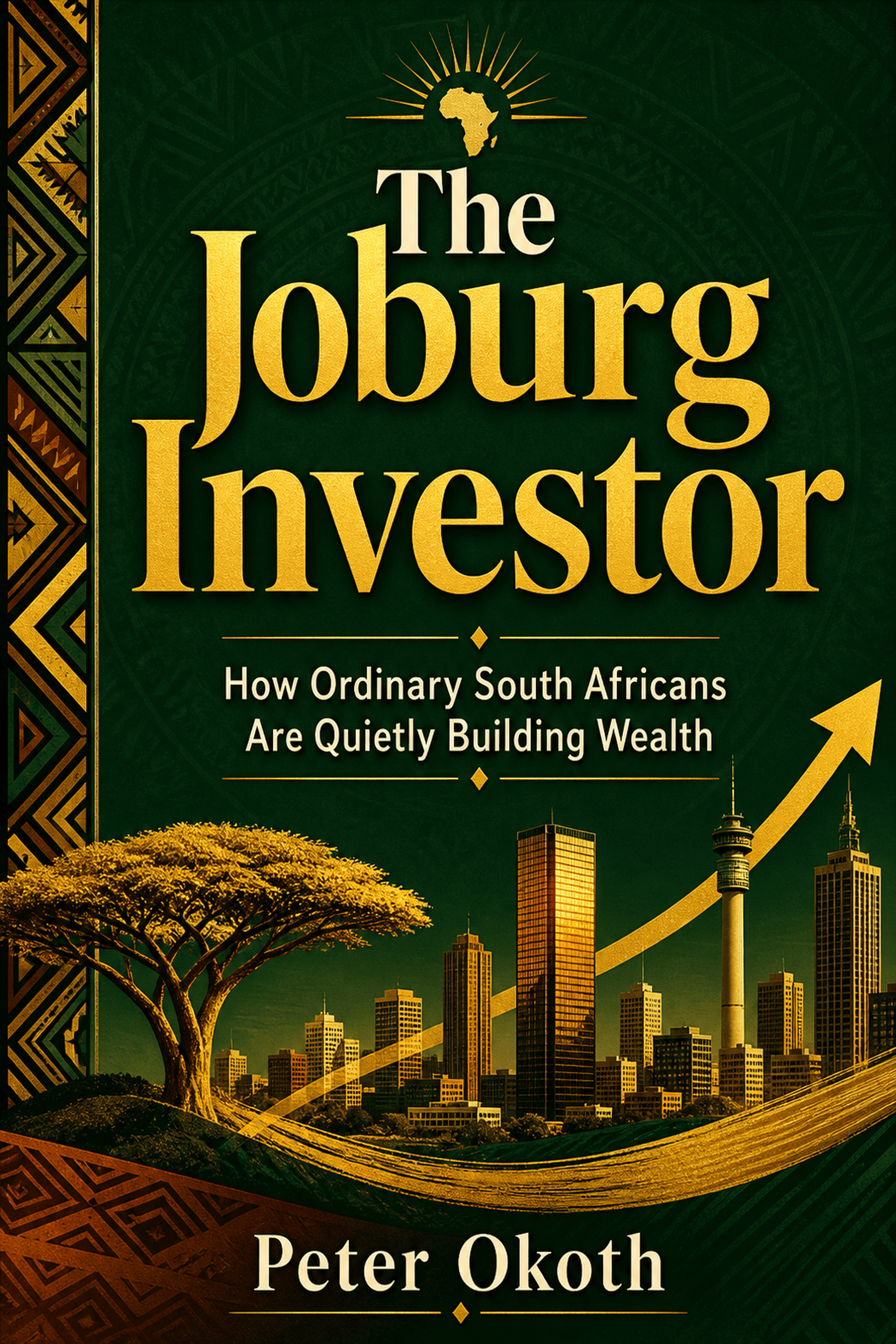
The Joburg Investor
How Ordinary South Africans Are Quietly Building Wealth
Read the first chapter in your browser. It's free, with no account and no email needed.
Free to read. No account required.
About this book
Two people can look very different on the surface. One drives a flashy car and posts every weekend, while the other drives an older hatchback and never flexes. The book opens with that contrast, and it asks which of them is really building wealth.
The Joburg Investor tells the stories of eight ordinary South Africans who grew their money with vehicles you may already have access to. You meet the stokvel millionaire, the TFSA strategist, the JSE faithful, the property hunter, the stokvel builder, the diaspora investor, and the side hustle investor. Each story shows what they did, the numbers involved, and the mistakes along the way.
A chapter on the lessons pulls the common threads together, and the closing chapter helps you identify your own investor identity and build a 90-day action plan. It is written for cautious and sceptical readers, stokvel members, and first-time investors who want to see what consistent investing looks like in practice.
Look inside
Preface
Two people. Bongani, 36, drives a BMW 3 Series, lives in Midrand, posts braai photos every weekend. Net worth: negative R180,000 (car finance, credit card debt, lifestyle funded by salary advances). Nomsa, 38, drives a 2017 Polo Vivo, lives in Tembisa, has never posted a financial flex. Net worth: R1.2 million (stokvel investments, TFSA maxed for 6 years, ETFs on Easy Equities, and a rental room built onto her family's property in Limpopo). One looks wealthy. One is wealthy.
This book tells the stories of eight ordinary South Africans who built real wealth – not through luck, connections, or high salaries, but through disciplined use of investment vehicles that you already have access to.
Who This Book Is For
- South Africans interested in investing but sceptical, cautious, or unsure where to start
- Anyone who needs proof before committing – someone like them who has actually done it
- Stokvel members, TFSA holders, and first-time investors who want to see what consistent investing looks like over 5-15 years
- Readers who finished *Money Wise Mzansi* and want real-world validation
What You Will Walk Away With
By the last page, you will have seen the exact strategies, numbers, and mistakes of eight investors across different income levels and investment vehicles. You will know which investor archetype fits your situation and have a personalised 90-day action plan to start.
The Millionaires You Pass on the Street
Two people. Bongani, 36, drives a BMW 3 Series on finance. Lives in a Midrand complex. Posts braai photos and travel snaps every weekend. His Instagram says success. His bank statement says: car payment R6,800, credit card balance R45,000, personal loan R23,000, clothing account R8,000. Net worth: negative R180,000. Bongani looks wealthy.
Nomsa, 38. Drives a 2017 Polo Vivo – paid off in 2021. Lives in Tembisa. Has never posted a financial flex on social media. Her bank statement says: Capitec savings R42,000, TFSA on Easy Equities R280,000 (maxed for 6 years), Satrix 40 ETF outside TFSA R85,000, stokvel investment group R120,000, rental room built onto her family property in Limpopo earning R2,500/month. Net worth: approximately R1.2 million. Nomsa is wealthy.
One looks the part. One has the money.
What You Will Learn
- Distinguish between lifestyle spending and actual wealth
- Understand net worth – the only number that matters
- See proof that ordinary South Africans build real wealth with ordinary incomes
- Meet the eight investor profiles you will study in this book
- Calculate your own net worth today
The Wealth Illusion
The Reality
South Africa has a dangerous confusion between income, spending, and wealth. Social media has made it worse. Every weekend, timelines are full of leased cars, financed apartments, and borrowed lifestyles presented as success.
Real wealth is invisible. It is the R280,000 in Nomsa's TFSA that nobody sees. It is the stokvel investment that does not make for a good Instagram story. It is the boring, consistent, undramatic act of putting R3,000 per month into an ETF for a decade.
Net Worth: The Only Number That Matters
Net worth = Total assets minus total liabilities.
Assets: savings, investments (TFSA, ETFs, unit trusts, shares), property value, stokvel balance, retirement funds.
Liabilities: home loan, car finance, personal loans, credit cards, clothing accounts, store credit.
If your assets exceed your liabilities, your net worth is positive. You are building wealth. If your liabilities exceed your assets, your net worth is negative. You are in debt, regardless of how your lifestyle looks.
Your Net Worth Calculator
- Bank savings — R
- TFSA balance — R
- Other investments (ETFs, unit trusts, shares) — R
- Stokvel balance (your share) — R
- Retirement fund (RA, pension, provident) — R
- Property value (market value, not purchase price) — R
- Other assets — R
- Total Assets — R
- Home loan outstanding — R
- Car finance outstanding — R
- Personal loans — R
- Credit card balance — R
- Clothing accounts — R
- Student loans / NSFAS — R
- Other debts — R
- Total Liabilities — R
Net Worth = Total Assets - Total Liabilities = R
The Eight Profiles
This book tells the stories of eight ordinary South Africans who built real wealth. They are not celebrities. They are not trust fund beneficiaries. They did not win the lottery. They are:
- The Stokvel Millionaire – A teacher who built R800,000 through a disciplined investment stokvel
- The TFSA Strategist – A call centre worker who maxed her TFSA for 7 years
- The JSE Faithful – A procurement officer buying ETFs every quarter for a decade
- The Property Hunter – A couple who bought and developed in a township
- The Stokvel Builder – An investment stokvel that evolved from a burial society
- The Diaspora Investor – A South African in the UK investing back home
- The Side Hustle Investor – A minibus taxi driver saving R1,500/month
- The Lessons – What every successful SA investor has in common
Each profile breaks down: starting point, strategy, timeline, real Rand numbers, mistakes, and the lesson you can steal.
Your Checklist
- ☐ — I understand the difference between lifestyle and wealth — Net worth, not income or spending
- ☐ — I have calculated my net worth — Assets minus liabilities
- ☐ — I know which profiles to read first — The ones closest to my situation
Your Move
Before you turn the page:
- Calculate your net worth using the worksheet above. Be honest. Include everything.
- Write the number down and date it. You will recalculate in 3, 6, and 12 months.
- Do not panic if the number is negative. Several of the people in this book started with negative net worth. The point is to know where you stand today so you can measure progress.
What is Next
Your first profile: a secondary school teacher in Gauteng who earns less than R30,000 per month and built R800,000 through an investment stokvel. The stokvel millionaire.
The Stokvel Millionaire
Dineo is 46. She teaches Life Sciences at a secondary school in Tembisa. Her current salary is R28,000 per month after deductions. She has never earned more than R30,000 in a month.
Her stokvel balance, accumulated over 12 years: R810,000.
She drives the same Toyota she bought in 2019. She lives in the house she grew up in – now renovated with two rental rooms that bring in R4,500 per month. She has never taken a flashy holiday. She has never posted about money on social media. Most of her colleagues have no idea how much she has saved.
Dineo is the stokvel millionaire. And she built it on a teacher's salary.
What You Will Learn
- How Dineo chose and structured her investment stokvel
- The exact contribution amounts and investment strategy over 12 years
- How compound returns turned small monthly contributions into R810,000
- The mistakes she made and what she would do differently
- The transferable lesson you can apply starting this month
Dineo's Starting Point
In 2014, Dineo was 34. Earning R18,000 per month after deductions. Supporting her mother (R3,000/month), contributing to a nephew's school fees (R1,000/month), and paying off a personal loan from her training year.
She had no savings. No investments. No financial plan. She had a burial society stokvel that she had been in since 2010 – contributing R150/month for funeral cover.
Then a colleague invited her to join a different kind of stokvel.
The Investment Stokvel
The stokvel was called Ikhwezi – "morning star." Eight teachers. Monthly contribution: R2,000 each. Total monthly pool: R16,000.
The rules were simple:
- Contributions are mandatory and due by the 5th of every month.
- No withdrawals for the first 3 years.
- The money is invested – not saved, not rotated.
- Investment decisions are made collectively at quarterly meetings.
- A written constitution governs everything.
Free to read. No account required.