Free first chapter
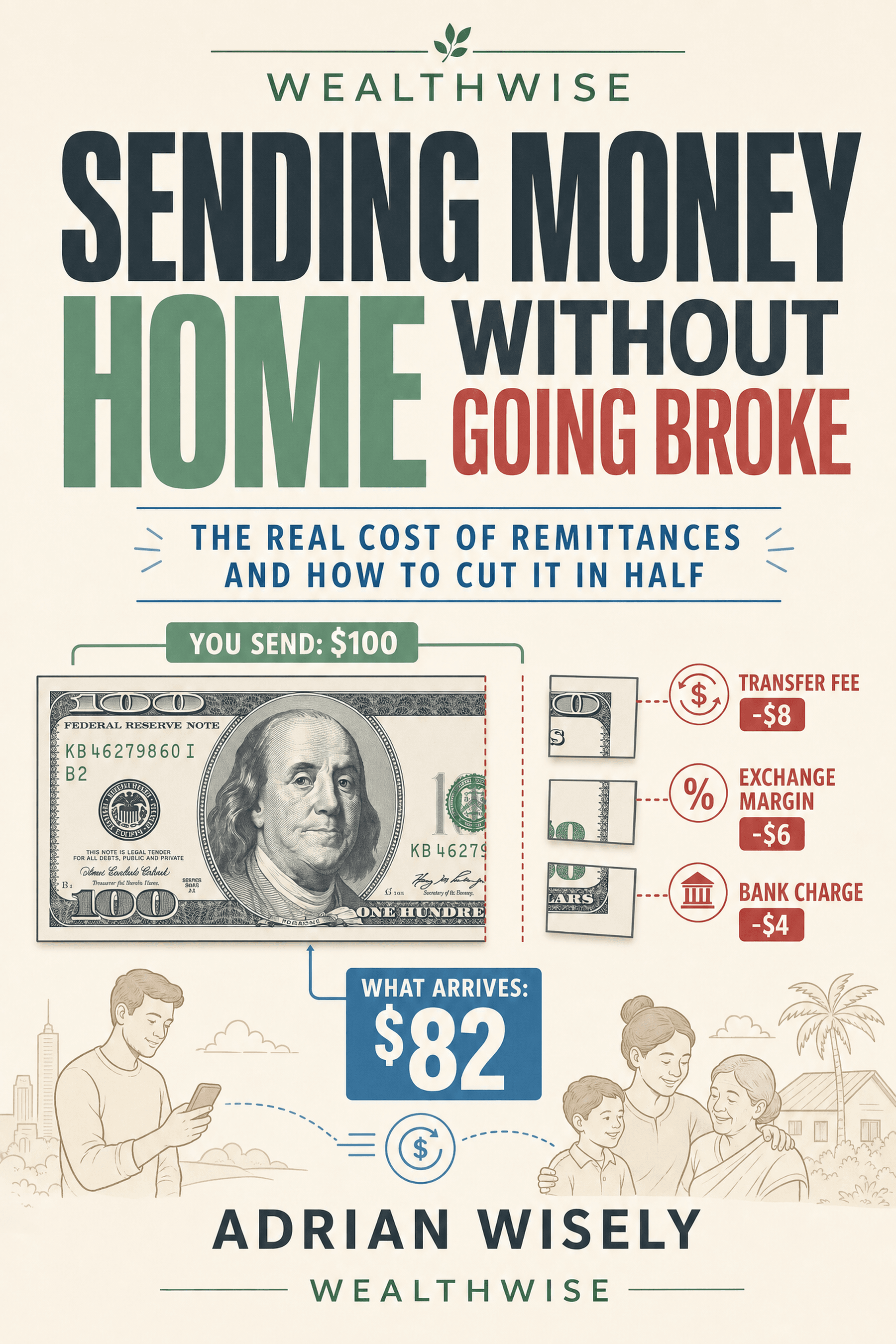
Sending Money Home Without Going Broke
The Real Cost of Remittances and How to Cut It in Half
Read the first chapter in your browser. It's free, with no account and no email needed.
Free to read. No account required.
About this book
Every month you send money home, and every month part of it quietly disappears. The fee shown in the app says one number. The amount your family actually receives tells a very different story.
This book starts with a single transfer and follows the real cost all the way through: the gap between the market exchange rate and the rate you are given, and how it adds up over a year. You then see every way of sending money home ranked side by side, so you can choose with your eyes open.
Beyond the mechanics, it deals with the human side. You get a way into the family expectations talk, a support budget that is honest about what you can give, and ideas for timing, batching and automating your transfers. It also covers building your own wealth while you support family, recognising scams and predatory services, and pulling everything together into one remittance system you can run month after month.
Look inside
Preface
Who This Book Is For
You are holding this book because you send money home. That means you carry something most of your coworkers and neighbors in your adopted country do not understand — the weight of being a financial bridge between two worlds.
You earn in dollars, pounds, euros, or Canadian dollars. Your family spends in shillings, naira, cedis, Birr, or rand. Between your bank account and your family's pocket, there is a gap — filled by fees, exchange rate markups, transfer services, family expectations, and your own guilt. This book is about closing that gap.
This book is written for Africans in the diaspora — primarily those from Kenya, Nigeria, Ghana, Ethiopia, South Africa, and Somalia who live and work in the US, UK, Canada, or Europe. But the core principles apply wherever you are from and wherever you are sending.
You do not need to be a financial expert to use this book. You need a smartphone, your last three bank statements, and about four hours to build a system that will save you thousands of dollars over the next decade.
What This Book Will Teach You
By the time you finish, you will be able to:
- Calculate the true cost of any transfer — not just the advertised fee, but the exchange rate markup, receiving-end conversion, and cash-out fees that together represent the real cost of every transfer you make.
- Choose the right service for your corridor — out of the ten major remittance channels, you will know which one is best for your specific situation: your country pair, your recipient's access, your typical transfer amount, and how urgent the money is.
- Have the family expectations conversation — the script you have been avoiding, with the tools to set a sustainable structure without damaging the relationships you care about.
- Build a structured family support budget — your Maximum Sustainable Support, three-tier allocation, and multi-recipient plan, so every dollar you send is deliberate and every request has a clear answer.
- Automate and optimize your transfers — batching, rate alerts, scheduled recurring transfers — so the system runs in 15 minutes per month instead of hours of stress.
- Build your own wealth alongside family support — an emergency fund sized for diaspora realities, a retirement savings plan you can actually keep, and a dual-priority budget that funds both engines simultaneously.
- Protect yourself from scams and predatory services — the five scam types that target diaspora remitters, a verification process for any service, and a fraud reporting contact list.
How to Use This Book
Read it in order, at least once. Each chapter builds on the previous one. The budget in Chapter 5 depends on the cost understanding from Chapters 1 and 2. The automation in Chapter 6 builds on the budget from Chapter 5. The complete system in Chapter 9 assumes all eight preceding chapters.
Do the exercises. Each chapter ends with four exercises at three difficulty levels — Core (immediate application), Stretch (deeper analysis), and Challenge (synthesis across chapters). The Core exercises take 15-30 minutes. Do not skip them.
Fill in the worksheets. Every chapter includes fill-in worksheets, calculators, and checklists. These are not optional extras — they are the chapter's deliverable. A chapter you read but did not apply is a chapter you did not finish.
Keep this book. The quarterly review process in Chapter 9 is designed to be revisited. The worksheets have blank fields for a reason. Come back when your income changes, when your family situation shifts, or when a new request lands and you need to know where it falls in your system.
A Note on Numbers
All exchange rates, fees, and cost figures in this book are illustrative of typical conditions as of early 2026. Exchange rates change daily. Service fees change quarterly. The specific numbers will be different when you read this — but the principles, formulas, and frameworks are durable.
Every fee and rate table is marked "Last verified: March 2026." When you use the True Cost Formula or the comparison tables, update the numbers from your app or from Google. The math stays the same. The inputs change.
A Note on Voice
This book speaks to you directly — as a person who is navigating a specific, difficult, and important financial reality. It does not pretend the system is fair. The global average cost of sending money to Sub-Saharan Africa is approximately 8.5%, the highest of any region in the world. That is not an accident. It is the result of regulatory barriers, infrastructure costs, and limited competition in specific corridors. We name those realities and then show you how to navigate around them.
The voice in this book is modeled on what we call the "diaspora bridge" register: someone who has navigated these systems themselves, who respects your intelligence, who does not have time for motivational fluff, and who wants to give you the playbook as directly as possible.
There is no shame in this book. Not for sending money home. Not for struggling with family expectations. Not for having been charged too much for too long. Most people are never taught this. Now you will be.
The Promise
If you read this book and build the system it describes, you will save money. A lot of it. The difference between the most expensive and cheapest service for a typical African diaspora corridor is 7-10% per transfer. On $500 per month, that is $420-$600 per year. Over ten years, it is thousands of dollars that stayed with your family instead of disappearing into transfer fees.
More than the savings, you will have a system. A structure that says: yes, I will take care of my family — and yes, I will take care of myself. Those are not competing goals.
Let us build it.
The $47 That Disappeared
Amara had been in Minneapolis for six years. She worked as a registered nurse at Hennepin Healthcare — twelve-hour shifts, alternating days and nights, the kind of schedule that turns your body clock into a suggestion rather than a rule. She earned $72,000 a year before taxes. Good money by Minnesota standards. Life-changing money by Nairobi standards.
Every month, on the 15th, Amara sent $500 to her mother in Umoja estate through Western Union. Her mother picked it up at an Equity Bank agent in Kayole. The routine was sacred — as reliable as the rent payment, as non-negotiable as the electric bill. Amara's mother depended on it for food, for her diabetes medication, for the water bill, and for the small contributions she made to her church women's group.
The Western Union app showed a fee of $12 per transfer. Amara did the math: $12 per month, $144 per year. Not ideal, but manageable. The cost of supporting her mother.
Except the cost was not $12.
One evening, Amara's colleague — a Ghanaian lab technician named Kwesi — asked her how she sent money home. "Western Union," she said. "The fee is only twelve dollars."
Kwesi pulled out his phone. "Open Google and type 'USD to KES.' Tell me the rate."
The Google rate — the mid-market rate, the rate banks use when they trade with each other — was KSh 129 per dollar that day. At that rate, Amara's $500 should have converted to KSh 64,500.
"Now check your last transfer receipt. How much did your mother get?"
Free to read. No account required.