Free first chapter
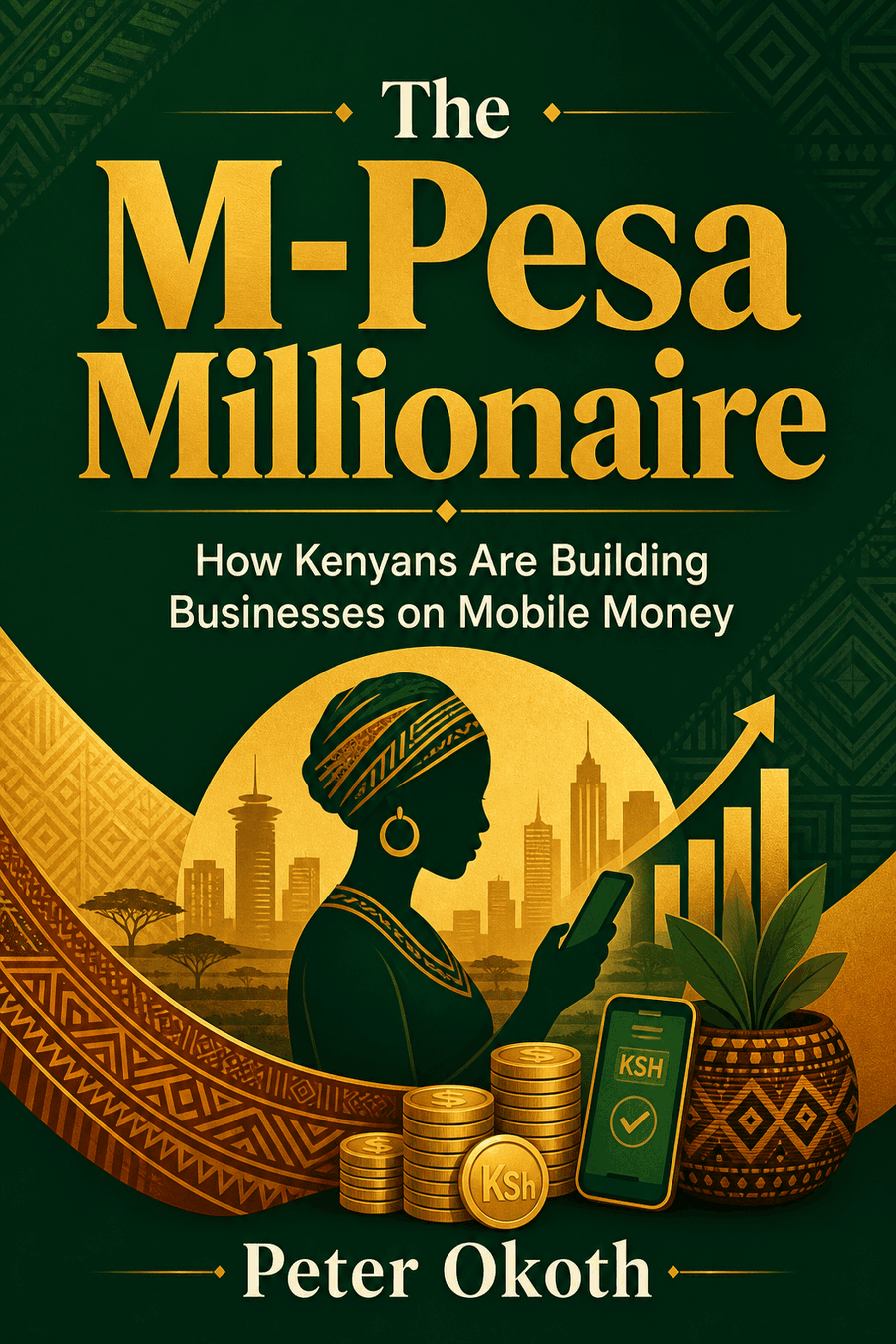
The M-Pesa Millionaire
How Kenyans Are Building Businesses on Mobile Money
Read the first chapter in your browser. It's free, with no account and no email needed.
Free to read. No account required.
About this book
Across Kenya, businesses run on a green SIM card and a phone: mitumba sellers, hustlers, agents, and shopkeepers who never needed a bank branch. Yet many owners use M-Pesa only as a way to receive money, and may never have looked at how Fuliza at two in the morning is really priced.
The M-Pesa Millionaire shows you how Kenyans are building businesses on mobile money. You will see how the Till number economy works, how to set up your M-Pesa business properly, and how to get the most from Lipa Na M-Pesa. You will learn float management, how Fuliza, M-Shwari, and KCB M-Pesa can be used as business tools, and how the debt trap develops when they turn against you.
Later chapters cover scaling on mobile money, your tax obligations with KRA, business models that work in Kenya, and a 90-day M-Pesa business plan to put it all to work.
Look inside
Preface
There is a woman in Githurai who moves KSh 2.3 million through her M-Pesa Till every month. She sells mitumba — secondhand clothes. She has never had a bank loan. She has never walked into a bank. Her entire business runs on a green SIM card and a phone she bought for KSh 14,000.
She is not an exception. She is the new normal.
Kenya processes over KSh 38 trillion in M-Pesa transactions every year. That is more money than the GDP of most African countries — flowing through phones, not bank branches. Over 40 million Kenyans are active M-Pesa users. If M-Pesa were a bank, it would be the largest financial institution in East Africa by transaction volume.
This book is about the people building real businesses on those rails. Not theory. Not fintech conference buzzwords. The actual mechanics of how Kenyans are using M-Pesa Till numbers, Lipa Na M-Pesa, Fuliza, M-Shwari, and KCB M-Pesa to start, run, and scale businesses — often without ever touching a bank account.
Who This Book Is For
- Small business owners already using M-Pesa but not optimizing it — you are leaving money, data, and tax advantages on the table
- Hustlers and traders who want to formalize on M-Pesa rails without the cost and friction of traditional banking
- M-Pesa agents looking to maximize float returns and build beyond the agency model
- Side hustlers collecting payments via personal M-Pesa and wondering when to get a Till number
- Anyone who has taken a Fuliza loan at 2am and wonders how the system actually works — and how to stop the bleeding
What You Will Walk Away With
By the last page, you will know how to set up and optimize an M-Pesa business account, manage float like a professional, use Fuliza and M-Shwari strategically instead of desperately, read your M-Pesa statements for business intelligence, handle KRA obligations on mobile money income, and build a business that scales on mobile money rails.
Every number in this book is real. Every strategy has been used by actual Kenyan businesses. Where fees and rates change, we tell you exactly where to check for updates.
This is not a book about M-Pesa the technology. It is a book about M-Pesa the economy — and your place in it.
Let us get into it.
The Till Number Economy
Mama Njeri sells sukuma wiki and tomatoes at a market stall in Kawangware. Five years ago, she kept her day's earnings in a pouch under her apron. Customers paid in crumpled notes and coins. She lost KSh 2,000 to KSh 3,000 every month — wrong change, "I will pay you tomorrow" debts that never came back, and one theft that cost her KSh 7,500 on a Friday afternoon.
Today, a laminated card hangs from the front of her stall. It reads: Lipa Na M-Pesa Till Number 5XXXXXX. She processes KSh 380,000 through that Till every month. She has never walked into a bank branch. She has never filled out a loan application on paper. Last year, she pulled up her M-Pesa transaction history, walked into a Safaricom shop, and used those records to qualify for a KCB M-Pesa loan of KSh 150,000. She used it to rent a second stall at Kawangware's evening market.
Mama Njeri is not a tech entrepreneur. She is a mama mboga — a vegetable seller — who figured out that the green SIM card in her phone is the most powerful business tool in Kenya.
She is not an exception. She is the new normal.
Here is what most Kenyans do not realize about the economy they are already part of — and what this chapter will teach you.
What You Will Learn
- Describe the real scale of the M-Pesa economy in Kenya — the numbers will surprise you
- Identify every component of the M-Pesa business stack (Till, Paybill, credit products, API)
- Name at least three ways you are currently underusing M-Pesa in your business
- Explain why M-Pesa business literacy — not just M-Pesa usage — is the most important financial skill in Kenya today
Why This Matters
You already use M-Pesa. You send money to your mum. You pay your electricity bill. You buy airtime. You split the bill at a restaurant by sending your friend their share.
But using M-Pesa and understanding the M-Pesa business economy are two completely different things. The first makes you a consumer. The second makes you a business operator in the largest mobile money ecosystem on earth.
If you run any kind of business in Kenya — a salon, a kiosk, a boda boda, a catering service, a freelance hustle, a chama, anything — and you are not optimizing how you use M-Pesa, you are leaving money on the table. Not theoretical money. Real shillings. Every month.
This chapter shows you how big the table is.
The Numbers That Define Kenya's Economy
The Reality
Ask most Kenyans how much money flows through M-Pesa, and they will guess something vague. "A lot." "Billions." They are wrong. It is not billions. It is trillions.
How It Actually Works
Here are the numbers. Let them sink in.
- Annual M-Pesa transactions — KSh 38.3 trillion — More than the GDP of Uganda, Rwanda, and Burundi combined — and nearly ten times the national budget
- Active M-Pesa users — 40 million+ — In a country of 55 million people
- Lipa Na M-Pesa merchants — 600,000+ — Businesses accepting M-Pesa payments
- M-Pesa agents — 381,000+ — More than all bank branches, ATMs, and petrol stations combined
- Daily M-Pesa transactions — Over 100 million — Every single day
- Active Fuliza users — 9.1 million — Millions depend on M-Pesa's overdraft facility regularly
- Fuliza disbursed (FY2025) — KSh 981 billion — That is nearly a trillion shillings in one year
Last verified: March 2026. Source: Safaricom annual reports and Central Bank of Kenya financial stability reports.
Read that table again. KSh 38.3 trillion. To put that in perspective, the entire Kenyan government budget for 2025/2026 was approximately KSh 4 trillion. M-Pesa moves nearly ten times the national budget through phones every year.
This is not a payment app. This is the financial infrastructure of Kenya. And if you run a business, you are either building on this infrastructure or you are building on sand.
Common Trap: "M-Pesa Is Just for Small Traders"
Some business owners — especially those who have been to business school or worked in corporate environments — still think of M-Pesa as the payment method for mama mboga and boda boda riders. "Serious" businesses use bank transfers and card payments, they think.
The data says otherwise. Some of the fastest-growing businesses in Kenya — delivery services, e-commerce platforms, subscription businesses — run their entire payment infrastructure on M-Pesa rails. Lipa Na M-Pesa processes more retail transactions than all card payments and bank transfers combined.
The question is not whether M-Pesa is "serious enough" for your business. The question is whether your business is smart enough to use M-Pesa properly.
Your Move
Look at your phone right now. Open M-Pesa and check your last 30 days of transactions. How much money flowed through your M-Pesa? Now ask yourself: how much of that was business money, and how much of it was tracked, categorized, and visible to you as business data? If the answer is "I have no idea," you are exactly where most Kenyans are — and exactly who this book is for.
Free to read. No account required.