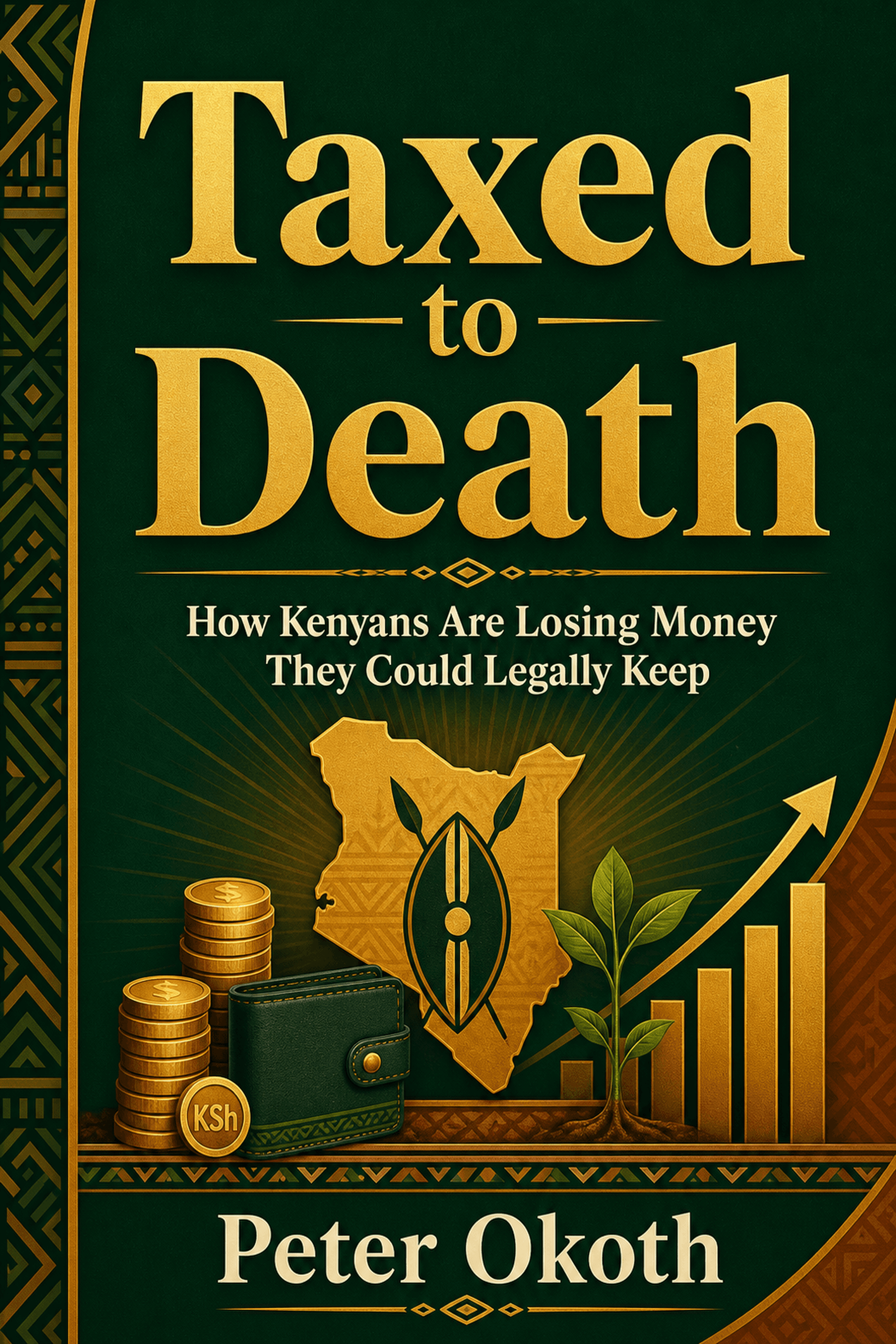
Free first chapter
Taxed to Death
How Kenyans Are Losing Money They Could Legally Keep
Read the first chapter in your browser. It's free, with no account and no email needed.
Free to read. No account required.
About this book
Every month, money leaves your account before you see it. PAYE hits the payslip, M-Pesa charges add up, your side hustle sits in a grey zone, and nobody explains which of it is optional. Most people assume there is nothing to be done.
Taxed to Death is a plain-language guide to the legal ways Kenyans keep more of what they earn. It begins by showing where your money is going and how to read a payslip properly. You then learn about deductions and reliefs that people rarely hear about, how side hustle income is treated, and how digital money and M-Pesa fit with KRA.
Further chapters tackle rent and property traps, family money and the taxman, and how to recognize scams and penalties and respond to them. A tax calendar closes the book so you know what is due and when. It is about understanding the rules that apply to you, with no accounting degree required.
Look inside
Preface
Every month, money leaves your account that did not have to leave. Not because you are spending too much. Because nobody told you it was optional.
PAYE hits your payslip before you see it. M-Pesa fees get taxed. Your side hustle income sits in a grey zone you are afraid to ask about. Your landlord charges you rent that includes taxes you might qualify to deduct — if you knew to ask.
This is not a book about accounting. This is a book about money — your money — and the legal ways to keep more of it.
The Kenya Revenue Authority (KRA) collects what the law says it is owed. Fair enough. But the law also says you are entitled to deductions, reliefs, and exemptions that most Kenyans have never heard of. Your employer does not tell you. Your bank does not tell you. KRA certainly does not volunteer the information.
So this book does.
Who This Book Is For
- Salaried Kenyans who see PAYE on their payslip and assume there is nothing they can do
- Side hustlers earning extra income and hoping KRA does not come knocking
- Landlords with one or two rental properties who are not sure what they owe
- Young professionals in their first or second job who have never filed a return
- Anyone who has ever googled "how to reduce tax in Kenya" and got confused by the jargon
- Parents, spouses, and families navigating shared financial obligations and tax implications
What You Will Walk Away With
By the last page, you will know exactly where your money is going, which deductions and reliefs you qualify for, how to handle side hustle income without fear, and how to deal with KRA if things go wrong. No accounting degree required. No expensive consultant needed.
Every strategy in this book is legal. Every number is real and verified as of March 2026. Where things change, we tell you where to check.
If you want the deep business-level strategies, read What KRA Doesn't Tell You (Book 2) and Don't Feed KRA Your Profits (Book 4). This book gives you the essentials — the money-saving knowledge every Kenyan adult should have and almost nobody does.
Let us get your money back.
The Money You Don't Know You Are Losing
Mercy earns KSh 85,000 per month. Not bad. She is 28, works as a marketing coordinator for a mid-size firm in Westlands, and thinks she has a reasonable handle on her finances. She budgets. She saves a little. She uses M-Pesa for almost everything.
If you asked Mercy how much she pays in tax, she would say about KSh 12,000. That is the PAYE (Pay As You Earn) line on her payslip — the income tax her employer deducts before her salary hits her account.
She is wrong. KSh 12,000 is not even half of it.
Every month, Mercy pays approximately KSh 11,350 in PAYE. She pays KSh 1,700 to NHIF (health insurance). She pays KSh 2,160 to NSSF (retirement fund). She pays the housing levy — 1.5% of her gross salary, another KSh 1,275. That is roughly KSh 16,485 gone before she sees a shilling.
But it does not stop there.
When Mercy buys groceries at Naivas, she pays 16% VAT (Value Added Tax) on most items. When she sends money to her mother via M-Pesa, she pays a transaction fee — and 20% of that fee is excise duty going to the Kenya Revenue Authority (KRA). When she takes an Uber, the fuel price includes fuel levy, excise duty, and VAT. When she buys airtime, 20% excise duty is built into the price.
Add it all up. Mercy's real monthly tax footprint — visible and invisible — is approximately KSh 25,000. That is about 30% of her gross salary. Nearly one shilling out of every three she earns goes to the government in some form.
Here is what Mercy did not know — and what this chapter will teach you.
What You Will Learn
- Calculate your real total tax burden — not just PAYE, but everything
- Identify the hidden taxes you pay every day without realizing it
- Understand which of these taxes you can reduce and which are fixed
- See exactly where your money goes before it reaches your pocket
Why This Matters
Most Kenyans think they pay one tax: income tax. Employees think it is PAYE. Business owners think it is turnover tax or corporate tax. That is like thinking rent is the only expense in your life.
The Kenyan government collects tax at every level of your daily existence. Some of it is visible. Most of it is not. And the taxes you cannot see are the ones you never think to reduce.
This chapter makes the invisible visible. Once you can see where your money goes, you can start making decisions about it. Some taxes are fixed — you cannot avoid VAT on a bottle of cooking oil. But some are not fixed — your PAYE can be reduced through deductions most Kenyans never claim. Your side hustle income can be structured to minimize what you owe. Your investment income can be sheltered through reliefs the tax code provides.
The first step is knowing the real number.
The Taxes You See — Your Payslip
The Reality
Every salaried Kenyan has a payslip. Most look at one line: net pay. The deductions above it feel like a wall of abbreviations — PAYE, NHIF, NSSF, HELB, housing levy. Let us break them down for Mercy's KSh 85,000 salary.
How It Actually Works
Here is Mercy's actual payslip breakdown:
- Gross salary — KSh 85,000 — What the company pays you — —
- PAYE — ~KSh 11,350 — Income tax — Yes — through deductions and reliefs
- NHIF/SHIF — KSh 1,700 — Health insurance contribution — No — fixed by salary band
- NSSF (Tier I + II) — KSh 2,160 — Retirement fund contribution — No — mandatory rates
- Housing levy — KSh 1,275 — 1.5% of gross salary — No — mandatory
- Total deductions — ~KSh 16,485
- Net pay — ~KSh 68,515 — What hits your account
Last verified: March 2026. NHIF/SHIF and NSSF rates from kra.go.ke and respective fund websites.
That roughly KSh 16,485 is the tax you see. Every month. Approximately KSh 198,000 per year.
But notice the column on the right. Only one of those deductions — PAYE — can be reduced. And it can be reduced significantly, through reliefs and deductions that most Kenyans never claim. Chapter 3 shows you exactly how.
Your Move
Do this now: Pull up your last payslip. Compare it to the table above. Write down your total deductions. That is the visible portion of your tax burden. We are about to add the invisible portion.
The Taxes You Don't See — Your Daily Life
The Reality
After Mercy receives her KSh 67,465, she starts spending. And with almost every transaction, more tax leaves her pocket.
VAT — The 16% You Pay on Almost Everything
VAT is a 16% tax added to most goods and services in Kenya. Some basics are exempt or zero-rated (unprocessed food, some agricultural products), but most of what you buy at a supermarket, restaurant, or online shop includes VAT.
Mercy spends approximately KSh 40,000 per month on goods and services that carry VAT. Not all of that spending is on taxable items at the full rate, but roughly KSh 4,500 per month goes to VAT. Last verified: March 2026.
She does not see this as "tax." She sees it as "the price of things." But it is tax.
Quotes to share
Most people assume there is nothing to be done.
Free to read. No account required.