Free first chapter
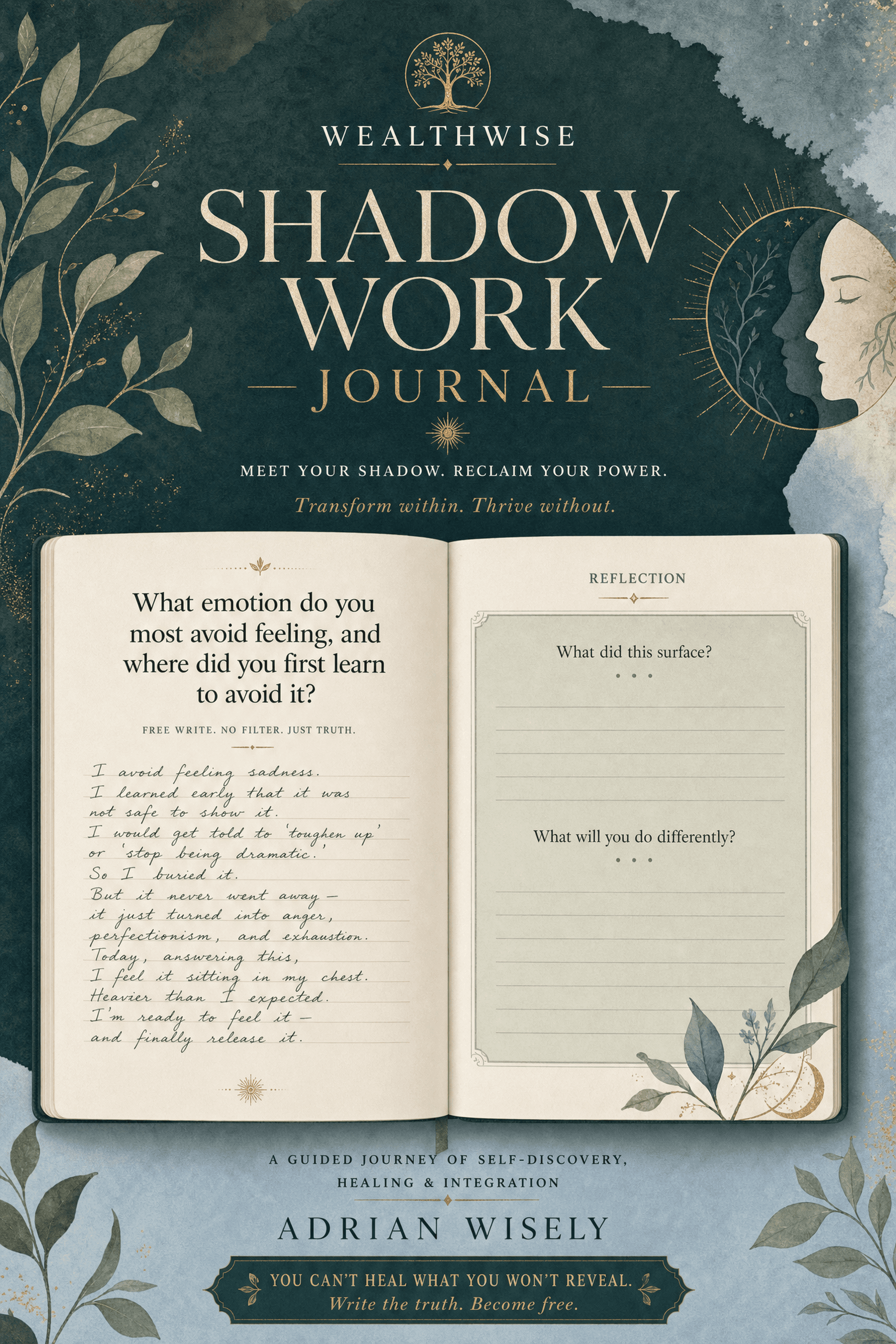
Shadow Work Journal
100 Prompts for Deep Self-Discovery
Read the first chapter in your browser. It's free, with no account and no email needed.
Free to read. No account required.
About this book
Some of your reactions, habits and judgments may come from parts of yourself you learned to hide. Shadow work, an idea drawn from Carl Jung, is the practice of looking at them honestly. This journal gives you a structured way to begin.
It has 100 prompts in five categories: the inner child, relationships and attachment, anger and resentment and boundaries, self-worth and identity, and integration and wholeness. Each category opens with a grounding exercise and closes with an integration page. Every prompt carries a reminder that you can come back to it later, and the pace is yours.
The introduction speaks plainly about safety, advising you to stop and talk to a professional if memories or feelings become overwhelming. The journal is meant as a companion to healing work, such as between therapy sessions, and not a replacement for it.
Look inside
100 Prompts for Deep Self-Discovery
The Parts of You That You Hide.
Shadow work sounds intense. Maybe even a little scary. And honestly, it can be. But it's also one of the most freeing things you'll ever do – because the parts of yourself you've been hiding from are already running the show. You might as well meet them.
The concept comes from Carl Jung, who suggested that everyone has a "shadow" – the parts of our personality we've rejected, repressed, or been taught to hide. The anger you swallowed as a kid. The ambition you were told was "too much." The grief you never let yourself feel. The needs you learned to call "selfish."
Your shadow isn't evil. It's just the stuff you shoved into the basement because someone told you it didn't belong in the living room. The problem is, it doesn't stay in the basement. It leaks out as self-sabotage, people-pleasing, sudden rage, chronic shame, and patterns you can't seem to break no matter how hard you try.
Shadow work is the process of going into the basement with a flashlight.
What This Journal Is
One hundred prompts designed to help you explore your shadow self – the parts of you that are hidden, rejected, or unexplored. The prompts are organized into five categories:
- The Inner Child (Prompts 1-20): Your earliest experiences of shame, rejection, and the rules you learned about who you were allowed to be
- Relationships & Attachment (Prompts 21-40): How your shadow shows up in how you connect (or disconnect) with other people
- Anger, Resentment & Boundaries (Prompts 41-60): The emotions you were taught to suppress and the boundaries you struggle to hold
- Self-Worth & Identity (Prompts 61-80): The masks you wear, the roles you perform, and who you are underneath
- Integration & Wholeness (Prompts 81-100): Bringing the shadow into the light and making peace with your full self
How to Use This Journal
This is not a race. Some of these prompts will take five minutes. Some will take days to sit with before you write a single word. Some you'll skip entirely and come back to months later. All of that is exactly right.
Before you write: Each category opens with a brief grounding exercise. Use it. Shadow work can bring up intense emotions, and grounding helps you stay present instead of getting swept away.
While you write: Be honest. This journal is for you alone. Nobody will read it. Nobody will judge it. Let the real answer come out, not the polished one.
After you write: Check in with yourself. If something heavy came up, do something gentle – drink water, step outside, text a friend. Every prompt includes the note: "Come back to this later if you need to." That's not a suggestion. It's permission.
If you're neurodivergent: Shadow work can be especially powerful for neurodivergent people who've spent a lifetime masking and performing. These prompts are designed with clear structure: one question per page, no multi-part instructions, generous space. Skip freely. Come back freely. Your shadow work doesn't need to look like anyone else's.
Safety First
I need to be direct with you. Shadow work can surface painful memories, deep grief, and intense emotions. That is part of the process, but it should never feel dangerous.
Please stop and reach out to a professional if:
- You feel overwhelmed to the point of panic or dissociation
- Traumatic memories surface that you're not equipped to process alone
- You notice a significant increase in depression, self-harm urges, or hopelessness
This journal is a companion to healing work, not a replacement for it. If you're currently in therapy, this makes an excellent between-sessions tool. If you're not in therapy, and this journal reveals things that feel too big, that's valuable information – it means you deserve support.
One Last Thing Before We Start
You might be tempted to perform your shadow work. To write the "deep" answer, the poetic answer, the answer that would make a good Instagram post. Resist that. The whole point of shadow work is to stop performing.
Write the ugly truth. The petty one. The embarrassing one. The one that makes you squirm. That's where the gold is.
This journal is for you. Not your feed. Not your therapist. Not your partner. You.
Let's go into the basement.
Free to read. No account required.